Lip plates, lacquered black teeth, male beauty contests, carved spoons and necklaces that talk: thirty verified customs, past and present, showing that beauty is a convention and that courtship works the same way everywhere.
Why look elsewhere
Every society is convinced that its own way of finding someone beautiful, of approaching them
and of letting them know they are liked is simply the natural way. Change continent, or century,
and almost all of it turns out to be convention: the colour of teeth, the shape of a foot, whether
it is the man or the woman who dresses up, whether a declaration comes as a song, a spoon or a
necklace. This page gathers some thirty customs, ancient or still alive, chosen because they are
well documented rather than because they are spectacular. It does not judge; it explains. Several of
these practices have disappeared, others are contested — including by the peoples who carry them
— and we say so when that is the case.
Where a country mentioned is covered on this site, a link leads to its page. For courtship as
it works where you live, read Flirting or the page on the
first date instead.
In the Omo valley of south-western Ethiopia, Mursi and Suri women have their lower lip pierced
in adolescence and insert clay or wooden discs of increasing size, up to ten or fifteen centimetres
across. The plate, called dhebi a tugoin by the Mursi, is not worn all the time: it is put
in to serve a meal, for a dance, for a ceremony. Anthropologists who lived there — David Turton,
Shauna LaTosky — insist that it is a mark of pride and of passage to adulthood, that the young
woman herself decides on the size, and that the practice is receding among the youngest, not least
because it gets in the way of schooling.
The neck coils of the Kayan (Myanmar, Thailand)
A Kayan woman and her brass coil, northern Thailand. Photo : Steve Evans, CC BY 2.0, via Wikimedia Commons.
Kayan women, a Karen subgroup living between Myanmar's Kayah State and northern Thailand, wind a
brass coil around the neck from childhood. The "giraffe neck" is an illusion: the metal does not
lengthen the vertebrae, it pushes down the collarbones and upper ribs, which is what makes the neck
look longer. The explanations the Kayan give vary — beauty, a badge of identity, a protective legend
— and the custom, in decline in the 1980s, made an ambiguous comeback with tourism in the Thai
refugee camps, where it became a source of income.
Bound feet (China)
Embroidered lotus shoes, for bound feet of about ten centimetres. Photo : Queensland Museum, CC BY-SA 3.0, via Wikimedia Commons.
For nearly a thousand years, from the 10th century to the 1940s, millions of Chinese girls had
their feet bound from the age of four or five to obtain "lotus feet" of about ten centimetres,
shod in embroidered slippers. What had begun at the Song court as a dancers' refinement became,
under the Ming and Qing, an almost compulsory condition for a respectable marriage: an unbound foot
signalled a poor family or Manchu origins. The practice was banned in 1912, at the fall of the
Empire, and took another thirty years to die out. The last lotus-shoe factory, in Harbin, closed
in 1999.
Japan's black teeth
Woman blackening her teeth (ohaguro), print by Utagawa Kunisada, 19th century. Photo : Utagawa Kunisada, public domain, via Wikimedia Commons.
Until the end of the 19th century, married Japanese women — and, in some periods, aristocrats
of both sexes — lacquered their teeth black with a solution of iron filings dissolved in vinegar
and tea, the ohaguro. Shiny black teeth were thought beautiful, they signalled the status
of a wife, and the dye actually protected the enamel from decay. The print reproduced here, by
Utagawa Kunisada, shows a woman blackening her teeth in front of her mirror. The Meiji government
banned the custom in 1870 to look modern in Western eyes; it survives in some theatre roles and
among a few geisha.
The nose plugs of the Apatani (India)
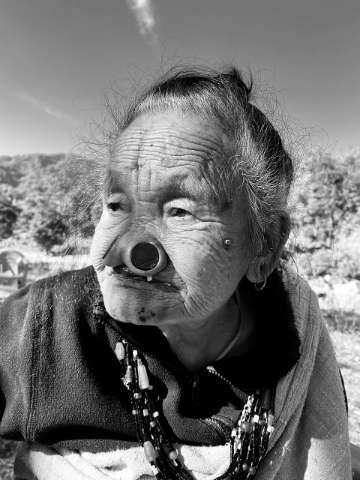
An Apatani woman of the Ziro valley, with her nose plugs and tattooed line. Photo : Soup0w0, CC BY-SA 4.0, via Wikimedia Commons.
In the Ziro valley of Arunachal Pradesh, India, Apatani women
wore until the 1970s two large plugs of black wood in the wings of the nose, the yaping
hullo, and a tattooed line from forehead to chin. The most common explanation — making
themselves unattractive so as not to be abducted by neighbouring tribes — is the one the Apatani
give themselves, but anthropologists see it rather as a mark of belonging and of the group's own
idea of beauty, as everywhere else. The generation born after 1970 gave up the practice; it is now
seen only on elderly women.
Tattooed faces: Chin, Ainu, Amazigh, Māori
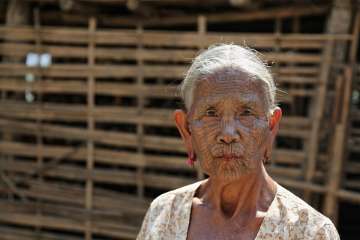
A Chin woman with a tattooed face, western Myanmar. Photo : Jean-Marie Hullot, CC BY 3.0, via Wikimedia Commons.
The tattooing of women's faces has existed on almost every continent. Chin women of Myanmar had
the whole face covered with lines or dots; Ainu women of northern Japan tattooed a wide smile
around the mouth as a mark of adulthood, until the ban of 1871; Amazigh (Berber) women of Algeria,
Tunisia and Morocco wore protective patterns on chin and forehead, the siyala, which their
granddaughters' generation stopped having done. Among the Māori of New Zealand, by contrast, the moko kauae, the tattoo
of chin and lips, long abandoned under colonial pressure, has enjoyed since the 1990s a revival
claimed as an act of identity — a television news presenter wore one on air in 2019.
The ochre of the Himba (Namibia)
A Himba woman, hair plaited and coated with otjize, northern Namibia. Photo : Josep M. Gracia, CC BY-SA 4.0, cropped, via Wikimedia Commons.
Himba women of the Kaokoland, in north-western Namibia, coat their skin and hair every morning
with otjize, a paste of butterfat and red ochre scented with resin. The colour, which
evokes earth and blood, is the group's standard of beauty; the paste also protects from sun and
insects and replaces water, which is scarce, for washing. The hairstyle says everything: plaits
forward for little girls, backward at puberty, and the erembe leather headdress for women
married for a year or who have had a child.
Scarification (Ethiopia, Sudan, West Africa)
Among the Karo and Hamar of the Omo, the Nuba of Sudan and many peoples of the Gulf of Guinea,
patterns cut into the skin and then rubbed with ash or plant sap formed raised designs that
signalled lineage, endurance and, for women, beauty and readiness for marriage. The practice has
declined sharply since the 1970s, and several countries have banned it on minors; it remains
visible on the faces of older generations.
When roundness is the ideal
In southern Nigeria, the Efik of Calabar sent a betrothed
girl to a "fattening room", the nkuho: several weeks of rest, abundant meals and
instruction by older women, before a coming-out ceremony at which she appeared plump and adorned.
In Mauritania, leblouh — the force-feeding of girls with camel milk and millet — aimed at
the same ideal of opulence; condemned for its effects on health, it is receding but has not
disappeared. These ideals say something simple: where food is short, roundness shows the family's
wealth, exactly as slimness, in our societies of plenty, shows the time and money devoted to
oneself.
And at home: high foreheads, joined eyebrows, corsets
Europe has nothing to envy anyone. In the 15th century, Flemish and Italian ladies plucked their
hairline to obtain a domed forehead, and whitened their faces with ceruse, a toxic lead carbonate
still in use in the 18th century. In Persia under the Qajars, in the 19th century, portraits of
women show joined eyebrows and a shadow of a moustache, drawn on if need be, and much admired at
the time. And the corset, from the 16th century to the First World War, reshaped the torsos of
generations of women down to the S-shaped silhouette of 1900, before fashion declared it barbaric
in under ten years.
Courting in public: festivals, contests and ordeals
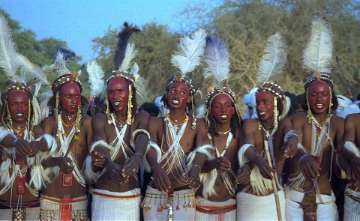
At the end of the rainy season, the Wodaabe lineages — nomadic Fulani of Niger and Chad — gather
for the Gerewol, a week of dances whose high point is a male beauty contest. The young men
paint their faces with yellow ochre, line their eyes with kohl and their lips with black, wear
ostrich feathers and dance for hours in a line, on tiptoe, rolling their eyes and baring their
teeth to show how white they are. The judges are young women chosen by the elders; the one who
picks a dancer may follow him for the night, and sometimes for life, even if she is already
married. It is one of the few rituals in the world in which it is the man who adorns himself in
order to be chosen.
The jumping of the Maasai warriors (Kenya, Tanzania)
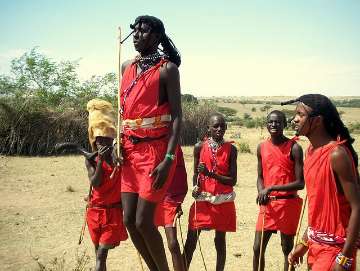
The adumu, the jumping dance of young Maasai warriors, is performed at the
eunoto, the ceremony that promotes them to the rank of elders and gives them the right to
marry. The young men form a circle, sing in polyphony and, in turn, jump as high as they can with
heels together, never letting the heels touch the ground between two leaps. The height of the jump
is watched by the young women present as proof of strength and stamina. The dance has become a
tourist image of Kenya, but it keeps its function among the
Maasai.
The bull jumping of the Hamar (Ethiopia)
The Hamar bull jumping (ukuli bula), Omo valley. Photo : Richard Mortel, CC BY 2.0, via Wikimedia Commons.
To be allowed to marry, a young Hamar man of the Omo valley must run naked, four times and
without falling, across the backs of a row of about ten castrated bulls that his relatives hold
side by side: this is the ukuli bula. Before the ordeal, the women of his family ask to be
whipped by the already-initiated men, the maza, and display their scars as proof of
devotion to the jumper, who will owe them help for the rest of his life. That part of the rite is
much debated, including in Ethiopia.
The sharo of the Fulani (Nigeria)
Among the Jafun Fulani of northern Nigeria, the suitor
stands bare-chested before the assembly and takes, without flinching or grimacing, several blows
of a stick delivered by a young man of another lineage: this is the sharo. The one who
flinches loses face — and the bride. The ordeal, like the bull jumping, has the same logic as a
sporting contest: showing publicly that one can bear pain for the person one wants.
The betrothal moussem of Imilchil (Morocco)
Every September, in the Moroccan High Atlas, the Aït Haddidou tribes gather around the shrine
of Sidi Mohammed el-Maghani for a moussem that combines market, pilgrimage and meetings. Young women
in striped capes and young men in white djellabas observe one another and talk, and couples who
agree — often after an engagement already negotiated by the families — can have their marriage
registered on the spot by the notaries. The legend of Isli and Tislit, two lovers from enemy
tribes whose tears are said to have formed the two nearby lakes, serves as founding story; the
moussem itself is above all a practical way of marrying young people scattered across mountain
villages.
The Lisdoonvarna Matchmaking Festival (Ireland)
Matchmaking Festival banners in Lisdoonvarna, County Clare. Photo : Ian Capper, CC BY-SA 2.0, via Wikimedia Commons.
In this small spa town of County Clare, Ireland, September
has been the month of the Matchmaking Festival since the 1850s. Originally, farmers of the region
came to take the waters after the harvest and used the occasion to look for a wife through a
professional matchmaker. The festival still exists, draws tens of thousands of singles through the
whole month, and the current matchmaker, Willie Daly, keeps a ledger handed down by his father and
grandfather. Since 2013 one weekend has been devoted to same-sex matchmaking.
Fensterln and the maypole (Bavaria, Austria, Rhineland)
In the countryside of Bavaria and Austria, Fensterln had a young man climb by night,
with a ladder, up to his sweetheart's window to talk to her — and sometimes climb in, if she
opened. In the Rhineland the living custom is the Maibaum: on the night of 30 April, young
men set up in front of the house of the girl they like a young birch decorated with crêpe-paper
ribbons and a heart bearing her first name; on 1 June they come to take it back and receive in
exchange a meal, a crate of beer or a kiss. In leap years it is the girls who plant the tree.
Bundling (New England, Wales)
In the 17th and 18th centuries, in the New England colonies as in rural Wales and Holland, a
courting couple was allowed to spend the night in the same bed, fully clothed, under the roof of
the girl's parents — sometimes separated by a board or sewn into a sack. The point was to let the
young people get to know each other without wasting candles or firewood, on isolated farms where
the suitor had come from far away. The practice died out in the 19th century in the
United States under the criticism of preachers.
The harana (Philippines)
In the Philippines, the harana had a young man
come in the evening, with friends and a guitar, to sing under the window of the girl he was
courting, gentle songs in the kundiman style. The ritual had its rules: the young lady and
her family first listened behind the window, then perhaps invited him in. Born of Spanish
influence, the harana faded in the 1970s with radio and cassettes, but is regularly revived in
films and village fiestas.
The bride's salty coffee (Turkey)
During the visit of the families at which a young woman's hand is formally asked for, the
kız isteme, it is she who prepares and serves the Turkish coffee. Tradition allows her to
put salt — or pepper, or soap — in the future groom's cup, which he must drink to the last drop
without changing expression. It is read both as a test of his patience and as a small power left
to the bride in a negotiation that largely takes place over her head.
Dipo and kwanjula (Ghana, Uganda)
Among the Krobo of Ghana, the dipo ceremony marks
every April the passage of girls to adulthood; they appear adorned with strings of glass beads
handed down in the family, and the beads, a speciality of the region, tell of lineage and wealth.
In Uganda, among the Baganda, the kwanjula is the
ceremony at which the young woman formally introduces her fiancé to her extended family; it is she
who presents him, and he who brings the negotiated gifts, in a rite of several hours that opens the
way to marriage.
Objects that speak of love
Zulu bead letters (South Africa)
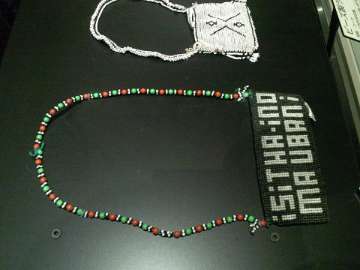
A Zulu beaded “love letter”, collected in 1996 (National Museum of Ethnology, Osaka). Photo : Yanajin33, CC BY-SA 3.0, via Wikimedia Commons.
In KwaZulu-Natal, South Africa, a young Zulu woman
declared or described her feelings with an incwadi, a square of sewn glass beads which she
gave to the young man, who wore it at the neck. Each colour has a meaning that can be read for good
or ill: white says purity and true love, red passion or a bleeding heart, black mourning or
marriage, green faithfulness or jealousy, yellow wealth or spite. The combination of colours and
patterns forms a message that family and friends know how to decipher. These "love letters" are
still made, today mostly for sale.
Welsh lovespoons (United Kingdom)
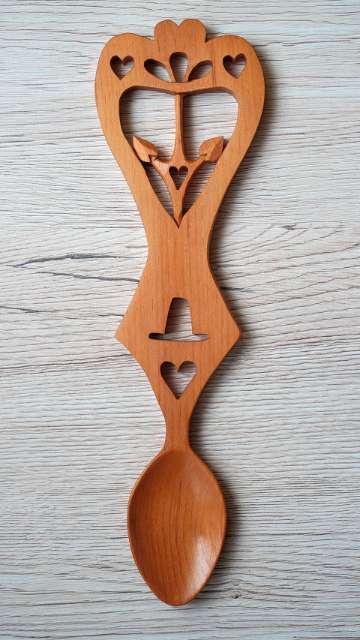
A Welsh lovespoon: heart, chain and pierced handle, carved from a single piece. Photo : Kmtextor, CC BY-SA 4.0, via Wikimedia Commons.
In Wales, United Kingdom, a young man carved from a
single piece of wood a spoon whose handle bore symbols — a heart for love, a key for the home, a
wheel for work, a chain for faithfulness, balls trapped in a cage for the number of children hoped
for — and gave it to the young woman he was courting. The oldest dated spoon, at the St Fagans
museum near Cardiff, bears the year 1667. The carver's skill proved his patience and dexterity; an
accepted spoon amounted to a promise. Lovespoons are still given today, for a wedding or an
anniversary.
Beauty patches and fans (France)
In the 17th and 18th centuries, fashionable Frenchwomen stuck small pieces of black taffeta on
their faces, the mouches, whose position was supposed to carry a message: near the eye
the "passionate", at the corner of the mouth the "kissing" patch, on the forehead the "majestic".
The so-called "language of the fan" — opened slowly to say "wait", rested on the left cheek to say
"no" — was largely manufactured in the 19th century by fan makers themselves, including the house
of Duvelleroy in Paris, to sell their wares. Both codes say the same thing: in a society where
nothing could be said, objects were made to say it.
The bride's henna (India, Pakistan)
On the eve of an Indian or Pakistani wedding, the mehndi ceremony gathers the women
of both families around the bride to draw henna patterns on her hands and feet, in which the
groom's initials are often hidden for him to find. A saying has it that the darker the henna, the
more the husband — or the mother-in-law — will love the young wife; the practical sense of the
custom is to perfume, to cool and to give the bride a few days' rest, since she must do nothing
while the patterns last.
Bine-bine and mokk pooj (Senegal)
In Senegal, waist beads, the bine-bine, are worn under the clothes and are heard more
than seen; together with thiouraye incense and the small knotted wrap they belong to the
mokk pooj, the Wolof art of pleasing one's husband in private, which older women pass on
to young brides. It is a seduction designed for the inside of the couple, not for the street, and
it is now the subject of debate in Senegal itself about the place it assigns to women.
The vodiondry (Madagascar)
In Madagascar, the marriage proposal takes the form of the vodiondry, literally "the
sheep's rump": the young man's family goes to the girl's home with an orator, exchanges codified
speeches and hands over a symbolic sum in an envelope, in memory of the piece of meat once offered
to the bride's parents. The ceremony, often followed by the civil and religious wedding, remains
very common, including in the diaspora.
Chocolates, matching outfits and Black Day (Japan, Korea)
In Japan, Valentine's Day took root the other way round: it is women who give chocolate on 14
February — honmei-choco to the man they love, "obligation" giri-choco to
colleagues — and men return the favour a month later, on 14 March, White Day, invented by
confectioners in 1978. South Korea added Black Day on 14 April, when singles go out together to
eat noodles in black bean sauce, and couples display their status with matching outfits and rings,
the couple look, very visible in the street.
Other ways of forming a couple
The Mosuo, on the shores of Lake Lugu between Yunnan and Sichuan, practise "walking marriage"
(zouhun): the woman stays all her life in her mother's house, the man comes to her at night
and leaves in the morning, and the children are raised by the maternal line, uncles included. The
Khasi of Meghalaya, in India, pass the name and the house down
through the youngest daughter. In some valleys of Tibet and Ladakh, several brothers married the
same woman so as not to divide the family land. And medieval Europe invented, with the Occitan
troubadours of the 12th century, fin'amor, courtly love, in which the knight puts himself
in the service of an unattainable lady: a literary ideal that shaped for centuries the way we speak
of love as a quest.
What all these customs have in common
Behind the variety, a few mechanisms recur everywhere. The beauty that is prized is always the
one that costs: time, pain, food, money — a lip plate, a plucked forehead or a weekly manicure say
the same thing about the possibility of devoting oneself to oneself. Public courtship goes through
ordeals that prove stamina, skill or courage before witnesses, whether a bull jump, a carved spoon
or a marathon. Objects serve to say what words cannot, and collective festivals to bring together
people who live far apart, as dating apps do today. And almost
everywhere, families keep a say that our societies have handed to individuals.
What one can keep from this for oneself: a first impression is a language, and it helps to know
which one you are speaking; small material gestures count, as the page on small gestures reminds us; and what we find beautiful in another
person is largely learned, which leaves more freedom than we think.
Most do, but rarely in their original form: the Gerewol, the bull jumping, Imilchil,
Lisdoonvarna, mehndi, the Maibaum and the kwanjula are very much alive; bound feet, ohaguro, Apatani
nose plugs and Ainu tattoos have disappeared or are seen only on the very old; lip plates and neck
coils are receding among the young.
Can one attend these festivals?
Some are open and even organised for visitors — Lisdoonvarna, the Imilchil moussem, Maasai
dances. Others are family or initiation rites where a stranger has no place, or raise real ethical
questions, like the whipping of Hamar women. The rule is simple: find out beforehand, ask, and never
pay to watch someone get hurt.
Why do so many customs bear on women's bodies?
Because in most societies marriage was an alliance between families in which the woman changed
house, and her exchange value was read on her body. The exceptions — the Gerewol, the sharo, the
bull jumping, Welsh lovespoons — show that when it is the man who must convince, it is he who
adorns himself or who suffers.
Page checked in September 2026. The data cited can change.