
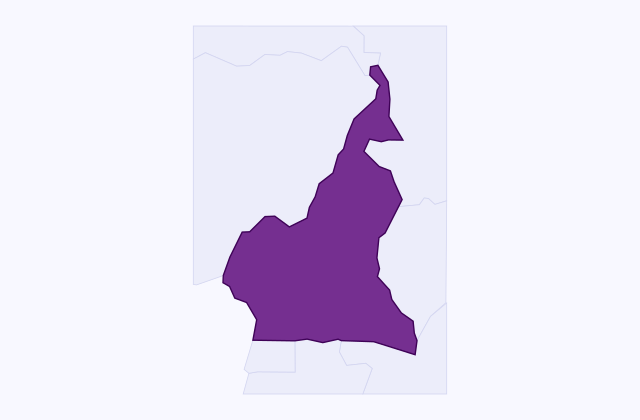
The legal framework
There is no Cameroonian legislation devoted to assisted reproduction. The activity is carried on within the framework of general medical law, under authorisation from the Ministère de la Santé publique. The first children conceived in Cameroon by FIV (fécondation in vitro, IVF) were born in the 2000s, and the offer has since developed in a few private facilities in Douala and Yaoundé, which perform IVF and ICSI (intracytoplasmic sperm injection, in which a single sperm is injected into the egg). The couple's work-up (bilan) is available in the university hospitals (CHU, centres hospitaliers universitaires) and in private laboratories in the large cities. Gamete donation (don de gamètes) is not legally organised: the parentage (filiation) of a child born from a donation rests on no text and can be challenged. There is no cover by any scheme, and private insurers generally exclude IVF from their policies. The private offer is aimed at married couples of a man and a woman. Those who need techniques that are not available locally — above all donation — go to Morocco, Tunisia, South Africa or Europe.
In Cameroon the critical point is the embryologist: an IVF laboratory is only as good as the person who handles the eggs and sperm, and several facilities work with embryologists who come on occasional missions. Ask who will actually carry out the fertilisation and the embryo culture, and on what date. Among women, the after-effects of sexually transmitted infections are the leading cause of infertility, which ties the prevention of infections directly to fertility; among men, severe sperm abnormalities are frequent and call for ICSI. Family pressure leads many couples to consult late, after years of traditional treatments — yet time is the one factor nothing can make up: at 40, the chances of IVF with one's own eggs are low, however good the centre. Since the centres are in Douala and Yaoundé, couples from the English-speaking North-West and South-West regions, like British nationals working elsewhere in the country, have to plan their stays around the monitoring, which requires several ultrasound scans a few days apart.
For Cameroonians in the UK — many of them from the English-speaking regions — and for British-Cameroonian couples, the choice is often between treatment in Cameroon and treatment in the UK. In the UK, NHS funding for IVF is decided locally, on criteria such as the woman's age, and differs between England, Scotland, Wales and Northern Ireland; people living in the UK on a visa who have paid the immigration health surcharge use the NHS much as residents do, but must still pay for assisted conception; and the NHS pays nothing for treatment abroad. UK fertility clinics, private as well as NHS, are licensed by the HFEA (Human Fertilisation and Embryology Authority), which has no powers overseas: it cannot deal with a complaint about a clinic in Douala, and its donor register covers only UK clinics — a person conceived with a donation made in a UK clinic since April 2005 can learn the donor's identity at 18, whereas nothing organises donation in Cameroon. For British citizenship and a UK passport, who is a parent is decided by UK law: the woman who gives birth is the mother, and her husband is the father if he consented to the treatment — which is why the copie intégrale (full certified copy) of a marriage recorded in the état civil (civil status registry) matters, while a customary marriage that was never recorded proves nothing. Surrogacy is lawful in the UK only on a non-commercial basis, and the parental order that transfers parenthood from the surrogate is available only to intended parents living in or domiciled in the UK; Cameroon, which has no law on assisted reproduction, provides no framework for it either.
Key points
| Law | No dedicated law; general medical law and authorisations from the Ministère de la Santé publique |
|---|---|
| Provision | A few private centres in Douala and Yaoundé (IVF and ICSI); first IVF births in the 2000s |
| Donation | Not legally organised; the parentage of a donor-conceived child rests on no text and can be challenged |
| Cover | None; private insurers generally exclude IVF |
| Work-up | In the university hospitals (CHU) and in private laboratories of the large cities |
| Bottleneck | The availability of an embryologist; several facilities work through occasional missions |
| Costs | IVF or ICSI cycle 2 to 4 million CFA francs (about 3,050 to 6,100 euros at the fixed rate); couple's work-up 150,000 to 400,000 CFA francs (about 230 to 610 euros) |
| Alternatives | Morocco, Tunisia, South Africa or Europe, above all for donation |
| Same-sex couples | The private offer is aimed at married couples of a man and a woman |
| British patients and Cameroonians in the UK | HFEA regulates only UK clinics; no NHS funding abroad; visa holders pay for assisted conception despite the immigration health surcharge; parentage for UK purposes follows UK law |
In practice
- See a gynaecologist and have both partners assessed from the start, with a semen analysis (spermogramme) every time — in a CHU or a private laboratory in Douala or Yaoundé. If you move between the UK and Cameroon, keep copies of all results so that they can be used in both countries.
- Look for and treat curable causes first, in particular genital infections and their after-effects.
- Check the centre's authorisation and that it has an embryology laboratory on site; ask who will carry out fertilisation and embryo culture, and when — a centre that works through missions must be able to give the date.
- Obtain a written quote covering the whole cycle, medication included, before you start.
- Plan the journeys that monitoring requires — several ultrasound scans close together: for couples from Bamenda, Buea or the UK, a question of leave and accommodation.
- Couples living in the UK should ask their GP about NHS referral and the local criteria before paying privately, and check that any UK clinic is licensed by the HFEA; a married couple proves the marriage with the copie intégrale of the Cameroonian certificate and a certified English translation if it is in French.
- If the child is born in Cameroon to a British parent, declare the birth at the centre d'état civil (civil status centre) within the legal time limits, then apply to HM Passport Office for the first British passport with the birth certificate and a certified translation; whether the child is British depends on the British parent's own status — a parent who is British by descent does not automatically pass citizenship on to a child born abroad.
Cost and coverage
A cycle of IVF or ICSI costs 2 to 4 million CFA francs in Cameroon — about 3,050 to 6,100 euros at the fixed rate (655.957 CFA francs to the euro), a little less in pounds — and the couple's work-up 150,000 to 400,000 CFA francs, about 230 to 610 euros. There is no cover, and private insurers generally exclude IVF; add travel and stays for the monitoring and, for treatment in Morocco, Tunisia or South Africa, flights and accommodation. The NHS pays nothing for treatment abroad. In the UK, NHS-funded IVF depends on local criteria, visa holders pay for assisted conception even after the immigration health surcharge, and private clinics set their own prices — ask whether medication is included.
Recent changes
The number of trained practitioners in Cameroon is growing, and partnerships with European and South African centres allow regular missions by embryologists, whose availability remains the main limiting factor. In the UK, the HFEA reminds patients considering treatment abroad that it has no powers over foreign clinics and that rules on donor anonymity, the number of families per donor and surrogacy differ from country to country.
Where to go
- Private reproductive medicine centres in Douala and Yaoundé.
- Obstetrics and gynaecology departments of the Hôpital Général de Douala and the Hôpital Gynéco-Obstétrique et Pédiatrique de Yaoundé.
- Centre Pasteur du Cameroun and approved laboratories, for the tests; Ministère de la Santé publique, for the authorisation of facilities; Cameroonian learned societies of obstetrics and gynaecology.
- HFEA: guidance on treatment abroad and licensed UK clinics; GPs for NHS referral; HM Passport Office for a child's first British passport; British High Commission in Yaoundé (consular assistance); Irish citizens: Department of Foreign Affairs.
Worth knowing
No law governs gamete donation in Cameroon: the parentage of a child born from a donation rests on no text and can be challenged. Before any treatment with donor eggs or sperm, in Cameroon or elsewhere, check the consequences for parentage and for the child's British citizenship under UK law, and remember that the HFEA has no powers over clinics abroad. And whatever is paid in Douala or Yaoundé, the NHS will not reimburse.
Frequently asked questions
Can I have IVF in Cameroon?
Yes: a few private facilities in Douala and Yaoundé perform IVF and ICSI, under authorisation from the Ministère de la Santé publique. A cycle costs 2 to 4 million CFA francs, about 3,050 to 6,100 euros, with no cover. Before choosing, check the authorisation, the permanent presence of an embryologist — ask who will carry out fertilisation and embryo culture, and on what date —, the centre's volume of activity and a complete written quote.
We are a married British-Cameroonian couple in London: will the NHS pay for treatment in Douala?
No: the NHS pays nothing for fertility treatment abroad. In the UK, NHS-funded IVF depends on criteria set locally, such as the woman's age; a partner who lives in the UK on a visa must still pay for assisted conception even after paying the immigration health surcharge, so ask your GP early how the rules apply to you. Prove your marriage with the copie intégrale of the Cameroonian certificate and a certified English translation if it is in French; a customary marriage never recorded in the état civil will not do.
Is there egg or sperm donation in Cameroon?
It is not legally organised, and the parentage of a child conceived that way would have no basis in any text and could be challenged; couples who need a donation go to Morocco, Tunisia, South Africa or Europe. In the UK, donation in licensed clinics is regulated by the HFEA: a donor's sperm or eggs can be used for a limited number of families, and people conceived with donations made since April 2005 can learn the donor's identity at 18. Abroad, these protections may not exist: ask a specialist adviser about the consequences for the child before any treatment.
Should we go abroad straight away?
Only for techniques that are not available in Cameroon, above all gamete donation; standard cases can be treated there. What matters most is time: many couples come after years of traditional treatments and family pressure, yet at 40 the chances of IVF with one's own eggs are low, however good the centre. Start the work-up of both partners early, semen analysis included; couples living in the UK should compare with what the NHS offers locally before paying privately anywhere.
Official sources and links
- Services du Premier ministre — official government website — laws and regulations of Cameroon (French version)
- HFEA — fertility treatment abroad — UK regulator's guidance: what to check, donor identity, surrogacy and parental orders
- British High Commission Yaoundé — consular assistance for British nationals in Cameroon