
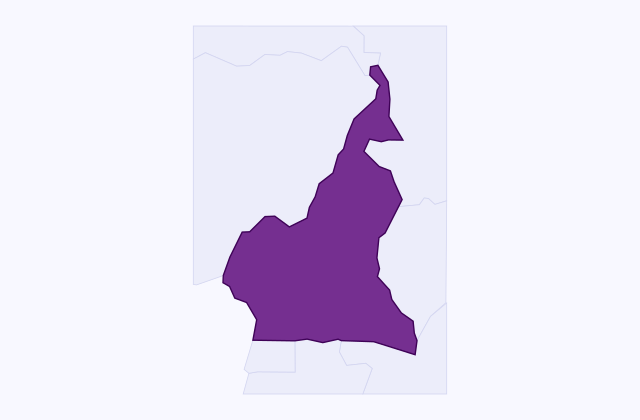
The legal framework
Marriage and its dissolution are governed by Ordinance No. 81-02 of 29 June 1981 on the organisation of civil status registration and the texts that supplement it, and by the Civil Code inherited from the colonial period; customary laws coexist with the written law, and the English-speaking regions apply rules inspired by the common law to certain questions of personal status. Depending on the type of marriage, the modern-law courts or the juridictions coutumières (customary courts) have jurisdiction; for a marriage celebrated at the état civil, it is the tribunal de première instance. Divorce is judicial and, depending on the court, is granted for fault (divorce pour faute), by mutual consent (consentement mutuel) or for breakdown of the life in common (rupture de la vie commune); a tentative de conciliation (attempt at conciliation) before the judge must come first. The option between monogamy and polygamy chosen at the ceremony and entered in the marriage certificate, and the property regime — separation or community of property, depending on the choice made — shape the outcome. The judge decides the custody (garde) of the children, the child's interest coming first; maintenance (pension alimentaire) is set in the judgment, but enforcing it remains the main practical difficulty. The restitution of the dot (bride price) is frequently argued before the customary courts. The judgment is effective against third parties only once it has been noted in the margin of the marriage certificate at the état civil. A marriage celebrated only according to custom and never recorded in the état civil has no full civil effects: its dissolution gives no right to maintenance or to a division of property before the modern-law courts.
British-Cameroonian couples who separate often have a choice of courts. A couple living in Cameroon goes before the tribunal de première instance — in the English-speaking regions, ask a local lawyer which court deals with the case and which rules it applies —, but the courts of England and Wales may also have jurisdiction, in particular when either spouse is domiciled there, as many British people abroad remain, or on grounds of habitual residence. A couple living in the UK divorces before the UK courts, which apply their own law: in England and Wales, a no-fault divorce, and a court that divides all the assets at its discretion, wherever they are, land in Cameroon included, and can share UK pensions. A marriage contracted under the polygamy option is no bar: English courts can grant a divorce and make financial orders in respect of a polygamous marriage. The difference in outcome — maintenance, pensions, property — can be considerable, so the financially weaker spouse should take advice in both countries before anyone files; Cameroonian couples living in the UK face the same choice.
A Cameroonian divorce is recognised in the UK under the Family Law Act 1986 without any procedure, as long as it is effective in Cameroon and either spouse was habitually resident in, domiciled in or a national of Cameroon when it was obtained; since divorce in Cameroon is judicial, a separation settled only between the families, with no court decision, does not dissolve a marriage recorded in the état civil, and UK authorities will not treat it as a divorce. A spouse with a strong connection to England and Wales who was divorced in Cameroon can, with the court's permission, ask an English court for financial provision under Part III of the Matrimonial and Family Proceedings Act 1984. In the other direction, a lawyer in Cameroon can say whether and how a UK divorce is recognised there and noted in the margin of the marriage certificate; the UK final order is legalised by the FCDO Legalisation Office for that purpose. For children, taking a child under 16 out of the UK without the consent of everyone with parental responsibility or the court's permission is a criminal offence in England and Wales, and whether the 1980 Hague Convention on international child abduction can be used depends on whether it is in force between the UK and Cameroon: ask the International Child Abduction and Contact Unit (ICACU). Where it does not apply, a return has to be sought before the courts of the country where the child is, which is slow and uncertain. Irish citizens should check how Ireland, which applies its own rules, will treat the divorce.
Key points
| Law | Ordinance No. 81-02 on civil status and supplementing texts; Civil Code inherited from the colonial period; customary laws |
|---|---|
| Grounds | Fault, mutual consent or breakdown of the life in common, depending on the court |
| Court | Tribunal de première instance for marriages celebrated at the état civil; customary courts depending on the type of marriage |
| Conciliation | Compulsory prior attempt before the judge |
| Option | Monogamy or polygamy, chosen at the ceremony and entered in the marriage certificate |
| Property regime | Separation or community of property, depending on the choice made |
| Children | Custody decided by the judge; the child's interest comes first |
| Maintenance | Set in the judgment; enforcement is the main practical difficulty |
| Dot (bride price) | Its restitution is frequently argued before the customary courts |
| Registration | Noted in the margin of the marriage certificate; only then effective against third parties |
| Unregistered customary marriage | No maintenance and no division of property before the modern-law courts |
| British and Irish couples | Cameroonian divorce recognised in the UK under the Family Law Act 1986 without procedure; English courts may have jurisdiction (domicile, habitual residence) and apply English law; financial provision after an overseas divorce possible with permission (Part III, Matrimonial and Family Proceedings Act 1984); recognition of a UK divorce in Cameroon to be checked with a Cameroonian lawyer |
In practice
- Before the first hearing, gather the copie intégrale (full certified copy) of the marriage certificate, the children's birth certificates and proof of income; the copy also shows the option and the property regime, which shape the outcome. UK documents for use in Cameroon are legalised by the FCDO Legalisation Office first.
- Attend the attempt at conciliation: it is compulsory, and a spouse living in the UK should agree early with his or her lawyer in Cameroon how to take part in the hearings and whether representation is possible.
- Ask for the judgment to set maintenance precisely — amount, date of payment, method of payment — and to spell out the visiting arrangements: a vague decision cannot be enforced, and across a border even less so.
- Settle the property regime and document any claim to land in Cameroon paid for with money earned in the UK: deeds of purchase, titles, records of transfers.
- Have the judgment noted in the margin of the marriage certificate at the état civil and keep several copies; for UK purposes add a certified English translation if it is in French — the register office will ask to see it before any new marriage in the UK.
- To divorce in England and Wales, apply online through GOV.UK with the copie intégrale of the Cameroonian marriage certificate and its certified translation, then ask a lawyer in Cameroon how the final order can be recognised and noted there.
- Never take the children out of Cameroon, or keep them in the UK, without the other parent's agreement or a court decision. If it happens, seek urgent advice from a family solicitor: the ICACU deals with cases under the Hague Conventions in England and Wales, the British High Commission can give consular support, and Reunite International advises parents.
Cost and coverage
In Cameroon court fees are moderate; assistance judiciaire (legal aid) exists but is little used. The practical costs — travel, copies of records, lawyers' fees — weigh more, especially outside the big cities, and for a spouse living in the UK so does travel or representation. In England and Wales, the divorce application fee is published on GOV.UK and can be reduced on a low income through Help with Fees; solicitors' fees for a financial settlement depend on the assets, and legal aid in family cases is largely limited to situations involving domestic abuse or child protection. Add the FCDO's fee for each legalised document and certified translations.
Recent changes
A draft Code des personnes et de la famille (Code of Persons and the Family) has been under discussion for many years, dealing in particular with the age of marriage, polygamy and the equality of spouses; it has not been adopted. In England and Wales, no-fault divorce has existed since 6 April 2022: neither spouse has to prove fault, and at least 20 weeks must pass between the application and the conditional order, then six more weeks before the final order.
Where to go
- Tribunaux de première instance (courts of first instance) and tribunaux de grande instance (High Courts).
- Lawyers' associations and university cliniques juridiques (law clinics), often free.
- Social services of the communes (municipalities) for family mediation.
- British High Commission in Yaoundé: consular assistance and lists of local lawyers; GOV.UK for divorce in England and Wales; the International Child Abduction and Contact Unit (ICACU) and Reunite International for children; Irish citizens: Department of Foreign Affairs.
Worth knowing
A marriage celebrated only according to custom and never recorded in the état civil has no full civil effects: its dissolution gives no right to maintenance or to a division of property before the modern-law courts. Enforcing maintenance is the weak point: have the amount, the date and the method of payment written into the judgment, otherwise no enforcement is really possible. British-Cameroonian couples should decide early where to divorce, because the financial outcome can differ greatly — and no parent should move the children from one country to the other without the other parent's consent.
Frequently asked questions
Is my Cameroonian divorce valid in the UK?
Yes, automatically, under the Family Law Act 1986, if it is effective in Cameroon and at least one of you was habitually resident in, domiciled in or a national of Cameroon when it was granted. Keep the judgment, noted in the margin of the marriage certificate, with a certified English translation if it is in French: the register office will ask to see it before you remarry in the UK. A separation agreed only between the families, without a court, does not dissolve a marriage recorded in the état civil.
We married in Cameroon and live in England: can we divorce here?
Yes, if the English court has jurisdiction — for instance because you are both habitually resident in England and Wales, or one of you is domiciled there. The court applies English law: a no-fault divorce, applied for online, with the copie intégrale of your marriage certificate and its certified translation; a marriage under the polygamy option is no obstacle. The English court can deal with all your assets, including land in Cameroon, but an order about that land will need to be recognised or enforced there: ask a Cameroonian lawyer, who can also see to the note in the margin of your marriage certificate.
I live in Yaoundé with my Cameroonian husband: can I still divorce in England?
Possibly, if you are domiciled in England and Wales or meet another ground of jurisdiction; the English court would apply English law and could make financial orders over all the assets. Whether the English decree and its orders will be recognised in Cameroon, especially for land there, is a question for a Cameroonian lawyer before you file; the alternative is the procedure before the tribunal de première instance, with its compulsory conciliation.
How is maintenance for our child secured if one parent lives in Cameroon and the other in the UK?
Have it set precisely in the judgment — amount, date, method of payment —: even within Cameroon enforcement is the main practical difficulty, and across a border it is harder still. The UK Child Maintenance Service generally cannot act when the paying parent lives abroad, so ask a solicitor what can be enforced between the two countries; payment by bank transfer leaves a record that protects both parents.
Official sources and links
- Services du Premier ministre — official government website — laws and regulations of Cameroon (French version)
- GOV.UK — getting a divorce — divorce in England and Wales
- GOV.UK — international child abduction (ICACU) — Hague Convention 1980
- British High Commission Yaoundé — consular assistance for British nationals in Cameroon