
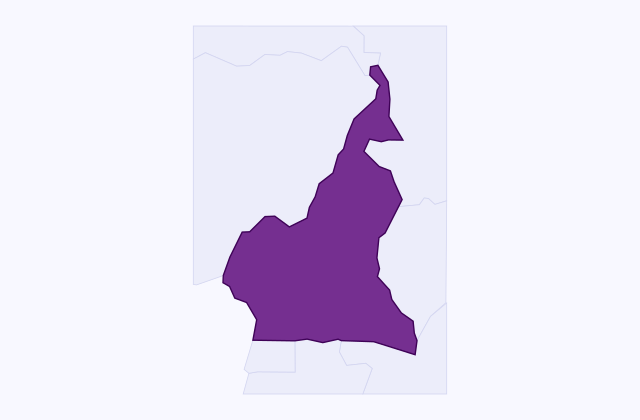
The legal framework
Cameroonian family law rests on the Civil Code inherited from the colonial period, supplemented by Ordinance No. 81-02 of 29 June 1981 on the organisation of civil status registration (état civil), which governs the celebration of marriage; recognised customary laws coexist with the written law, and the two English-speaking regions apply rules inspired by the common law to certain questions of personal status. The marriage is celebrated in public before the officier d'état civil at the centre d'état civil of the commune (municipality), after the intended marriage has been posted at the centre, and in the presence of witnesses; the consent of both spouses is mandatory. At the ceremony the future spouses declare whether they opt for monogamy or polygamy, and the option is entered in the marriage certificate (acte de mariage). The minimum age is set by the texts in force; human rights organisations are calling for it to be raised to 18 for both spouses. The dot is not a condition of the validity of a civil marriage, but it remains a strongly rooted social practice. A marriage celebrated according to custom (mariage coutumier) must be recorded in the état civil; late registration requires a jugement supplétif (a court judgment standing in for the missing record), which is slow and costly. Without a registered certificate there is no judicial divorce, no pension and no inheritance right for the spouse. The draft Code des personnes et de la famille (Code of Persons and the Family), discussed for many years, has not been adopted.
The British tie with Cameroon goes back to the First World War: the German colony of Kamerun was divided between France and Britain, and Britain administered the western part, next to Nigeria, until 1961, when the Southern Cameroons joined the Republic of Cameroon, independent since 1960, while the Northern Cameroons joined Nigeria. That is why Cameroon has two official languages, French and English, why the North-West and South-West regions — around Bamenda and Buea — are English-speaking, and why a common-law tradition survives there alongside the written law of French origin; Cameroon is also a member of the Commonwealth. The Cameroonian community in the UK includes many people from these English-speaking regions, and British nationals live in Cameroon for work with companies, NGOs, churches, schools and development programmes. British-Cameroonian couples marry in both countries, and every marriage needs papers that hold good in both.
A British national who wants to marry in Cameroon should start with the GOV.UK 'marriage abroad' tool, which sets out what a British national must provide for Cameroon, and then ask the centre d'état civil where the marriage will take place for its own list of documents. UK public documents are legalised by the FCDO Legalisation Office; English being one of Cameroon's official languages, ask the centre whether it also wants a French translation, or legalisation by the High Commission of Cameroon in London. Once celebrated before the officier d'état civil, the marriage is valid in the UK if it was valid under Cameroonian law and both parties had capacity to marry; there is no UK registration of foreign marriages, and for UK purposes the proof is the copie intégrale (full certified copy) of the certificate, with a certified English translation if it is in French. The option between monogamy and polygamy is no formality for a British spouse: English and Scots law accept a marriage contracted under the polygamy option as long as neither spouse already has another spouse, but nobody domiciled in the UK can validly enter into an actually polygamous marriage, and the Immigration Rules allow only one spouse of a polygamous marriage to come to the UK as a spouse.
Key points
| Law | Ordinance No. 81-02 of 29 June 1981 on civil status; Civil Code inherited from the colonial period; draft Code des personnes et de la famille not adopted |
|---|---|
| Authority | Officier d'état civil of the centre d'état civil of the commune |
| Notice | The intended marriage is posted at the centre d'état civil before the ceremony |
| Witnesses | Required; ask the centre how many and with which identity documents |
| Option | Monogamy or polygamy, chosen at the ceremony and entered in the marriage certificate; hard to reverse |
| Age | Set by the texts in force; human rights organisations call for 18 for both spouses |
| Dot (bride price) | Not a condition of validity of the civil marriage, but strongly rooted in social practice |
| Customary marriage | Must be recorded in the état civil; late registration only by jugement supplétif |
| Without a registered certificate | No judicial divorce, no pension, no inheritance right for the spouse |
| Proof | The copie intégrale (full certified copy) of the marriage certificate, to be obtained in several copies |
| British and Irish nationals | GOV.UK 'marriage abroad' tool; UK documents legalised by the FCDO Legalisation Office; no notarial acts by the British High Commission in Yaoundé (Commonwealth country); marriage valid in the UK without registration; an actually polygamous marriage is void for anyone domiciled in the UK |
In practice
- Check the GOV.UK 'marriage abroad' tool for Cameroon, then ask the centre d'état civil where you will marry for its own list before handing in the file — usually birth certificates and proof of identity, and after an earlier marriage the divorce decree or death certificate. UK documents are legalised by the FCDO Legalisation Office first.
- Wait for the notice period and, at the public ceremony, choose between monogamy and polygamy deliberately: the option is entered in the certificate and governs the spouses' rights on divorce and on death. A spouse domiciled in the UK cannot validly enter into a second, actually polygamous marriage; take advice from a lawyer familiar with both systems before choosing anything other than monogamy.
- When you sign, check names and dates carefully: an error in the certificate can afterwards be corrected only through the courts — and any discrepancy between British and Cameroonian papers will slow down passports, visas and every later procedure.
- Ask for several copies intégrales of the marriage certificate and keep them in separate places; for the Home Office, a certificate in French must be accompanied by a full certified English translation.
- For copies or declarations that must be certified in Cameroon, go to a local notary: the British High Commission in Yaoundé, which also provides consular support in Chad, Gabon and Equatorial Guinea, does not carry out notarial acts — certified copies, oaths, affidavits — in Commonwealth countries.
- If you married only according to custom, have the marriage recorded in the état civil without waiting: without a certificate there are no rights in Cameroon, and in practice nothing to show UK authorities for a visa, a pension or an inheritance.
Cost and coverage
État civil fees are low: marrying and registering on time costs very little, whereas late registration by jugement supplétif is far more expensive. On the UK side, add the FCDO's fee for each legalised document, any legalisation by the High Commission of Cameroon in London, translations, a local notary's fees for certified copies and, if the Cameroonian spouse is to move to the UK, the visa fee and the immigration health surcharge published on GOV.UK.
Recent changes
Public campaigns in Cameroon aim at the systematic registration of marriages and births, whose absence deprives many families of their rights; the draft Code des personnes et de la famille, which deals in particular with the age of marriage, polygamy and the equality of spouses, has still not been adopted. In England and Wales the minimum age for marriage has been 18, with no exception, since 27 February 2023, and causing a child to marry is an offence, including when the marriage is arranged abroad.
Where to go
- Centres d'état civil of the communes: file, notice, ceremony, copies of the marriage certificate.
- Tribunaux de première instance (courts of first instance) and the courts dealing with jugements supplétifs: late registration of a marriage, judicial correction of records.
- Legal aid associations and university cliniques juridiques (law clinics): support, including for recording a customary marriage; local notaries for certified copies and declarations.
- British High Commission in Yaoundé (consular assistance), the GOV.UK 'marriage abroad' tool and the FCDO Legalisation Office; the High Commission of Cameroon in London for Cameroonian formalities; the Forced Marriage Unit if a marriage is being imposed; Irish citizens: Department of Foreign Affairs.
Worth knowing
The option between monogamy and polygamy is written into the certificate, is hard to reverse and governs the whole succession: discuss it before the ceremony, not afterwards, and check the copie intégrale. A marriage celebrated only according to custom, with no record in the état civil, is legally almost nothing — no judicial divorce, no pension, no inheritance — and in practice impossible to rely on in the UK. And a British spouse should remember that UK law applies its own rules to polygamy: what Cameroonian law allows is not necessarily valid for someone domiciled in the UK.
Frequently asked questions
Is a marriage celebrated in Cameroon valid in the UK?
Yes, automatically, if it was celebrated before the officier d'état civil in accordance with Cameroonian law and both of you had capacity to marry under the law of your domicile. There is no need — and no procedure — to register it in the UK; keep several copies intégrales of the certificate, with a certified English translation if it is in French, for passports, visas, pensions and inheritance. For a spouse domiciled in England, Wales or Scotland, a marriage under the polygamy option is accepted as long as neither spouse already had another spouse.
What do I need as a British national to marry in Cameroon?
First, whatever the GOV.UK 'marriage abroad' tool lists for Cameroon — the guidance is updated from time to time, so check it shortly before you start. Then the documents the centre d'état civil asks for, usually birth certificates and proof of identity and, after an earlier marriage, the divorce decree or death certificate. UK documents are legalised by the FCDO Legalisation Office; ask the centre whether it also wants legalisation by the High Commission of Cameroon in London or a French translation. The British High Commission in Yaoundé cannot certify copies or take affidavits in a Commonwealth country, so use a local notary for that.
My Cameroonian husband or wife wants to join me in the UK: how does it work?
Through a family visa as a spouse, applied for from Cameroon under the conditions published on GOV.UK, including the financial and English-language requirements. The Home Office will want the marriage certificate, with a certified English translation if it is in French; a customary marriage that was never recorded in the état civil will not do. If the polygamy option was chosen, only one spouse of a polygamous marriage can come to the UK as a spouse. Irish citizens follow the rules of the Irish immigration service, which are different.
Official sources and links
- Services du Premier ministre — official government website — laws and regulations of Cameroon (French version)
- GOV.UK — getting married abroad — documents a British national needs, by country
- GOV.UK — get a document legalised — legalisation of UK documents by the FCDO Legalisation Office
- British High Commission Yaoundé — consular assistance; no notarial acts in Commonwealth countries