
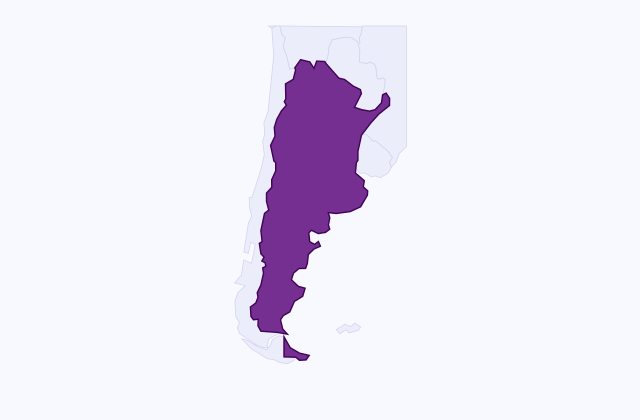
The legal framework
The Código Civil y Comercial (Civil and Commercial Code) of 2015, articles 401 to 445, governs marriage throughout the country: people of 18 may marry, those of 16 and 17 with the authorisation of their legal representatives, and anyone younger only with a judicial dispensation. Law 26.618 of 2010 opened marriage to same-sex couples, the first such law in Latin America. The marriage is celebrated before the public officer of the Registro Civil of any jurisdiction — each province and the City of Buenos Aires runs its own — in the presence of two witnesses; a religious marriage, whatever the faith, produces no civil effect. Each spouse may add the other's surname to his or her own, with or without 'de', but nobody is obliged to change name. The default matrimonial regime is the community of acquisitions (comunidad de ganancias); separation of property is chosen by a marriage agreement (convención matrimonial) signed before a notary (escribano). The 2015 Code abolished fidelity as a legal duty and allows either spouse to ask for a divorce without giving grounds.
Argentina is home to the best-known community of British descent in Latin America. British merchants settled in Buenos Aires soon after independence, British capital built much of the railway network in the nineteenth century, and English and Scottish families ran estancias and sheep farms from the pampas to Patagonia, founded schools and clubs, published the English-language Buenos Aires Herald from 1876 to 2017 and brought football, rugby and polo with them. Irish emigrants, many of them shepherds and sheep farmers in Buenos Aires province, formed one of the largest communities of Irish descent outside the English-speaking world — Admiral William Brown, born in County Mayo, founded the Argentine navy — and in 1865 Welsh settlers landed in Chubut from the Mimosa: the colony they built in the Chubut valley, at Rawson, Gaiman and Trelew and later at Trevelin in the Andes, still speaks and teaches Welsh. Today British and Irish expatriates, Anglo-Argentines holding British or Irish passports and many British-Argentine couples live above all in Greater Buenos Aires.
A British or Irish national can marry in Argentina with a passport, without being resident, on the same terms as an Argentine: the Registro Civil asks for a birth certificate and proof of marital status — and, after an earlier marriage, the divorce decree or death certificate — each bearing the apostille of the 1961 Hague Convention, to which Argentina, the United Kingdom and Ireland are all parties (in the UK, apostilles are issued by the FCDO Legalisation Office), and translated into Spanish in Argentina by a traductor público (sworn public translator). What else a British national must provide is set out for Argentina in the GOV.UK 'marriage abroad' tool, which should be checked before booking; Irish citizens ask the Embassy of Ireland in Buenos Aires. There is no UK registration of foreign marriages: an Argentine marriage certificate (acta de matrimonio), apostilled by the Argentine Ministry of Foreign Affairs and translated, is valid in the UK as it stands.
Key points
| Age | 18; 16 and 17 with the authorisation of the legal representatives; under 16 only with a judicial dispensation |
|---|---|
| Authority | Officer of the Registro Civil of the province or of the City of Buenos Aires; appointment (turno) booked in advance |
| Documents | DNI (national identity document) or passport, birth certificates, divorce judgment or death certificate where applicable; two adult witnesses |
| Premarital certificate | Abolished at national level; some provinces still require medical tests |
| Default regime | Community of acquisitions (comunidad de ganancias); separation of property by agreement before an escribano |
| Cost | Free at the Registro Civil during office hours; a fee for a ceremony outside the office or on a non-working day |
| Foreigners | Passport or foreign identity document; no residence required; foreign documents apostilled and translated by a traductor público |
| Surnames | Either spouse may add the other's; children bear the surname chosen by their parents |
| British and Irish nationals | Documents listed in the GOV.UK 'marriage abroad' tool; UK apostille from the FCDO Legalisation Office; marriage valid in the UK without registration there; Irish citizens: Embassy of Ireland in Buenos Aires |
In practice
- Book an appointment (turno) with the Registro Civil — online in the City of Buenos Aires and in many provinces — and hand in the documents a few days before the ceremony; ask the registry exactly what it requires from a foreign spouse, since practice varies between jurisdictions.
- Have UK documents apostilled by the FCDO Legalisation Office first, then have them translated in Argentina by a traductor público registered with the Colegio de Traductores; translations made abroad are generally refused.
- The convención matrimonial choosing separation of property is signed before an escribano before the wedding and noted in the marriage record; after the wedding, the regime can be changed only once a year has passed.
- Foreign spouses may marry with their passport, even without residence; the marriage then makes it easier to obtain residence (radicación) as the family member of an Argentine from the Dirección Nacional de Migraciones (national immigration office).
- Many registries offer Saturday ceremonies for a fee; a religious ceremony may follow, but only the civil marriage counts in law.
Cost and coverage
Free during office hours; 10,000 to 60,000 pesos for a ceremony outside the office or at the weekend, depending on the jurisdiction. Marriage agreement before an escribano: fees are unregulated, from 100,000 to 300,000 pesos — at 2025 exchange rates, a few tens to a few hundred pounds. Sworn translations are charged by the page, and the FCDO charges a fee for each UK apostille.
Recent changes
The 2015 Code removed fidelity as a legal obligation (it remains a moral duty), allowed unilateral divorce and opened the choice of matrimonial regime. Equal marriage turned fifteen in 2025, with more than 30,000 weddings celebrated. For British nationals, the documents required are those listed in the GOV.UK 'marriage abroad' tool at the time of the wedding: the guidance is updated from time to time, so check it shortly before booking.
Where to go
- Registro Civil of each province and of the City of Buenos Aires: appointments and requirements.
- Argentine Ministry of Foreign Affairs: apostille of Argentine documents; Colegio de Traductores Públicos: sworn translations.
- Colegios de escribanos (notaries' associations): marriage agreements; Dirección Nacional de Migraciones: residence of a foreign spouse.
- British Embassy in Buenos Aires (consular assistance, notarial services), the GOV.UK 'marriage abroad' tool and the FCDO Legalisation Office; Irish citizens: Embassy of Ireland in Buenos Aires.
Worth knowing
Without an agreement before an escribano, the regime is the community of acquisitions: everything acquired during the marriage is split in halves on divorce, whoever paid for it, and anyone who wants separation of property must sign it before the wedding or wait a year. And British documents go through two steps in a fixed order: the UK apostille first, then the translation in Argentina by a traductor público — a document without the apostille, or translated in the UK, is likely to be refused at the registry.
Frequently asked questions
Is a marriage celebrated in Argentina valid in the UK?
Yes, automatically, provided it was valid under Argentine law and both parties had capacity to marry. There is no need — and no procedure — to register it in the UK; keep the acta de matrimonio with the apostille of the Argentine Ministry of Foreign Affairs and a translation for pensions, immigration and inheritance. The same applies to same-sex marriages, recognised as marriages throughout the UK.
Can two British visitors marry in Argentina?
Yes: Argentine law requires no residence, so a couple who have entered as tourists can marry with their passports, an appointment at the Registro Civil, two adult witnesses and their documents apostilled in the UK and translated in Argentina by a traductor público — which takes some organising from abroad. Check first in the GOV.UK 'marriage abroad' tool what a British national must provide. The marriage is valid in the UK without registration; in practice, marrying in Argentina makes most sense for couples who live there or have family there.
What changes for a British spouse after marrying an Argentine?
Residence: the marriage makes it easier to obtain Argentine residence (radicación) as the family member of an Argentine, through the Dirección Nacional de Migraciones. Property: unless an agreement was signed before an escribano, a couple whose first marital home is in Argentina falls under the community of acquisitions for everything acquired during the marriage. Name: nothing changes unless you choose to add your spouse's surname. Nationality: Argentina, the UK and Ireland all allow dual nationality; an Argentine spouse moving to the UK applies for a family visa under the conditions published on GOV.UK.
Official sources and links
- Civil and Commercial Code — Book II, family relations (marriage, articles 401-445) — official text
- Civil Registry of the City of Buenos Aires — marriage — appointments and requirements
- GOV.UK — getting married abroad — documents a British national needs, by country
- GOV.UK — get a document legalised — apostilles from the FCDO Legalisation Office
- argentina.gob.ar — official portal of the Argentine state: procedures, civil registry, migration, health, justice
- Normativa nacional (InfoLeg) — official texts of Argentine laws and decrees
- British Embassy Buenos Aires — gov.uk — consular help, notarial and documentary services for British nationals in Argentina