The religious ceremony

Depending on the country, the same ceremony creates a marriage, creates nothing at all, or creates one only once it is registered.

Illustration: The religious ceremony

Appear on this page

Get our daily news watch

This page deals with what the religious ceremony is worth in law. What the religions themselves say about the couple — marrying before sex, duties of spouses, same-sex marriage, interfaith marriage, children — is on the page The couple and religion.

Three systems, three opposite consequences

The first model requires a prior civil marriage: the religious ceremony is a personal matter with no legal effect, and a celebrant who reverses the order may face prosecution. The second entrusts solemnisation to an authorised officiant, who may be a minister of religion: the religious ceremony is the marriage, provided a licence was issued and the paperwork returned. The third draws no distinction at all: the religious act is the marriage, and registration determines its effects.

The question that decides everything: who is officiating?

An engaged couple talks with a celebrant seated behind a wooden desk in a quiet, cosy study
Before planning the party, check that the person officiating is legally authorised.

In countries following the second model, validity depends neither on the venue, nor the rite, nor the solemnity of the occasion, but on one thing: is the celebrant on the official register? A flawless ceremony conducted by an unauthorised person creates no marriage. That check takes minutes and belongs before the planning of the celebration, not after.

Religious-only marriage: the riskiest position

Where the ceremony has no civil effect and no formality has been completed, the couple are legally two single people. There is no matrimonial property regime, no spousal maintenance, no inheritance entitlement and no possibility of a judicial separation — because there is nothing to dissolve. The person who bears the consequences is the one with less financial independence, often the one who stepped back from paid work, and it lands at the worst moment: a separation or a death.

Register, even late
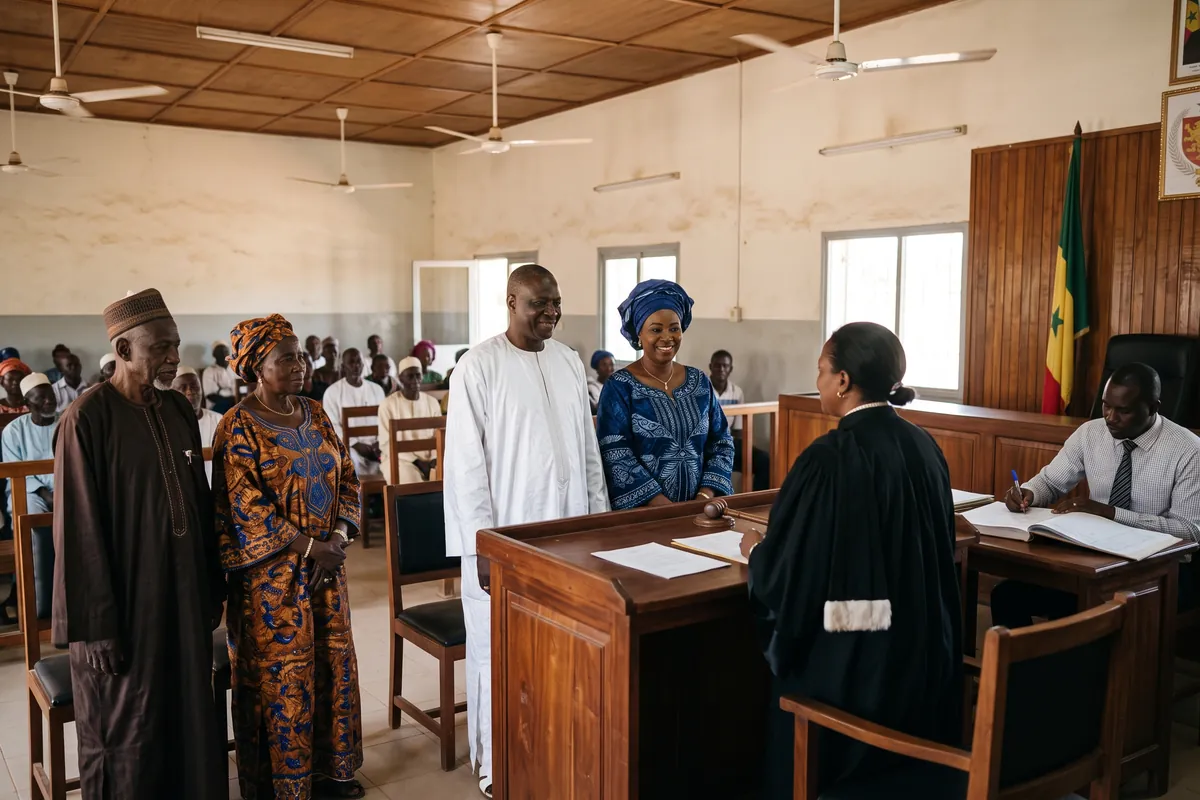
An elderly couple and two witnesses before a judge in a Senegalese court, to record their customary marriage
Having a customary union recorded afterwards requires witnesses and a judge: a record obtained while both spouses are alive is worth more than a ruling after a death.

Where a religious or customary union can be recognised after the event, do it without delay. Late procedures exist almost everywhere, but they require witnesses to be found, cost more and go through a court. A record obtained while both spouses are alive settles what a judgment obtained after a death never settles as cleanly.

A civil divorce does not undo the religious bond

Where both orders coexist, they are dissolved separately. A civil decision has no religious effect, and a religious procedure has no civil consequence. If you are contemplating a further religious marriage, find out about your own community's procedure before committing: it is often long and entirely independent of the court process.

Beyond the religious rite: customs

Around the religious ceremony, family rites that belong to no religion appear almost everywhere: the approach to the families, a bride price or dowry, entering the in-laws' household, the celebration. They follow a logic of their own, and that is usually where misunderstandings arise. → Wedding customs and ceremonies, country by country.

The law country by country

The legal framework, the procedure, the time limits and the costs differ from one country to another. Each country below has a detailed page: governing texts, key facts, the actual procedure, costs, where to go and the traps to avoid.

Select a country to open its detailed page.

Europe

Ireland

A religious ceremony has full civil effect if the solemniser is on the state register and notice was given three months in advance.

United Kingdom

A religious ceremony can be the legal marriage — but only in a registered building, with an authorised person, and the rules differ across the four nations.

Western Africa

Ghana

Three marriage regimes — Ordinance, customary and Mohammedan — each with its own registration route.

Nigeria

A church wedding is not automatically a statutory marriage: the place of worship must be licensed and the registrar's certificate obtained.

Eastern Africa

Ethiopia

A religious wedding is a legal marriage under the Revised Family Code if it follows the rites of the spouses' religion and the Code's essential conditions (arts 3 and 26), and the Federal Courts of Sharia in Addis Ababa and Dire Dawa hear family cases of Muslims only where the parties have expressly consented (Proclamation No. 188/1999, art. 4).

Kenya

The Marriage Act 2014 unified five kinds of marriage — civil, Christian, Hindu, Islamic and customary — under one registration system.

Rwanda

A religious ceremony has no marital effect in Rwanda: the Law recognises only the civil marriage and the marriage is valid from the time it is celebrated before a civil registrar (Law No 71/2024, Arts. 195(1) and 233), so a church or mosque wedding follows the civil one rather than replacing it.

Tanzania

On the Mainland a religious ceremony is a legal marriage when a licensed minister or a kadhi celebrates it (Law of Marriage Act, ss. 25 and 30), and since 2019 the Court of Appeal has held that customary and Islamic rules do not apply to anything the Act itself regulates.

Uganda

Church, mosque, civil and customary marriages are all recognised, each under its own statute and each requiring registration.

Zambia

Two systems: statutory marriage under the Marriage Act, and customary marriage — and you cannot be in both at once.

Southern Africa

South Africa

The religious nature of a ceremony does not, by itself, determine its legal effect. A duly designated religious officiant can also solemnise a legally recognised marriage.

Southern Asia

India

Religious ceremonies are the marriage — under the personal law of the community — but registration has become effectively compulsory.

Pakistan

The nikah is the marriage, and the nikahnama must be registered with the union council — the registration is what protects the wife.

Eastern Asia

Hong Kong

Competent ministers and civil celebrants both perform legally valid ceremonies, after a notice period.

South-eastern Asia

Indonesia

In Indonesia religion decides whether a marriage is valid: Article 2(1) of the Marriage Law accepts only a marriage celebrated under the religion and belief of the parties, Muslims follow the Compilation of Islamic Law (guardian, two witnesses, a bar on marriage between a Muslim and a non-Muslim) before a KUA registrar, and the Constitutional Court has twice refused to open the way to interfaith marriage.

Malaysia

A strict dual system: civil law for non-Muslims, state Islamic family law and Syariah courts for Muslims.

Philippines

Priests, imams and rabbis may solemnise, but only if registered — and a marriage licence is required first.

Singapore

Two separate legal systems: civil marriages under the Women's Charter, Muslim marriages under a separate registry and its own law.

Northern America

Canada

Outside Quebec, a registered religious officiant performs a legally valid marriage; a provincial licence is required first.

United States

There is no separate civil ceremony: clergy solemnise legally valid marriages, but a state marriage licence must be obtained first.

Caribbean

Jamaica

Ministers of religion are marriage officers, so the church ceremony is the legal marriage — after a licence or banns.

Trinidad and Tobago

Four marriage statutes — civil, Muslim, Hindu and Orisa — and since 2017 a uniform minimum age of eighteen.

Oceania

Australia

Only an authorised celebrant can create a valid marriage; a religious ceremony by anyone else has no legal effect.

New Zealand

A marriage licence plus an approved celebrant, who may be religious, makes the ceremony legally binding.

This topic is also covered for French-speaking countries · German-speaking countries.

Further reading

Links to official or reference sources. They open in a new tab.

Content updated in . The instruments cited can change: if in doubt, confirm with the official source given.

Text written with the help of AI, under the editorial responsibility of CAPIT. Human reviews are occasional (method: About). Spotted an error? Write to us.

Locate this page in the site map