
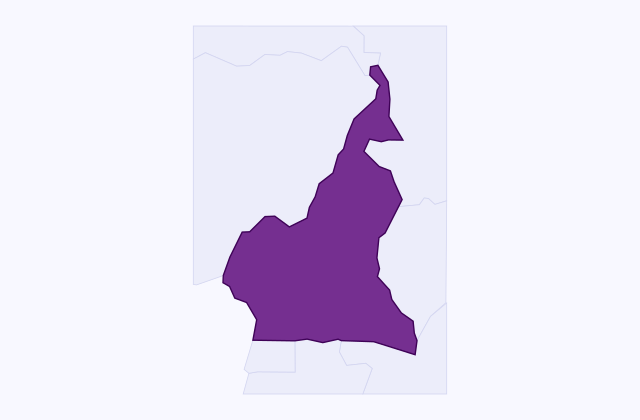
The legal framework
Cameroon has public enseignement maternel (nursery education) under the Ministry of Basic Education, but its coverage remains limited, above all in rural areas, and reaches only a minority of children. Where public pre-school exists it is free or almost free, though extra costs remain: uniform, supplies, a contribution to the parents' association. Private crèches and jardins d'enfants (kindergartens) are numerous in the two big cities, Douala and Yaoundé; they operate under an autorisation d'ouverture (licence to open), and the inspections de l'éducation (education inspectorates) keep the list of authorised establishments. For children under three there is no public provision: they are looked after by grandmothers, aunts or a live-in domestic helper (aide à domicile logée). There is no specific allowance for childcare. Anyone who employs domestic help does so under national labour law: a written contract, at least the applicable minimum wage plus contributions, and declaration; without it, the employee has no protection at all. Enrolment in public pre-school almost everywhere requires a birth certificate, and most establishments close during the school holidays. Fees are paid in CFA francs (XAF), pegged to the euro.
The general rule in Cameroon is simple: there is nothing institutional before the age of three. Family solidarity absorbs all the care of the youngest children, and its cost is invisible because it falls on the women of the family, sometimes on older sisters at the expense of their schooling. For Cameroonian families in the UK the contrast is sharp: the grandmothers and aunts who would step in at home are far away and nursery fees are high, but every child in England is entitled to funded hours of early education from the term after the third birthday, working parents can get funded hours from nine months, and Scotland, Wales and Northern Ireland run their own schemes; access to some support depends on immigration status — Child Benefit, for instance, is a public fund that a parent whose visa carries the condition 'no recourse to public funds' cannot claim. British families who move to Cameroon organise childcare themselves: a private crèche, a jardin d'enfants or a nanny, often all three, and in British-Cameroonian families the Cameroonian relatives frequently take a share. English being one of the country's two official languages, families looking for English-medium nursery education should ask about it when visiting authorised establishments; the English-speaking regions have their own English-medium schools.
Private provision in the cities is very uneven: two neighbouring establishments can charge the same fee with staffing levels that vary threefold. The useful criteria are concrete: the number of children per adult, staff stability from one year to the next, clean toilets, an outdoor space, and what happens when a child is hurt. The birth certificate is the key: children not declared to the état civil (civil status registry) are in practice shut out of the system, and late registration is a long procedure, so declaring the birth within the legal time limits is the first step. For a child with a British parent, the same certificate opens the way to a British passport: a child born in Cameroon to a parent who is British otherwise than by descent is normally British by descent, and the first passport is applied for from HM Passport Office with the Cameroonian birth certificate and, if it is in French, a certified English translation. A child born abroad to an Irish citizen who was born on the island of Ireland is Irish from birth; when the Irish parent was born abroad, citizenship goes through registration in the Foreign Births Register. UK support stays behind: Tax-Free Childcare and the funded hours stop when the family leaves the UK, whether Child Benefit continues depends on the GOV.UK rules for people moving abroad, and an employee posted by a UK employer should check what leave and benefits the UK contract keeps, local leave being a matter for Cameroonian labour law.
Key points
| Pre-school | Public and private; reaches a minority of children, concentrated in towns |
|---|---|
| Under three | No public provision; extended family and live-in domestic help |
| Private sector | Crèches and jardins d'enfants, mainly in Douala and Yaoundé; autorisation d'ouverture required |
| Authority | Ministry of Basic Education for nursery education; list of authorised establishments at the inspections de l'éducation |
| Cost | Public pre-school free or almost free; urban private provision about 10,000 to 60,000 CFA francs a month (about 15 to 91 euros) |
| Allowances | No specific childcare allowance |
| Domestic help | Written contract, at least the applicable minimum wage plus contributions, declaration |
| Enrolment | A birth certificate is required almost everywhere for public pre-school |
| Holidays | Most establishments close |
| Currency | CFA franc (XAF), pegged to the euro (1 euro = 655.957 CFA francs) |
| British and Irish families | UK childcare support stops on leaving the UK; Child Benefit abroad only under the GOV.UK rules; child of a British parent normally British by descent, first passport from HM Passport Office; Irish citizens: Foreign Births Register where needed |
In practice
- Ask the mairie (town hall) or the inspection de l'éducation about public establishments in your area; the inspections keep the list of authorised private establishments.
- Visit the private establishments you are considering, count the children per carer and watch for half an hour; ask to see the autorisation d'ouverture and what the protocol is in case of an accident — and, if you want English-medium care, in which language the children are looked after.
- Declare the birth at the centre d'état civil (civil status centre) within the legal time limits: without a birth certificate there is no place in public pre-school. A British parent then applies to HM Passport Office for the child's first passport, with the birth certificate and a certified English translation if it is in French; an unmarried British father keeps the evidence of paternity that HM Passport Office accepts. Irish citizens ask the Department of Foreign Affairs about the Foreign Births Register.
- If you employ a domestic helper or a nanny, sign a written contract, pay at least the applicable minimum wage and declare her with the contributions: without declaration she has no protection and the employer carries the risk. If she lives in, put accommodation, working hours, rest days and leave in writing.
- Plan for the holidays: most establishments close, and care falls back on the family or the domestic helper.
- Before moving, check with your employer and HMRC what happens to your leave, your Child Benefit and your Tax-Free Childcare account, and read the FCDO travel advice for Cameroon, which treats the regions differently. Cameroonian families settling in the UK should ask their local council's Family Information Service early about nursery places and funded hours: places fill up well in advance.
Cost and coverage
Public pre-school is free or almost free where it exists; extra costs — uniform, supplies, the parents' association contribution — must be budgeted for. Private provision in the cities costs about 10,000 to 60,000 CFA francs a month — about 15 to 91 euros at the fixed rate, a little less in pounds — plus enrolment fees and supplies. A declared domestic helper costs at least the applicable minimum wage plus contributions. On the UK side, add the passport fee for the child, certified translations and, for UK documents needed in Cameroon, the FCDO's legalisation fee.
Recent changes
Extending public pre-school and training its staff are recurring priorities of Cameroon's education sector plans. In England, funded childcare for working parents has been extended in stages since 2024 to children from nine months, reaching 30 hours a week in term time from September 2025 — support that, like Tax-Free Childcare, is available only while the family lives in the UK.
Where to go
- Mairie (town hall) or commune: public establishments in the area.
- Ministry of Basic Education and inspections de l'éducation: nursery education, list of authorised establishments.
- Authorised private crèches and jardins d'enfants in Douala and Yaoundé; associations and NGOs working in early childhood development.
- HM Passport Office for a child's British passport; British High Commission in Yaoundé for consular assistance and emergency travel documents; HMRC for Child Benefit and Tax-Free Childcare; in the UK, the local council's Family Information Service; Irish citizens: Department of Foreign Affairs (Foreign Births Register).
Worth knowing
Quality varies enormously between private establishments charging the same fee: check the autorisation d'ouverture and count the children per carer before deciding. Without a birth certificate there is no place in public pre-school — nor, for the child of a British parent, a British passport. And UK support — Tax-Free Childcare, the funded hours, usually Child Benefit — stays in the UK when the family leaves.
Frequently asked questions
Are there public crèches in Cameroon?
Not for children under three: public action concentrates on pre-school education, whose coverage still reaches only a minority of children and is especially thin in rural areas. The youngest children are cared for by grandmothers, aunts or a domestic helper; private crèches are found mainly in Douala and Yaoundé.
How much does a private establishment cost, and what should I check?
About 10,000 to 60,000 CFA francs a month in the cities — about 15 to 91 euros, since the CFA franc is pegged to the euro —, plus enrolment fees and supplies. The price says little about quality: check the autorisation d'ouverture, the number of children per carer, hygiene and the protocol in case of an accident.
We are moving to Yaoundé with our baby: what happens to Child Benefit and Tax-Free Childcare?
Tax-Free Childcare and the funded hours are for families living in the UK and stop when you leave. Child Benefit usually stops too when you move abroad for good; the GOV.UK rules for people moving abroad set out the exceptions, for instance for some Crown servants, and HMRC must be told of the move. Cameroon itself has no specific childcare allowance, so budget for a private crèche or a nanny.
Can I employ a nanny at home?
Yes, under national labour law: a written contract, at least the applicable minimum wage, and declaration with the contributions — otherwise the employee has no protection and you carry the risk if there is an accident. For a live-in helper, put accommodation, hours, rest days and leave in writing.
Official sources and links
- Services du Premier ministre — official government website — laws and regulations of Cameroon (French version)
- British High Commission Yaoundé — consular assistance and emergency travel documents for British nationals
- GOV.UK — get a document legalised — legalisation of UK documents, such as birth certificates, for use in Cameroon