
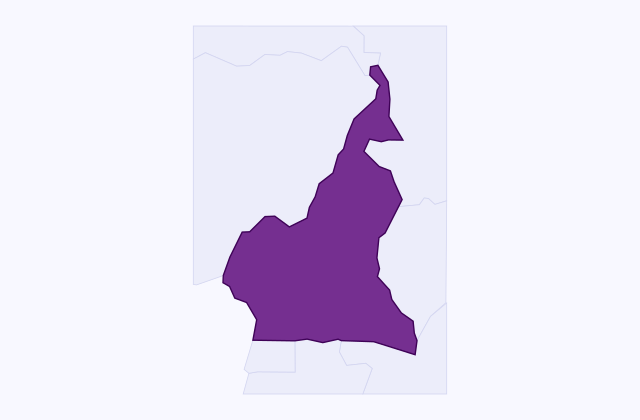
The legal framework
The applicable text is Law No. 97-19 of 7 August 1997 on the control of narcotic drugs, psychotropic substances and precursors (loi relative au contrôle des stupéfiants, des substances psychotropes et des précurseurs). It punishes use (usage), possession (détention) and trafficking (trafic); use carries imprisonment and a fine, but the law also provides treatment and rehabilitation measures (mesures de traitement et de réinsertion) for users. In practice the line between use and trafficking depends on the quantity seized, as assessed on the spot: a quantity intended for personal use can be reclassified as possession with a view to sale (détention en vue de la vente). After an arrest, détention provisoire (pre-trial detention) is the rule, and it is often long. The main health concern is diverted tramadol, an opioid painkiller subject to prescription that is sold outside the pharmaceutical circuit, cheaply and in doses far above therapeutic doses; many take it to keep going at work, and it causes widespread dependence and poisoning, with convulsions and respiratory depression. Cannabis remains the most widespread illicit substance and is grown in several regions. The services able to treat dependence can be counted on the fingers of one hand, mainly in Yaoundé and Douala: the psychiatry and addiction department of the Hôpital Jamot in Yaoundé and the Hôpital Laquintinie in Douala; elsewhere, the emergency departments of the regional hospitals deal with poisoning. There is also a Comité national de lutte contre la drogue (National Drug Control Committee). The law is national: it applies in the English-speaking North-West and South-West regions as in the rest of the country, and to foreigners as to Cameroonians.
For British and Irish nationals who live in or visit Cameroon — volunteers, NGO and company staff, teachers, partners of Cameroonians — three points matter. First, Cameroonian law applies to everyone on its territory, and the FCDO's travel advice for Cameroon states that penalties for using and possessing drugs are severe and usually include a prison sentence; since the line between use and trafficking depends on the quantity assessed on the spot, even a small amount can be treated as possession for sale. Second, after an arrest pre-trial detention is the rule: ask at once for the British High Commission in Yaoundé to be informed. Consular staff can visit, tell your family with your consent and provide a list of local lawyers, but they cannot obtain your release, interfere in the proceedings or pay fines, legal costs or bail; the charity Prisoners Abroad supports British nationals detained overseas and their families, and Irish citizens can turn to the Department of Foreign Affairs and the Irish Council for Prisoners Overseas. Third, medicines: prescription drugs that are controlled in the UK — strong painkillers, sleeping pills and tranquillisers, ADHD medicines — should travel in their original packaging, with a copy of the prescription and a doctor's letter, in the quantity needed for the stay; ask the High Commission of Cameroon in London about the conditions for bringing them in before you travel. This applies particularly to tramadol, whose distribution the Cameroonian health authorities have brought under tighter control. Finally, never carry a parcel, a suitcase or an envelope for someone else, even for a friend of the family: whoever is found with drugs in the luggage is normally held in pre-trial detention, even if he or she knew nothing.
In the UK the Misuse of Drugs Act 1971 classifies drugs by harm: cannabis is a class B drug, and possession is an offence even at home, punishable by up to five years' imprisonment; tramadol has been a class C controlled drug since 2014 and is available only on prescription. Cannabis-based medicines can be prescribed by specialist doctors in the UK since 2018, but a UK prescription is of no use in Cameroon, where the 1997 law applies — taking such medicines there without first checking with the High Commission of Cameroon in London exposes the traveller to prosecution. For Cameroonians in the UK — many of them students and workers on visas — a drugs offence has consequences beyond the sentence: a conviction can lead to the refusal of an extension of leave, of settlement or of naturalisation, and a prison sentence of 12 months or more makes a foreign national liable to deportation; see a solicitor early in any criminal case. Help with dependence is free and confidential from local drug and alcohol services, to which you can usually refer yourself, and Talk to Frank gives information to users and their families. Families in the UK who support a relative in Cameroon dependent on tramadol or another substance can advise him or her to go to a hospital psychiatric department, almost always the only structure with trained staff, and can help with the cost of treatment, which is rarely free.
Key points
| Law | Law No. 97-19 of 7 August 1997 on the control of narcotic drugs, psychotropic substances and precursors |
|---|---|
| Use | Imprisonment and a fine; treatment and rehabilitation measures provided |
| Use or trafficking | Depends on the quantity seized, assessed on the spot; a personal quantity can be reclassified as possession for sale |
| Pre-trial detention | The rule after an arrest, often long |
| Main concern | Diverted tramadol, sold outside pharmacies at high doses |
| Cannabis | Most widespread illicit substance, grown in several regions |
| Treatment | Hôpital Jamot, Yaoundé (psychiatry and addiction), Hôpital Laquintinie, Douala; very few services |
| Authority | Comité national de lutte contre la drogue |
| British and Irish nationals | FCDO: severe penalties, usually prison; consular visits and lists of lawyers, no release and no payment of fines or bail; medicines in original packaging with prescription and doctor's letter; in the UK cannabis class B, tramadol class C; a conviction can affect a Cameroonian's UK immigration status |
In practice
- Anyone who wants treatment should go to a hospital psychiatric department — almost always the only structure with trained staff: in Yaoundé, the Hôpital Jamot (psychiatry and addiction); in Douala, the Hôpital Laquintinie.
- Harm reduction associations (réduction des risques), where they exist, are the best point of entry for reliable, non-judgemental information.
- If you are arrested, ask immediately for the British High Commission to be informed — pre-trial detention is the rule —, sign nothing you do not understand, ask for an interpreter if the proceedings are in French, and choose a lawyer from the High Commission's list; Irish citizens ask for the Department of Foreign Affairs to be contacted.
- Carry ID at all times, as the FCDO advises: a residence permit or a certified copy of your passport showing a valid visa — the police can detain anyone without it.
- Travel with medicines only in their original packaging, with a copy of the prescription and a doctor's letter; take tramadol and other opioids only as prescribed and never buy them outside a pharmacy.
- Carry no luggage, parcel or envelope for anyone else, in either direction between Cameroon and the UK.
- In the UK, contact local drug and alcohol services (free and confidential, also for families) or Talk to Frank; in any criminal case, a non-British national should see a solicitor early, because the outcome can affect immigration status.
Cost and coverage
In Cameroon, public hospital treatment is charged at reduced rates but is rarely free, and the cost of treatment remains a major obstacle; fines and court costs depend on the decision, and the accused pays his or her own lawyer. The British High Commission does not pay fines, legal costs or bail, and travel insurance policies generally exclude anything linked to illegal drug use. The NHS does not pay for treatment in Cameroon. In the UK, local drug and alcohol services are free, and free legal advice is available to anyone held at a police station.
Recent changes
The Cameroonian health authorities have tightened control over the distribution of tramadol, whose doses sold in the street far exceeded therapeutic doses. In the UK, the list of controlled drugs continues to grow — nitrous oxide became a class C drug in November 2023 —, and the FCDO's travel advice for Cameroon continues to warn that penalties for using and possessing drugs are severe and usually include a prison sentence.
Where to go
- Hôpital Jamot, Yaoundé: psychiatry and addiction department.
- Hôpital Laquintinie, Douala.
- Comité national de lutte contre la drogue; emergency departments of the regional hospitals.
- British High Commission in Yaoundé and the FCDO (+44 20 7008 5000): consular support for detained British nationals; High Commission of Cameroon in London: bringing medicines into the country; Prisoners Abroad and, for Irish citizens, the Department of Foreign Affairs and the Irish Council for Prisoners Overseas; in the UK, local drug and alcohol services and Talk to Frank.
Worth knowing
In Cameroon pre-trial detention is long, and the line between use and trafficking depends on the quantity seized as assessed on the spot: a quantity for personal use can be reclassified as possession for sale. The High Commission can visit you but cannot get you out. Take no drugs in either direction, travel with medicines only with a prescription and a doctor's letter, and never carry anything for anyone else.
Frequently asked questions
Is a little cannabis tolerated in Cameroon?
No. Law No. 97-19 of 1997 punishes use and possession as well as trafficking, and the FCDO warns that penalties for using and possessing drugs are severe and usually include a prison sentence. Because the line between use and trafficking depends on the quantity assessed on the spot, even a small amount can be treated as possession for sale, and after an arrest pre-trial detention is the rule. The British High Commission can visit you, inform your family and give you a list of lawyers, but cannot obtain your release. There is no contrast with home to rely on: in the UK, too, cannabis is a class B drug and possession is an offence.
Is tramadol a narcotic?
Tramadol is an opioid painkiller available only on prescription, in Cameroon as in the UK, where it is a class C controlled drug. Sold outside pharmacies and at high doses, it causes dependence, convulsions and respiratory depression; in Cameroon its misuse is the main health concern in this field, and the health authorities have tightened control over its distribution. If it has been prescribed for you, travel only with the original packaging, a copy of the prescription and a doctor's letter, and never buy it in the street.
A relative in Cameroon is dependent — where can he or she get help?
Mainly at the Hôpital Jamot in Yaoundé, which has a psychiatry and addiction department, and at the Hôpital Laquintinie in Douala: hospital psychiatric departments are almost always the only structures with trained staff, and for relatives in Bamenda, Buea or elsewhere the journey has to be planned. Treatment there is charged at reduced rates but is rarely free. Harm reduction associations, where they exist, give information without judgement. The 1997 law expressly provides treatment and rehabilitation for users; in the UK, local drug and alcohol services also advise families who want to help from a distance.
I am a Cameroonian student in the UK — what does a drugs offence put at risk?
Besides the sentence itself, a drugs conviction can lead to the refusal of an extension of your visa, of settlement or, later, of naturalisation, and a prison sentence of 12 months or more makes a foreign national liable to deportation. Possession of cannabis is an offence in the UK even in private, and supplying any controlled drug is punished far more severely. If you are questioned or charged, ask for the free legal advice available at the police station and see a solicitor early; for any problem with substances, local drug and alcohol services are free and confidential.
Official sources and links
- Services du Premier ministre — official government website — laws and regulations of Cameroon, including Law No. 97-19 of 7 August 1997 (French version)
- GOV.UK — Cameroon travel advice: safety and security — local laws: severe penalties for using and possessing drugs, carrying ID
- British High Commission Yaoundé — consular assistance for detained British nationals