
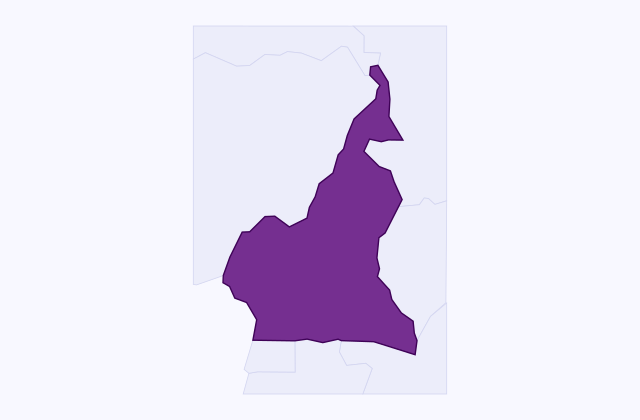
The legal framework
Articles 337 to 339 of the Code pénal punish abortion (avortement), for the woman as well as for the person who carries it out, while admitting two explicit exceptions: a pregnancy resulting from rape, and a serious risk to the mother's health. In practice the rape exception requires a medical report (constat médical) and often a complaint to the police, which makes it difficult to invoke within a useful time: the later the report is drawn up, the harder the exception is to establish. Parliament authorised the ratification of the Maputo Protocol (the Protocol to the African Charter on Human and Peoples' Rights on the Rights of Women in Africa), which provoked strong opposition from part of the religious authorities; the penal law itself has not been amended. Post-abortion care (soins après avortement) is one of the essential health services and is provided in the district and referral hospitals (hôpitaux de district et de référence). Contraception is available in pharmacies, in the formations sanitaires (health facilities) and from family planning associations. The Penal Code is a national text: the same rules apply in the English-speaking North-West and South-West regions as in the rest of the country, whatever the woman's nationality.
For every woman in Cameroon — Cameroonian, British or Irish, resident or visitor — the law is the same: the prohibition with its two exceptions. Relying on an exception requires evidence and a facility that applies it: for a risk to health, the medical finding; after a rape, the medical report from the days following the assault and usually a complaint. The first points of contact are the gynaecology departments of the district and referral hospitals, the Cameroon National Association for Family Welfare (CAMNAFAW), affiliated to the International Planned Parenthood Federation (IPPF), for contraception and confidential counselling, and the centres d'écoute (listening and support centres) for women who are victims of violence. Procedures outside this framework are offences and dangerous to health; complications after an abortion are treated in hospital, and nobody should put off such care out of fear. A British woman who is raped in Cameroon can contact the British High Commission in Yaoundé: the FCDO can help arrange a medical examination, by a female doctor where possible, and a consultation with a doctor who can advise on HIV and other infections and on pregnancy, depending on local law, and put her in touch with a rape crisis service — but it cannot collect evidence or investigate.
The contrast with the UK and Ireland is sharp. In England, Wales and Scotland the Abortion Act 1967 allows abortion up to 24 weeks when two doctors agree that a legal ground is met, and in England and Wales the pills for an early medical abortion can be taken at home after a remote consultation; in Northern Ireland abortion has been available on request up to 12 weeks since 2020, and in Ireland up to 12 weeks since 2019, with a three-day waiting period. For Cameroonian women in the UK — students, workers, families settled for a generation — that law applies as to any woman, and the practical question is cost: NHS care is free for those ordinarily resident, and visa holders who have paid the immigration health surcharge use the NHS much as residents do, but a visitor is charged, since the family planning services that are free for everyone do not include the termination of pregnancy. A British woman living in Cameroon who thinks of travelling to the UK should remember that free NHS treatment depends on being ordinarily resident in the UK, and that the journey, the appointments and the time limits leave little margin.
Key points
| Principle | Criminal prohibition, for the woman as for the person who performs the abortion |
|---|---|
| Exception 1 | Pregnancy resulting from rape |
| Exception 2 | Serious danger to the mother's health |
| Proof of rape | In practice a medical report, and often a complaint, is required, which makes the exception hard to use in time |
| Articles | Articles 337 to 339 of the Code pénal, applicable throughout the country, the English-speaking regions included |
| Maputo Protocol | Ratification authorised by Parliament, opposed by part of the religious authorities; penal law unchanged |
| Post-abortion care | Provided in the district and referral hospitals, as an essential health service |
| Points of contact | Hospital gynaecology departments; CAMNAFAW (IPPF); centres d'écoute for women victims of violence |
| British and Irish women | Cameroonian law applies in Cameroon; up to 24 weeks on legal grounds in Great Britain, 12 weeks on request in Northern Ireland and Ireland; NHS free only for those ordinarily resident or covered by the immigration health surcharge |
In practice
- The entry point is the gynaecology department of a district or referral hospital: the pregnancy is dated there, and the doctors assess whether one of the two exceptions applies.
- After a rape, have the medical report drawn up in the days following the assault and, if possible, report to the police or the gendarmerie: the later the report, the harder the exception is to invoke.
- Post-abortion care is an essential service: with heavy bleeding, fever or pain, go to a hospital at once.
- For contraception and confidential counselling, go to CAMNAFAW, a pharmacy or a formation sanitaire.
- A British woman in difficulty, in particular after an assault, contacts the British High Commission in Yaoundé or the FCDO in London (+44 20 7008 5000); the High Commission provides consular support but cannot pay medical bills. Irish citizens contact the Department of Foreign Affairs.
- In the UK, NHS abortion services can be contacted directly or through a GP or a sexual health clinic; a woman who is neither ordinarily resident nor covered by the immigration health surcharge should ask about charges when booking.
Cost and coverage
In Cameroon the cost depends on the facility: ask beforehand about the price of the consultation, ultrasound, treatment and follow-up. The medical report after a rape may be charged for; associations often help to obtain it free of charge. Travel insurance generally does not cover a termination of pregnancy — check the policy. In the UK, abortion is free on the NHS for those ordinarily resident and for visa holders who have paid the immigration health surcharge; visitors are charged. A journey from Cameroon adds flights and accommodation.
Recent changes
The debate sets the implementation of the Maputo Protocol, supported by public health actors, against organised religious opposition; the penal law has not been amended. In the UK, abortion has been available in Northern Ireland since 2020, home use of early medical abortion pills became permanent in England and Wales in 2022, and safe access zones around abortion clinics have applied in England and Wales since October 2024.
Where to go
- Cameroon National Association for Family Welfare (CAMNAFAW), affiliated to the IPPF: contraception and confidential counselling.
- Obstetrics and gynaecology departments of the regional, district and referral hospitals.
- Centres d'écoute for women victims of violence: support after a rape.
- British High Commission in Yaoundé and the FCDO (+44 20 7008 5000): consular support, including after a sexual assault; in the UK, NHS abortion services, GPs and sexual health clinics; in Ireland, the HSE's My Options service; Irish citizens abroad: Department of Foreign Affairs.
Worth knowing
The rape exception exists, but in practice it depends on time: a complaint and a medical report are often required, and the later the report, the harder the exception is to invoke — going to a health facility without delay increases the chance of timely care. Procedures outside the legal framework are offences and dangerous: if complications arise, go to hospital at once, since post-abortion care is an essential service. And for women moving between the two countries, UK and Irish time limits are counted in weeks of pregnancy: travel, appointments and, in Ireland, the three-day waiting period all take time.
Frequently asked questions
Does the Cameroonian prohibition apply to me as a British woman living in Yaoundé?
Yes: in Cameroon Cameroonian law applies to every woman, whatever her nationality. An abortion is lawful under the Code pénal only if the pregnancy results from rape or seriously endangers your health; the prohibition covers the woman as well as the person who performs the procedure. The British High Commission in Yaoundé can provide consular support but cannot pay medical bills. If neither exception applies, the alternative is treatment in the UK, where free NHS care depends on being ordinarily resident.
I was raped in Cameroon and I am pregnant: what should I do?
Go to a health facility as early as possible and have a medical report drawn up: in practice a report, and often a complaint, are required to rely on the exception, and the later the report, the harder it becomes. Report to the police or the gendarmerie if you can, and turn to a centre d'écoute for women victims of violence for support. A British woman can also contact the British High Commission in Yaoundé or the FCDO, which can help arrange an examination by a female doctor where possible and put you in touch with a doctor who can advise on the options open to you under local law; Irish citizens contact the Department of Foreign Affairs.
I am a Cameroonian student in Manchester: how does an abortion work there?
As for any woman in England: you can contact an NHS abortion service directly or go through your GP or a sexual health clinic; abortion is available up to 24 weeks when two doctors agree that a legal ground under the Abortion Act 1967 is met. In the early weeks the pills can be taken at home after a remote consultation. If you have paid the immigration health surcharge, NHS care is free; the consultation is confidential, and neither your family nor your partner is informed.
What is the Maputo Protocol, and has it changed Cameroonian law?
The Protocol to the African Charter on Human and Peoples' Rights on the Rights of Women in Africa commits the States parties, among other things, to authorise medical abortion in cases of sexual assault, rape and incest, and where the continued pregnancy endangers the mental and physical health of the mother or the life of the mother or the foetus. The Cameroonian Parliament authorised its ratification, which met strong opposition from part of the religious authorities. The penal law has not been amended: articles 337 to 339 of the Code pénal, with their two exceptions, still apply, and the debate on implementation continues.
Official sources and links
- Services du Premier ministre — official government website — laws and regulations of Cameroon, including the Penal Code (French version)
- GOV.UK — victim of rape and sexual assault abroad — FCDO support: medical examination, medical advice on HIV and pregnancy, support services
- British High Commission Yaoundé — consular assistance for British nationals in Cameroon