
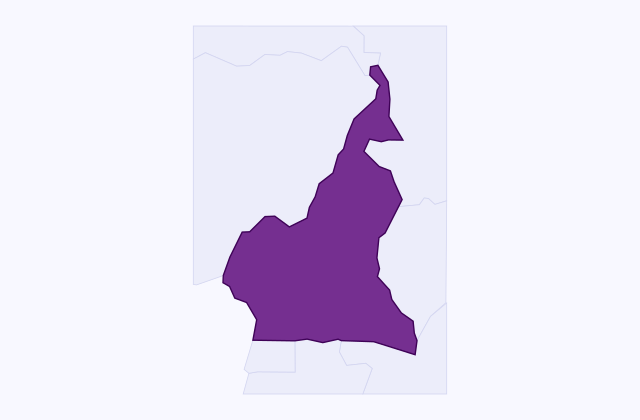
The legal framework
Cameroon punishes relations between persons of the same sex under article 347-1 of the 2016 Penal Code, which provides for six months to five years' imprisonment and a fine; the Code applies throughout the country, in the English-speaking regions as elsewhere. Cameroon is one of the few countries where this provision leads to regular prosecutions, including on the basis of denunciations or of content found on a phone; convictions have been based on messages and photos. There is no recognition of same-sex couples, as marriage or in any other form, and no legal protection against discrimination. A marriage celebrated abroad has no effect whatever in Cameroon: no residence as a spouse, no inheritance, no medical decisions for the partner. The law applies to everyone in the country, foreigners included.
For British-Cameroonian same-sex couples the gap between the two legal systems could hardly be wider. In the UK they can marry — in England, Wales and Scotland since 2014, in Northern Ireland since 2020 — and Ireland has allowed same-sex marriage since 2015; in Cameroon such a marriage is not merely ineffective: if it becomes known, it can expose the Cameroonian partner to prosecution. Cameroon is the case in French-speaking Africa where the gap between the text and its application is narrowest: the number of cases brought before the courts bears no comparison with the Maghreb or Senegal; proceedings almost always start with a denunciation, and private exchanges are frequently the evidence. The FCDO's travel advice for Cameroon states plainly that same-sex sexual acts are illegal there and that same-sex partners have been arrested and prosecuted.
LGBT+ Cameroonians are among those who have sought protection in the UK. Persecution on grounds of sexual orientation can found a claim for refugee status, decided case by case by the Home Office, and the leading judgment concerns a Cameroonian: in HJ (Iran) and HT (Cameroon) v Secretary of State for the Home Department (2010), the Supreme Court held that a gay asylum seeker cannot be refused on the ground that he or she could avoid persecution by concealing his or her sexuality. For British nationals who visit a partner in Cameroon or work there, digital caution is a safety measure: the data on a phone — messages and photos — have been the main source of evidence in Cameroonian cases. The British High Commission in Yaoundé can visit a British national who is detained, keep in touch with the family and provide a list of local lawyers, but it cannot prevent an arrest or a prosecution, nor interfere in the judicial process.
Key points
| Marriage | Not recognised |
|---|---|
| Criminal law | Article 347-1 of the Penal Code: six months to five years' imprisonment and a fine |
| Enforcement | Regular prosecutions, unlike several neighbouring countries |
| Evidence | Convictions based on messages and photos; proceedings usually start with a denunciation |
| Alternative union | None |
| Foreign marriage | No effect in Cameroon: no residence as a spouse, no inheritance, no medical decisions |
| Discrimination | No legal protection |
| Foreigners | The law applies to everyone in the country; consular protection does not prevent an arrest |
| UK and Ireland | Same-sex marriage in England, Wales and Scotland since 2014, Northern Ireland since 2020, Ireland since 2015; refugee status possible for persecution on grounds of sexual orientation (Supreme Court, HJ and HT, 2010) |
In practice
- No union between persons of the same sex can be registered in Cameroon, and a marriage celebrated abroad has no effect there: no residence as a spouse, no inheritance, no medical decisions.
- Couples who want to live together do so in the UK: marriage at a register office, with a visa for the Cameroonian partner — a marriage visitor visa or a family visa as a fiancé(e), under the conditions published on GOV.UK. Before any step with Cameroonian offices (copies of records, registrations, applications), consider whether it would make the relationship visible there.
- Draw up the documents that protect the couple — will, powers of attorney, bank mandates — in the country of residence, usually the UK; in Cameroon they have no reliable value for a same-sex couple.
- Treat digital caution as a safety measure: do not keep on your phone exchanges or images that could expose you, use locking and automatic deletion, and be wary of dating apps and of meetings arranged online with strangers.
- Before travelling, read the FCDO travel advice for Cameroon and GOV.UK's advice for LGBT+ travellers, and keep the contact details of the British High Commission in Yaoundé and of a local lawyer at hand. If arrested, ask for a lawyer and for the High Commission to be informed, and do not sign a statement you have not read.
Cost and coverage
In Cameroon there is nothing to pay for, since no procedure exists to register a union; legal assistance goes through lawyers and associations. In the UK, a marriage carries the register office's notice and ceremony fees, certified translations of Cameroonian documents and, for a partner coming from Cameroon, the visa fee and the immigration health surcharge; a will and lasting powers of attorney add modest fees.
Recent changes
International organisations continue to document arrests and trials under article 347-1, which places Cameroon among the countries where the provision is most actively applied. The FCDO's current travel advice for Cameroon mentions the arrests and prosecutions of same-sex partners. In the UK, same-sex marriage became possible in Northern Ireland in 2020, completing equal marriage across the country.
Where to go
- For British nationals, the British High Commission in Yaoundé: consular assistance, visits in detention, lists of local lawyers; for other foreigners, their own consulate; Irish citizens: Department of Foreign Affairs.
- Regional and international human rights organisations: documentation and support, including from abroad.
- A local lawyer, indispensable as soon as proceedings begin.
- In the UK: the register office for marriage, the Home Office for asylum claims, and organisations supporting LGBT+ asylum seekers such as Rainbow Migration.
Worth knowing
Cameroon is one of the countries where the risk is not theoretical: arrests and convictions are documented every year by human rights organisations, and the law applies to foreigners too. A marriage celebrated in the UK or Ireland gives no protection in Cameroon and may even endanger the Cameroonian partner if it becomes known there. The data on a phone are the main source of evidence — which is why digital caution matters so much.
Frequently asked questions
Can we marry in the UK as a British-Cameroonian same-sex couple?
Yes, at a register office or approved venue, after giving notice, like any other couple; the register office tells you which documents the Cameroonian partner must produce. A partner who lives in Cameroon needs a visa to come and marry: a marriage visitor visa to marry and leave, or a family visa as a fiancé(e) to marry and stay, under the conditions published on GOV.UK. The marriage has full effect in the UK, including for a later spouse visa — and none in Cameroon.
What should I do if my phone is seized in Cameroon?
Ask for a lawyer immediately and, as a foreigner, for your consulate to be informed — for British nationals, the British High Commission in Yaoundé. Phone data have served as the basis for convictions in Cameroon: they are the main source of evidence in these cases, which is also why digital caution matters so much. Do not sign a statement you have not read and understood.
Can my partner claim asylum in the UK if persecuted in Cameroon?
Persecution on grounds of sexual orientation can found a claim for refugee status; the claim is made in the UK and decided by the Home Office case by case. Since the Supreme Court's 2010 judgment in HJ (Iran) and HT (Cameroon), a claimant cannot be refused on the basis that he or she could avoid persecution by hiding his or her sexuality at home. Specialised organisations such as Rainbow Migration help prepare the claim; if you are married, a spouse visa is the more direct route.
Official sources and links
- Services du Premier ministre — official government website — laws and regulations of Cameroon, including the Penal Code (French version)
- British High Commission Yaoundé — consular assistance for British nationals in Cameroon
- GOV.UK — getting married abroad — what is possible for British nationals, by country