
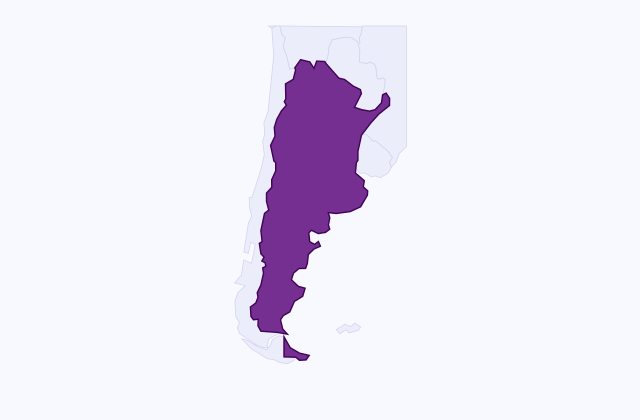
The legal framework
Law 26.618, promulgated on 21 July 2010, amended the Civil Code so that marriage has 'the same requirements and effects whether the parties are of the same or of different sex'. The 2015 Código Civil y Comercial (Civil and Commercial Code) fully integrated it: joint adoption, parentage by voluntad procreacional (the intention to become a parent) for children born through assisted reproduction — both spouses appear on the birth record without adoption —, pensions and family reunification. Law 26.743 on gender identity (2012) allows the registered sex to be changed by simple declaration before the Registro Civil (Civil Registry). Foreigners may marry in Argentina without residence; Buenos Aires is a wedding destination for couples from neighbouring countries that did not allow it.
Argentina opened marriage four years before England, Wales and Scotland, five before Ireland and almost ten before Northern Ireland, and its gender identity law remains one of the most liberal in the world. Buenos Aires — Palermo and San Telmo, the Pride march in November, venues and planners specialising in weddings — is, with São Paulo, the city of the continent where same-sex couples are most visible, and British and Irish couples who live there, or who have an Argentine partner, find full legal equality.
A same-sex marriage celebrated in Argentina is recognised as a marriage throughout the UK and in Ireland, with no registration there. British couples marry under the same procedure as any couple, with their documents apostilled by the FCDO Legalisation Office and translated by an Argentine traductor público (sworn public translator), and the GOV.UK 'marriage abroad' tool lists what else a British national needs. Children born in Argentina through assisted reproduction appear on the birth record with both mothers; how the UK treats the second mother for passports and citizenship depends on UK rules on parenthood, not on the Argentine record, so British families should check with HM Passport Office before travelling.
Key points
| Opening | 21 July 2010 (Law 26.618), the first in Latin America |
|---|---|
| Effects | Identical: joint adoption, parentage by voluntad procreacional, pensions, family reunification |
| Parentage | Both spouses (or cohabiting partners) appear on the birth record of a child born by assisted reproduction with prior informed consent; no adoption |
| Gender identity | Change of registered sex by declaration since 2012 (Law 26.743); treatments covered |
| Foreigners | May marry without residence; the marriage has no value in countries that do not recognise it |
| Figures | More than 30,000 marriages since 2010 |
| Context | Law on the employment quota for travesti and trans people (2021); hate crimes prosecuted |
| UK and Ireland | Recognised as a marriage throughout the UK and in Ireland, without registration; a two-mother birth record and a gender change follow UK rules for UK purposes |
In practice
- The procedure is that of civil marriage (see that page) before any Registro Civil, with an appointment and two witnesses; British partners bring the same apostilled and translated documents as any foreign spouse.
- For children born by assisted reproduction, both members of the couple sign the consent at the medical centre and the birth record is drawn up with both surnames; British parents then check with HM Passport Office how the UK treats the record.
- Foreign couples (Chileans before 2022, Peruvians, Paraguayans…) marry in Buenos Aires with their passports; they must check the effects in their own country — for British and Irish couples, recognition is assured.
- The foreign spouse of an Argentine obtains residence (radicación) as a family member from the Dirección Nacional de Migraciones; an Argentine spouse moving to the UK applies for a family visa like any other spouse.
- Joint adoption follows the general procedure, through the single register of prospective adopters (RUAGA).
Cost and coverage
Those of civil marriage: free during office hours; a fee for ceremonies outside them. UK apostilles are charged per document and sworn translations by the page.
Recent changes
The 2015 Code consolidated parentage by voluntad procreacional; the government elected in 2023 has cut back diversity policies without touching the marriage and gender identity laws. Fifteen years of equal marriage were celebrated in 2025.
Where to go
- Provincial civil registries and that of the City of Buenos Aires.
- Federación Argentina LGBT+ and Comunidad Homosexual Argentina: information and support.
- INADI (National Institute against Discrimination) or its successor bodies: complaints; Dirección Nacional de Migraciones: residence of the spouse.
- British Embassy in Buenos Aires: consular assistance, notarial services, guidance on documents; Irish citizens: Embassy of Ireland in Buenos Aires.
Worth knowing
Argentina offers the most complete protection in the region: marriage, parentage without adoption, gender identity by declaration. Couples from neighbouring countries who marry there must check what their own country will recognise: Chile and Uruguay, everything; Paraguay and Bolivia, nothing. For British and Irish couples the marriage itself raises no difficulty; the points to check are the UK treatment of a two-mother birth record and of a gender change made in Argentina, which follow UK rules rather than Argentine ones.
Frequently asked questions
We are a British same-sex couple: can we marry in Argentina?
Yes, with no residence requirement, on the same terms as any couple: passports, an appointment at the Registro Civil, two adult witnesses, birth certificates and proof of marital status apostilled by the FCDO Legalisation Office and translated in Argentina by a traductor público, plus whatever the GOV.UK 'marriage abroad' tool lists for British nationals. The marriage is valid throughout the UK without any registration there.
Our child was born in Buenos Aires to two mothers — what about the UK?
The Argentine birth record names both mothers, without adoption. For UK purposes, the child is British by descent if the British mother is the birth mother or, under the Human Fertilisation and Embryology Act rules, was married to the birth mother at the time of the treatment; a mother who is herself British by descent cannot usually pass on citizenship automatically to a child born abroad. Passports and citizenship are decided by HM Passport Office and the Home Office: check with them before travelling.
Is our Argentine marriage recognised in Ireland?
Yes: since same-sex marriage was introduced in Ireland in 2015, same-sex marriages celebrated abroad are recognised there as marriages. As in the UK, no registration is needed, but keep the acta de matrimonio with its apostille and a translation. Irish citizens can ask the Embassy of Ireland in Buenos Aires about the documents needed to marry in Argentina.
Official sources and links
- Law 26.618 — equal marriage — official text
- Law 26.743 — gender identity — official text
- Civil and Commercial Code — parentage by assisted reproduction (articles 560-564) — text
- GOV.UK — getting married abroad — documents a British national needs, by country
- argentina.gob.ar — official portal of the Argentine state: procedures, civil registry, migration, health, justice
- Normativa nacional (InfoLeg) — official texts of Argentine laws and decrees
- British Embassy Buenos Aires — gov.uk — consular help, notarial and documentary services for British nationals in Argentina