
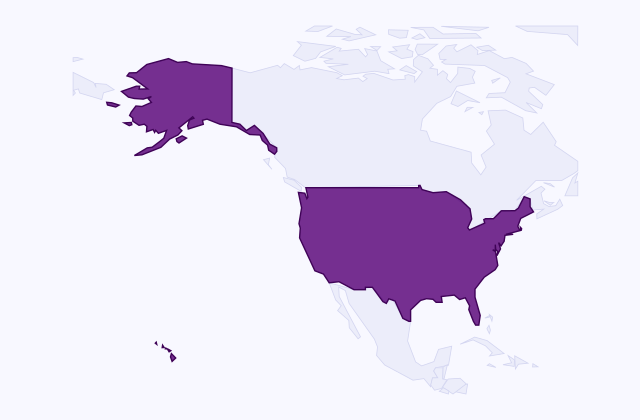
Consent and age of consent
There is no federal age of consent for most purposes. States set ages between 16 and 18, most with close-in-age or 'Romeo and Juliet' provisions. Definitions of consent vary: some states require force or incapacity, while a growing number have adopted affirmative consent standards, particularly for campus disciplinary proceedings under Title IX.
Key points
| Age of consent | 16 to 18 depending on the state |
|---|---|
| Close-in-age exemptions | Common, with varying age gaps |
| Position of authority | Higher ages apply for teachers, coaches, clergy and others in most states |
| Marital rape | Exemptions have been abolished in all states, though some vestigial differences remain |
| Affirmative consent | Adopted in some state laws and in many campus codes |
| Statutes of limitation | Vary widely; many states have extended or removed them for child sexual abuse |
| Civil claims | Lookback windows have allowed historic claims in several states |
| State definitions | Both the age of consent and the definition of the offence vary by state |
| Rape kit backlogs | A recognised problem; several states have tracking systems for survivors |
| Revived windows | Several states have opened lookback windows for historic claims |
In practice
- Ask for the kit tracking number where the state provides one.
- A civil claim is possible even if the prosecutor declines to charge.
Recent changes
A wave of state reforms has extended or removed limitation periods for childhood sexual abuse, opening civil claims that were previously time-barred.
Where to go
- RAINN national sexual assault hotline 800-656-HOPE, 24/7, and online chat.
- Hospital-based SANE programmes for forensic examination.
- State victim compensation programmes.
Worth knowing
In most states a forensic exam is free and does not require you to report to the police. Ask for a SANE nurse specifically — they are trained for this and the quality of the examination matters later. Forensic examination is free under federal law and does not require you to report to the police. Many survivors are told otherwise.
The general article: Consent and age of consent · Compare with another country
Domestic violence
Every state provides civil protection orders, variously called restraining orders, orders of protection or injunctions for protection. Federal law prohibits firearm possession by people subject to qualifying orders or convicted of domestic violence misdemeanours. The Violence Against Women Act funds services and provides immigration protections for abused spouses.
Key points
| Protection orders | Available in every state, often with emergency ex parte orders the same day |
|---|---|
| Firearms | Federal prohibition for qualifying orders and convictions |
| Full faith and credit | Protection orders are enforceable across state lines |
| VAWA immigration relief | Self-petitioning available to abused spouses of citizens and permanent residents, and U visas for crime victims |
| Housing | Protections against eviction for victims in federally assisted housing |
| Custody | Domestic violence is a factor in every state's best-interests analysis |
| Address confidentiality | Programmes in many states allow use of a substitute address |
In practice
- Carry a certified copy of the order when travelling between states.
- If your status depends on an abusive spouse, ask about self-petitioning before anything else.
Cost and coverage
Protection order applications are generally free, and court self-help centres assist with the paperwork. Legal aid and domestic violence clinics provide free representation in many areas.
Recent changes
Enforcement of firearms prohibitions has been the subject of significant litigation, and remains the most consequential federal protection in practice.
Where to go
- National Domestic Violence Hotline 800-799-7233, 24/7, with text and chat.
- StrongHearts Native Helpline 844-762-8483.
- State coalitions against domestic violence, which list local shelters and legal help.
Worth knowing
Protection orders are enforceable in every state, not just the one that issued them. Carry a certified copy and register it in a new state if you relocate. Immigration relief under VAWA does not require the abuser's knowledge or cooperation. Many people stay in dangerous situations believing the opposite.
The general article: Domestic violence · Compare with another country
Female genital mutilation
A federal ban restored by Congress in 2021 after a court struck down the earlier one, plus state laws covering most of the country.
The federal prohibition has a complicated history: a 2018 federal court decision held the original statute unconstitutional on federalism grounds, and Congress responded by re-enacting it on a firmer basis. The federal law covers performing FGM and knowingly transporting a girl for that purpose. Most states also have their own statutes, and many explicitly cover taking a child out of state or abroad.
The federal picture changed twice in a few years. A federal court struck down the original 1996 ban in 2018 on the ground that Congress had exceeded its powers; Congress responded with the STOP FGM Act of 2020, signed in January 2021, which re-enacted the prohibition on a firmer constitutional footing and expanded it. Most but not all states have their own laws, so where the conduct happens still matters.
Key points
| Federal law | Re-enacted after a 2018 ruling struck down the earlier statute |
|---|---|
| Vacation cutting | Transporting a girl for FGM is expressly covered |
| State laws | The large majority of states have their own prohibitions |
| Consent | Not a defence |
| Reporting | Mandatory child abuse reporting laws apply in every state |
| Affected population | Estimated in the hundreds of thousands, concentrated in a few metropolitan areas |
| Care | Specialist clinics exist in several major cities |
In practice
- Check your state's statute as well as the federal one: several go further, including on travel.
- Mandatory reporting laws apply to teachers, clinicians and social workers in every state.
- Specialist clinics in several cities provide deinfibulation and counselling.
- If a child may be taken abroad, contact child protective services and consider a court order.
Cost and coverage
Costs depend on insurance; community clinics and some specialist services operate on a sliding scale.
Where to go
- State child protective services.
- Specialist FGM clinics in major metropolitan areas.
- Community advocacy organisations working with affected diasporas.
Worth knowing
The patchwork means protection depends on where you live. Federal law covers transport for the purpose of FGM, which is the provision most often relevant in practice.
Frequently asked questions
Is FGM a federal crime in the United States?
Yes. The STOP FGM Act, signed in January 2021, restored and strengthened the federal offence after the earlier statute was struck down in 2018. It also covers transporting a girl out of the country for the purpose — so-called vacation cutting.
Do state laws still matter?
Yes. Most states have their own prohibitions, and several go further than the federal statute, for example by extending the limitation period or by adding civil remedies. A handful of states still have no specific law, in which case general assault and child-abuse provisions apply.
The general article: Female genital mutilation · Compare with another country
Sexual offences committed abroad
The PROTECT Act allows prosecution of citizens and residents for illicit sexual conduct abroad, with penalties up to thirty years.
Federal law makes it an offence for a United States citizen or lawful permanent resident to travel abroad and engage in illicit sexual conduct with a minor, or to travel with that intent. Dual criminality is not required. Registered sex offenders must notify intended international travel, and passports issued to certain offenders carry an endorsement.
The PROTECT Act allows prosecution of United States citizens and lawful permanent residents who travel abroad and engage in illicit sexual conduct with a minor, with no requirement that the conduct be criminal where it occurred, and it also criminalises arranging such travel for commercial purposes. International Megan's Law added passport identifiers and advance notification to destination countries for certain registered offenders.
Key points
| Basis | Federal law on illicit sexual conduct in foreign places |
|---|---|
| Who is covered | US citizens and lawful permanent residents |
| Penalty | Up to thirty years' imprisonment |
| Dual criminality | Not required |
| Travel notification | Required from registered offenders before international travel |
| Passport endorsement | Applied to certain convicted offenders |
| Reporting | Homeland security investigations tip line and the national centre's cybertipline |
In practice
- Report through the federal tip line; it accepts reports about conduct abroad.
- Intent alone can be an offence: travelling for that purpose is prosecutable even if nothing occurred.
- A witness abroad can report without being a victim and without a full identification.
- Convictions have followed reports made by hotel staff and fellow travellers.
Where to go
- Homeland Security Investigations tip line.
- National Center for Missing & Exploited Children — CyberTipline.
- Nearest US embassy or consulate.
- FBI, for related offences.
Frequently asked questions
What does the PROTECT Act cover?
Travel by a citizen or lawful permanent resident with intent to engage in illicit sexual conduct with a minor, and the conduct itself when it occurs abroad, with substantial penalties. It also reaches those who arrange or facilitate such travel for commercial purposes.
Sources
- NCMEC CyberTipline — national reporting line, accepts reports about conduct abroad
- Homeland Security Investigations tip line — federal tip line
The general article: Sexual offences committed abroad · Compare with another country
General sources
- USA.gov — official guide to government services
- Congress.gov — federal legislation