
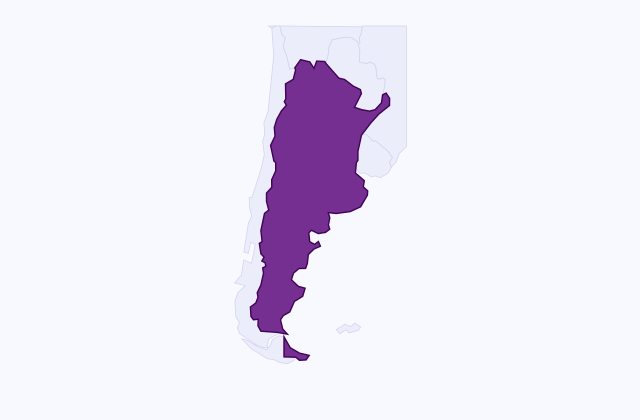
The legal framework
Law 23.737 (1989) punishes trafficking with 4 to 15 years, simple possession (tenencia simple) with 1 to 6 years, and possession for personal use (tenencia para consumo personal) with 1 month to 2 years, which can be replaced by treatment (article 14, second paragraph). In 2009, in the Arriola judgment, the Supreme Court held that punishing possession for personal use in private, without harm to third parties, violates article 19 of the Constitution, and the federal courts apply that doctrine case by case, although the law has not been reformed and arrests for possession still run to tens of thousands a year. Law 27.350 (2017) regulated the medical use of cannabis, and Decree 883/2020 created the REPROCANN, a register that authorises patients and 'solidarity growers' (cultivadores solidarios) to grow up to nine plants and to carry up to 40 grams; Law 27.669 (2022) created the medical cannabis and hemp industry, with its regulatory agency (ARICCAME). Recreational cannabis is not regulated. Law 24.788 (1997) prohibits the sale of alcohol to under-18s; Law 27.714 (2023) set a zero blood alcohol limit on national roads, adopted by most provinces (previously 0.5 g/l, 0.2 for motorcyclists and zero for professional drivers); Law 27.302 (2016) increased the penalties for trafficking in precursor chemicals. The Sedronar (the national secretariat for drug policy) coordinates prevention and treatment.
The Argentine paradox — a law that punishes use, a Supreme Court that forbids punishing it — has no equivalent in the UK or Ireland, where possession of cannabis remains an offence even at home (in the UK a class B drug, with up to five years' imprisonment). In practice, a discreet user in Buenos Aires risks little more than an unpleasant police check; a user in the street, especially if young and poor, risks arrest, a trip to the police station and proceedings dropped months later. The REPROCANN, with its hundreds of thousands of registrations, has become in practice the legal gateway to growing cannabis — but through an Argentine doctor: a UK prescription for cannabis-based medicine, available from specialists in the UK since 2018, is of no use in Argentina, and bringing cannabis into the country, even with a foreign prescription, exposes the traveller to prosecution for trafficking.
For British and Irish residents and visitors, two practical rules. Argentine law applies to them as to everyone, and the British Embassy in Buenos Aires can neither obtain anyone's release nor intervene in the proceedings: it can visit a detained national, inform the family and provide a list of lawyers; Irish citizens turn to the Embassy of Ireland in Buenos Aires. And the zero alcohol limit, now the rule in almost the whole country, catches out drivers used to 0.8 g/l in England and Wales or 0.5 in Scotland and Ireland: a single beer or glass of wine is enough. Trafficking, for its part, leads to heavy sentences and long pre-trial detention, notably for those arrested at Ezeiza and Córdoba airports.
Key points
| Possession for personal use | 1 month to 2 years (Law 23.737, article 14); unconstitutional in private without harm to third parties (Supreme Court, Arriola 2009); law not reformed |
|---|---|
| Trafficking | 4 to 15 years; simple possession 1 to 6 years |
| Medical cannabis | Law 27.350 (2017); REPROCANN: authorised growing (up to nine plants, 40 g carried) for patients and solidarity growers |
| Recreational cannabis | Not regulated; bills stalled |
| Alcohol | No sale to under-18s; zero blood alcohol on national roads and in most provinces (Law 27.714, 2023); 0.5 g/l where provinces have not adopted it |
| Figures | 8 % of adults used cannabis in the past year (Sedronar 2022); alcohol is the most problematic substance; high cocaine use in the Southern Cone |
| British and Irish nationals | Argentine law applies; consular visits and lists of lawyers, no intervention in proceedings; a UK cannabis prescription is not valid; zero alcohol at the wheel against 0.8 g/l (England and Wales) or 0.5 (Scotland, Ireland) |
In practice
- Possession of small amounts in private should not lead to a conviction since Arriola, but arrest, transfer to the police station and proceedings are common, especially in public places: the federal public defence service invokes the ruling systematically. If you are arrested, sign nothing without a lawyer and ask for the British Embassy (or, for Irish citizens, the Embassy of Ireland) to be informed.
- Patients with a medical indication register with the REPROCANN (online, with a participating doctor) to grow, or to be linked legally to a solidarity grower; registration was tightened in 2024.
- With the zero limit in most of the country, a single drink before driving is an infringement (fine, impounding of the vehicle and withdrawal of the licence, a UK or Irish licence included); check the provincial rule. Checks are frequent on the roads out of Buenos Aires and on the coast roads in summer.
- The Sedronar (line 141, free, 24 hours) refers people to public treatment centres and to the Casas de Atención y Acompañamiento Comunitario (community care and support centres); private therapeutic communities are regulated.
- Intercambios, ARDA and RESET work on harm reduction and test substances at festivals. Never carry a parcel or a suitcase for someone else through an Argentine airport: trafficking carries 4 to 15 years.
Cost and coverage
Treatment is free in the public network and covered by obras sociales (health insurance funds) under Law 26.657 on mental health; REPROCANN registration is free; drink-driving fines run from 30,000 to 300,000 pesos depending on the province. The federal public defence service is free; the British Embassy does not pay legal costs, fines or bail.
Recent changes
Law 27.714 (2023) imposed zero blood alcohol nationwide; the REPROCANN passed 300,000 registrations; the government elected in 2023 has hardened its tone, restricted the REPROCANN in 2024 and scaled back the Sedronar without reforming Law 23.737; the Supreme Court maintains Arriola.
Where to go
- Sedronar — line 141 (24 hours, free): guidance and treatment.
- REPROCANN (argentina.gob.ar/reprocann): medical cannabis register.
- Defensoría General de la Nación (the federal public defence service): defence in possession cases; Intercambios Asociación Civil and RESET: information and harm reduction.
- British Embassy in Buenos Aires: consular support for detained British nationals; Irish citizens: Embassy of Ireland in Buenos Aires; Prisoners Abroad (UK) and the Irish Council for Prisoners Overseas: support for prisoners and their families; Talk to Frank in the UK.
Worth knowing
The Arriola ruling protects you in court, not in the street: possession remains an offence on the statute book, and the police arrest for it. The REPROCANN gives patients legal certainty, but growing without registration is potential trafficking. And zero alcohol applies in almost the whole country: one drink is enough — for a British or Irish driver, it is the most tangible change.
Frequently asked questions
Is smoking a joint legal in Buenos Aires?
Neither fully legal nor really punished: possession for personal use remains an offence in the law, but the Supreme Court forbids punishing it when it takes place in private without harm to third parties. In the street or in a park the police may arrest you and open proceedings, which are almost always dropped; at home nobody prosecutes. Buying, on the other hand, feeds a trade punished with 4 to 15 years, and the seller risks far more than the buyer. Note the contrast with home: in the UK and Ireland, possession is an offence even in private.
What does a British national arrested with drugs at the airport risk?
It depends on the quantity and on how the case is classified: a few grams for personal use fall under Arriola and usually end with the case being dropped; a quantity intended for trafficking, or an attempt to take drugs out of the country, leads to pre-trial detention and then to a sentence of 4 to 15 years, as for anyone. The British Embassy can visit you, inform your family and provide a list of lawyers, but cannot obtain your release, interfere in the case or pay your legal costs; the charity Prisoners Abroad supports British nationals detained overseas and their families.
What is the drink-driving limit in Argentina?
Zero on all national roads since 2023 and in most provinces, which have adopted Law 27.714; 0.5 g/l (0.2 for motorcyclists, zero for professional drivers) in the few provinces that have not yet done so. That is stricter than anywhere in the UK or Ireland — 0.8 g/l in England and Wales, 0.5 in Scotland and Ireland. Checks are frequent on the roads out of Buenos Aires and on the coast in summer; the fine comes with the impounding of the vehicle and the withdrawal of the licence, including a UK or Irish licence.
Official sources and links
- Law 23.737 — narcotics — official text
- Supreme Court — Arriola judgment (2009) — case law
- Sedronar — REPROCANN and line 141 — official information
- British Embassy Buenos Aires — consular assistance for detained British nationals
- argentina.gob.ar — official portal of the Argentine state: procedures, civil registry, migration, health, justice
- Normativa nacional (InfoLeg) — official texts of Argentine laws and decrees
- British Embassy Buenos Aires — gov.uk — consular help, notarial and documentary services for British nationals in Argentina