
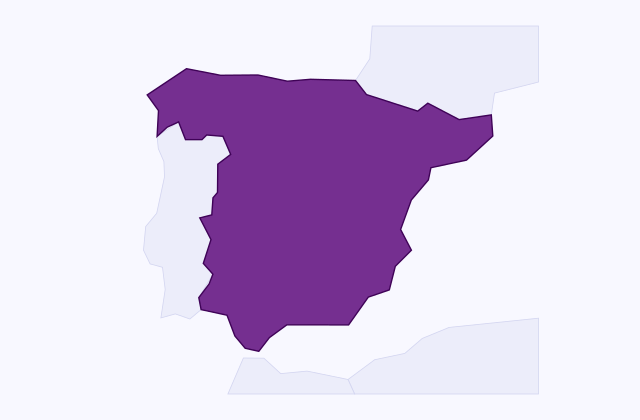
The legal framework
Law 13/2005 amended article 44 of the Civil Code: marriage has the same requirements and effects whether the spouses are of the same or different sex. Spain was the third country in the world to open it, with every effect: joint adoption, parentage (the mother's wife is the parent of a child born by assisted reproduction by consent before the Civil Registry, article 7.3 of Law 14/2006), survivor's pension, family reunification, nationality. The Constitutional Court upheld the law in 2012 (judgment 198/2012). Foreigners may marry in Spain if one of the two resides in the country, even if their national law does not allow it (Directorate-General of Registries resolution, 2005). Law 4/2023 (the 'trans law') and Organic Law 3/2007 complete the protection against discrimination; legal gender is changed by declaration since 2023.
Spain opened marriage nine years before England and Wales and remains one of the most accepting societies in Europe: Sitges, Torremolinos, Maspalomas and Madrid's Chueca are long-standing destinations, and British same-sex couples have married and retired along the coasts for two decades. Equality is complete on paper and in practice, including for parentage of children born to two mothers.
A same-sex marriage celebrated in Spain is fully recognised in the UK. A British couple resident in Spain marries there like any other couple (certificate of no impediment from the UK register office, apostilled and translated); a UK civil partnership gives no marital rights in Spain, so couples who hold one often marry. Children born in Spain to two married mothers are registered with both from birth; the UK recognises that birth certificate.
Key points
| Opening | 3 July 2005 (Law 13/2005) |
|---|---|
| Effects | Identical to opposite-sex marriage: joint adoption, parentage, pensions, reunification, nationality |
| Parentage | Two mothers by consent before the Civil Registry for children born by assisted reproduction (married or not since 2015); two fathers only by adoption |
| Foreigners | May marry in Spain if one of them resides in the country, even where their national law forbids it |
| Recognition | Recognised throughout the EU for residence (Coman) and in the UK; not in countries that do not admit it |
| Figures | About 4,000 to 5,000 marriages a year, 3 % of the total; more than 70,000 since 2005 |
| Context | Law 4/2023 against discrimination; aggravated hate crimes; legal gender by declaration since 2023 |
In practice
- The procedure is that of civil marriage (see that page): file at the Civil Registry, before a notary or court clerk, and ceremony before the mayor, justice of the peace, notary or clerk.
- For a couple of women, the parentage of a child born by assisted reproduction is registered with the wife's consent before the Civil Registry, without adoption.
- For a couple of men, parentage passes through adoption or, for children born by surrogacy abroad, through registration of the foreign judgment, under strict Supreme Court criteria (2022 and 2024).
- Foreign couples whose country does not recognise the marriage should know that their Spanish marriage will not be valid there; within the EU and the UK it is.
- Marriage to a Spaniard gives the foreign spouse the EU family-member card and, after one year of residence, the possibility of nationality.
Cost and coverage
Those of civil marriage: free at the Civil Registry and most town halls; 150 to 300 euros before a notary.
Recent changes
Law 4/2023 strengthened protection against discrimination and allowed parentage for unmarried female couples; the Supreme Court's 2022 judgment on surrogacy tightened the requirements for registering children born abroad. Twenty years of equal marriage were celebrated in 2025.
Where to go
- Civil Registry, town halls and notaries: marriage.
- Ministry of Equality — Directorate-General for Sexual Diversity and LGTBI Rights.
- FELGTBI+ (Spanish federation of LGTBI associations): information and support.
- British consulates: documents for marriage (certificate of no impediment is obtained in the UK).
Worth knowing
Spain marries foreign same-sex couples if one of them lives in the country, but the marriage will have no effect in countries that do not recognise it. For British couples there is no issue: both countries recognise each other's marriages. The one area of divergence is surrogacy, banned in Spain and lightly regulated in the UK: children born abroad by surrogacy are registered in Spain only under strict conditions.
Frequently asked questions
We are a British same-sex couple: can we marry in Spain?
Yes, if at least one of you is registered as resident (empadronado) in a Spanish municipality, with the same documents as any couple: UK certificate of no impediment, birth certificate, proof of marital status, all apostilled and translated by a sworn translator. The marriage is fully valid in the UK without any registration there.
Is our UK civil partnership worth anything in Spain?
Very little: it is not a marriage and Spain has no national civil partnership. For pensions, tax and inheritance you are treated as unmarried; some regional registers of unmarried couples accept it as proof of a stable relationship. Converting it into a marriage in the UK, or marrying in Spain, gives full marital rights.
Our child was born in Spain to two mothers — what about the UK?
The Spanish birth certificate naming both mothers is accepted in the UK for passports and citizenship purposes when at least one mother is British; the child is British by descent if the British mother is the birth mother or was married to her at the time of the treatment, under the Human Fertilisation and Embryology Act rules. Check with the passport office before travelling.
Official sources and links
- Law 13/2005 — same-sex marriage — BOE
- Constitutional Court — judgment 198/2012 — text
- Ministry of Equality — LGTBI rights — official portal
- Administración General del Estado — administracion.gob.es — official portal of Spanish public services, with pages in English
- Boletín Oficial del Estado (BOE) — Spanish legislation, official and consolidated texts
- British Consulates in Spain — gov.uk — living in Spain guide, consular help, lists of English-speaking lawyers