
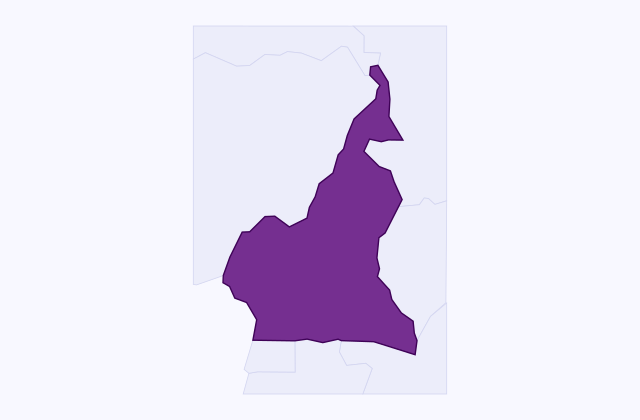
The legal framework
The Code pénal punishes violence (violences) and harassment (harcèlement), and the support of victims rests above all on centres d'écoute (listening and support centres) run by associations and on the social services. As throughout the region, the main difficulty is not a lack of rules but practical access to help: the courts are often far away, the medical certificate (certificat médical) costs money, the family and the community put pressure on the victim, and there are few shelter places, most of them provided by associations. A complaint (plainte) is made to the police, to the gendarmerie or, where they exist, to specialised units. The medical certificate is the decisive piece of evidence and should be obtained as early as possible: the first 72 hours count for the record of injuries and, after sexual violence, for preventive treatment against HIV. Recent texts provide for protection measures (mesures de protection) for victims, but their application varies from one place to another. Where children are involved, the social services or the juge des enfants (children's judge) can be asked to act, and the brigades de protection des mineurs (units for the protection of minors) deal with situations involving children. In practice the most effective entry point is the health centre, then the association; the police often come afterwards. The Penal Code is a national text: it applies in the English-speaking North-West and South-West regions as in the rest of the country, whatever the victim's nationality.
For anyone who suffers violence from a partner in Cameroon — a Cameroonian woman, or a British or Irish woman living there with a Cameroonian partner — the law and the practical route are the same. First the health facility, within 72 hours if possible: the injuries are recorded there, a written certificate is issued and, after sexual violence, preventive HIV treatment is started. Then an association or a centre d'écoute: associations often obtain the certificate free of charge, know the magistrates, the doctors and the shelter places available, and accompany the complaint and the proceedings — whether a case reaches its conclusion depends heavily on that support. British nationals can also turn to the British High Commission in Yaoundé or, at any hour, to the FCDO in London: consular staff can provide lists of local lawyers and interpreters, help to contact the family and UK support services and issue an emergency travel document if a passport has been lost or stolen, but they cannot intervene in Cameroonian proceedings or pay medical, hotel or legal bills; Irish citizens contact the Department of Foreign Affairs. The FCDO advises against all travel to the North-West region and to most of the South-West, and says that the High Commission can offer only limited support in areas where it advises against travel: there, every journey to a health facility, an association or a court takes longer. An English speaker may also need an interpreter in the French-speaking parts of the country — another reason to be accompanied.
In the UK, Cameroonians — students, workers, spouses and families settled for a generation, many of them from the English-speaking regions — have the same protection as any other victim, whatever their nationality or immigration status. In an emergency the police (999) intervene. In England and Wales the Family Court can make a non-molestation order, which bans contact and approaches, quickly and without notice to the abuser where there is a risk, and an occupation order, which decides who lives in the home (Family Law Act 1996); breaching a non-molestation order is a criminal offence, and the Domestic Abuse Act 2021 defines abuse broadly, economic abuse included. The National Domestic Abuse Helpline (0808 2000 247) answers free of charge, 24 hours a day, with interpreters, and refuges take in women with their children; in Ireland, safety and barring orders are granted by the District Court and Women's Aid runs a national helpline. A partner whose UK visa rests on a relationship with a British citizen or a person settled in the UK, and whose relationship has broken down because of domestic abuse, may be able to settle in his or her own right; the Migrant Victims of Domestic Abuse Concession gives permission to stay, with access to benefits for those who are eligible, while the settlement application is made — within three months. Take advice from a specialist organisation or a regulated immigration adviser before speaking to the Home Office, and gather the evidence: certificates, police reports and court decisions, from both countries. A Cameroonian protection measure is not recognised automatically in the UK or Ireland: it is quicker to apply for an order there and to produce the Cameroonian certificates and complaints, translated if they are in French, as evidence. And where there are children, neither parent should take them across the border without the other's consent or a court decision: taking a child under 16 out of the UK without the consent of everyone with parental responsibility or the court's permission is an offence in England and Wales, and whether the 1980 Hague Convention on child abduction can be used between the UK and Cameroon is a question for the International Child Abduction and Contact Unit (ICACU).
Key points
| Law | Code pénal: violence and harassment punished; applies throughout the country, the English-speaking regions included |
|---|---|
| Complaint | Police, gendarmerie, or specialised units where they exist |
| Medical certificate | The decisive evidence; to be obtained as early as possible; often charged for, frequently free through an association |
| Protection measures | Provided by recent texts, applied unevenly |
| Shelter | Few places, provided mainly by associations |
| Children | Social services or juge des enfants; brigades de protection des mineurs |
| Most effective entry point | The health centre, then the association: the police often come afterwards |
| 72 hours | Record of injuries and HIV prophylaxis |
| British and Irish nationals | Same rights in Cameroon; consular support from the British High Commission in Yaoundé (limited where the FCDO advises against travel), no intervention in proceedings; in the UK, non-molestation and occupation orders, National Domestic Abuse Helpline 0808 2000 247, settlement in one's own right for partners who are victims of domestic abuse; Cameroonian measures not recognised automatically |
In practice
- Go to a health centre or a hôpital de district (district hospital) within 72 hours: the injuries are recorded and, if necessary, preventive HIV treatment is started; ask for a written certificate and keep a copy away from home.
- Contact an association or a centre d'écoute: they often obtain a free certificate and accompany the complaint and the proceedings — the outcome depends heavily on it.
- Build a written file: certificates, dated photographs, names of witnesses.
- Put the essential documents in a safe place — passports, residence permits, birth and marriage certificates (copies intégrales, full certified copies) — or leave copies with someone you trust, and arrange a place to stay with relatives or friends.
- If there is a risk that the partner will take the children, tell their school; the social services or the juge des enfants can be asked to act.
- British nationals contact the British High Commission in Yaoundé or the FCDO (+44 20 7008 5000) for lists of lawyers and interpreters, contact with UK services and, if needed, an emergency travel document; Irish citizens contact the Department of Foreign Affairs.
- In the UK: in danger, call 999; for advice, the National Domestic Abuse Helpline (0808 2000 247, free, 24 hours); apply to the Family Court for a non-molestation order, for which legal aid may be available; anyone whose visa depends on the relationship should take specialist immigration advice before separating if possible, and in any case before contacting the Home Office.
Cost and coverage
In Cameroon a complaint is free; the medical certificate often has to be paid for — a real obstacle — but associations frequently obtain it free of charge. Add the journeys to the health facility, the police and the court, which can be far away outside the cities, and any lawyer's fees. Consular support is free, but the FCDO does not pay medical, hotel or legal bills, and an emergency travel document is charged for. In the UK the police, the National Domestic Abuse Helpline and the advice of refuges and specialist services are free, and legal aid may be available for a protective order; an application to settle as a victim of domestic abuse carries a Home Office fee, which is waived for applicants who show that they are destitute.
Recent changes
The Maputo Protocol and the national plans against violences basées sur le genre (gender-based violence) form the common framework of the region; the most visible progress concerns the guichets uniques (one-stop centres) that bring health care, police and legal support together. In the UK, the Domestic Abuse Act 2021 created a statutory definition of domestic abuse that includes economic abuse, and the UK ratified the Council of Europe's Istanbul Convention on violence against women in 2022; Ireland had ratified it in 2019.
Where to go
- Centres d'écoute and women's rights associations.
- Social services of the communes, centres de promotion de la femme (women's advancement centres) and cliniques juridiques (law clinics).
- Hôpitaux de district and health centres: certificate and care.
- Police and gendarmerie; the brigades de protection des mineurs where children are involved.
- British High Commission in Yaoundé and the FCDO (+44 20 7008 5000): consular support, lists of lawyers and interpreters; in the UK, the police (999), the National Domestic Abuse Helpline (0808 2000 247), refuges and, for children, the ICACU; in Ireland, Women's Aid; Irish citizens abroad: Department of Foreign Affairs.
Worth knowing
Where public services are weak, associations are often the fastest route to real protection: they know the magistrates, the doctors and the shelter places available. Go first to the health facility, within 72 hours if possible, and then have yourself accompanied. And where there are children, do not take them between Cameroon and the UK without the other parent's agreement or a court decision: take advice first, from an association, a clinique juridique or a lawyer — otherwise the violence you have suffered risks disappearing behind an accusation of abduction.
Frequently asked questions
I am British, I live in Douala and my partner is violent — where can I get help?
First go to a health centre or a hôpital de district, within 72 hours if possible: the injuries are recorded and, after sexual violence, preventive HIV treatment is started; ask for a written certificate. Then contact a women's rights association or a centre d'écoute: it often obtains a free certificate, knows the shelter places available and accompanies you to the police or the gendarmerie to make a complaint. The British High Commission in Yaoundé, or the FCDO at any hour, can give you lists of English-speaking lawyers and interpreters, put you in touch with UK services and issue an emergency travel document if your passport has been lost or stolen, but it cannot intervene in the proceedings. You can also call the National Domestic Abuse Helpline in the UK for advice.
I am Cameroonian, I live in the UK on a spouse visa and my husband is violent — will I lose my right to stay if I leave him?
Not necessarily. If your visa rests on your relationship with a British citizen or a person settled in the UK and the relationship has broken down because of domestic abuse, you may be able to apply to settle in your own right; the Migrant Victims of Domestic Abuse Concession gives you permission to stay, with access to benefits if you are eligible, while you make that application, which must follow within three months, and the fee is waived if you are destitute. See a specialist organisation or a regulated immigration adviser first, and gather evidence such as medical certificates, police reports and court orders. Your safety comes first: 999 in danger, the National Domestic Abuse Helpline (0808 2000 247), a refuge place and a non-molestation order from the Family Court.
Can I go back to the UK with our children?
Alone, yes, at any time. With the children, only with the other parent's agreement or a court decision: otherwise you risk being treated, in a later dispute, as the parent who abducted them, and your situation as a victim slips into the background. Take legal advice before leaving — from a lawyer in Cameroon (the British High Commission has lists), an association or a clinique juridique; the juge des enfants can be asked to act. In the UK, the ICACU can tell you whether the 1980 Hague Convention applies between the UK and Cameroon. Keep certificates, complaints and photographs: they will show later why you had to leave.
Is a Cameroonian protection measure valid in the UK?
Not automatically: there is no automatic recognition between Cameroon and the UK or Ireland. In England and Wales, apply to the Family Court for a non-molestation order under the Family Law Act 1996, producing the Cameroonian certificates, complaints and any decision, with an English translation if they are in French; it can be made quickly, without notice to the abuser where there is a risk. In Ireland the equivalents are safety and barring orders from the District Court. Conversely, a UK order can serve in Cameroon as evidence in support of a complaint or a request for protection.
Official sources and links
- Services du Premier ministre — official government website — laws and regulations of Cameroon, including the Penal Code (French version)
- GOV.UK — settlement for victims of domestic violence or abuse — eligibility, Migrant Victims of Domestic Abuse Concession, fee waiver
- British High Commission Yaoundé — consular assistance for British nationals in Cameroon