
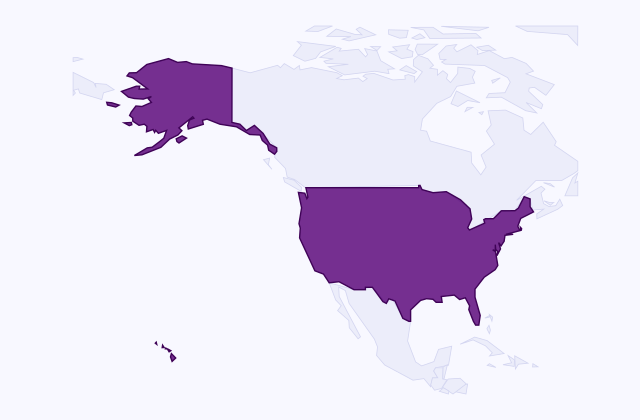
The legal framework
American assisted reproduction is largely self-regulated. The Fertility Clinic Success Rate and Certification Act of 1992 requires clinics to report outcomes, which the CDC publishes; the FDA regulates the screening and testing of donated tissue; the American Society for Reproductive Medicine and the Society for Assisted Reproductive Technology issue practice guidelines that most clinics follow voluntarily. Eligibility, donor compensation, embryo disposition and surrogacy are matters of state law and of contract.
The CDC and SART data are the American patient's real advantage. Every clinic's outcomes are reported by age band and cycle type. The catch is that clinics can improve their numbers by declining difficult patients, so a very high success rate can mean very selective intake — worth asking about directly.
Compensated donation makes the United States the largest market in the world for eggs and sperm, with waiting times measured in weeks rather than years. It also means donor selection is a consumer experience, with photographs, education and profiles, which sits uneasily with how the rest of the world regulates the field.
Donor anonymity has effectively collapsed. Consumer DNA testing means that any donor-conceived person who tests will, sooner or later, find relatives. Reputable banks now operate open-identity programmes, and promising anonymity to a donor today is a promise nobody can keep.
Same-sex couples: access depends on the clinic and on insurance rather than on the law; several state infertility mandates were written around heterosexual infertility and have been amended. Surrogacy is a matter of state law, from well-regulated to prohibited.
Key points
| Federal law | Fertility Clinic Success Rate and Certification Act 1992; FDA donor screening rules |
|---|---|
| Eligibility | Not regulated federally; set by clinic policy and state law |
| Data | CDC and SART publish clinic-level outcomes |
| Donation | Compensated; a genuine market, unlike most of Europe |
| Insurance | Mandates in roughly twenty states, with widely different scope |
| Surrogacy | Permitted and well developed in several states, prohibited or unenforceable in others |
In practice
- Check your insurance first: whether fertility treatment is covered, and whether your state has a mandate, changes the whole calculation.
- Compare clinics using the CDC and SART reports for your age band rather than clinic marketing.
- Complete the work-up, then agree a written treatment plan with itemised costs including medication.
- For donor or surrogacy arrangements, instruct a lawyer experienced in reproductive law in the relevant state.
- Decide in writing what happens to stored embryos on divorce, separation or death — courts enforce these clauses.
Cost and coverage
A fresh IVF cycle costs $15,000 to $25,000 including medication, which alone runs $4,000 to $7,000. Egg donation adds $20,000 to $45,000 once donor compensation and agency fees are counted; a gestational surrogacy arrangement runs $100,000 to $200,000. Around twenty states mandate some insurance coverage, but the definitions and exclusions vary enormously.
Recent changes
State court decisions on the legal status of embryos, and the resulting uncertainty for clinics in some states, have made written embryo disposition agreements and the choice of state materially more important than they were.
Where to go
- CDC ART Success Rates report and the SART clinic finder
- American Society for Reproductive Medicine, for patient guidance
- RESOLVE, the National Infertility Association, for advocacy and insurance information
- Licensed sperm and egg banks, and FDA-registered tissue establishments
- Academy of Adoption and Assisted Reproduction Attorneys, for legal referrals
Worth knowing
Multi-cycle and refund packages shift risk but rarely save money overall; read the exclusions, which usually remove the patients most likely to need the refund.
Frequently asked questions
Is IVF covered by insurance in the United States?
Sometimes. Around twenty states mandate some coverage, the scope differs greatly, and many plans exclude it entirely.
How much does a cycle cost?
$15,000 to $25,000 including medication for a fresh IVF cycle; donor egg and surrogacy arrangements cost far more.
How do I compare clinics?
Through the CDC and SART reports, by age band — while asking each clinic about its intake criteria, since selectivity inflates results.
Are donors anonymous?
In practice, no. Consumer DNA databases have made anonymity unenforceable, and reputable banks now run open-identity programmes.
How do I become an egg or sperm donor?
Through a licensed bank or clinic, which applies FDA screening rules. Compensation is lawful and varies widely by programme and region.
Official sources and links
- USA.gov — official guide to government services
- Congress.gov — federal legislation