
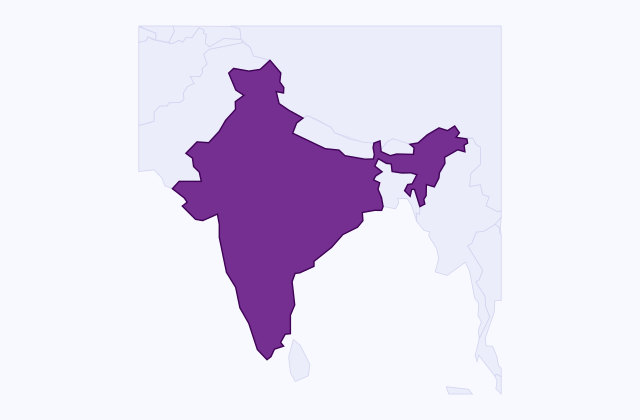
The legal framework
India has two parallel systems. The Juvenile Justice (Care and Protection of Children) Act 2015, with the Adoption Regulations made by the Central Adoption Resource Authority, is secular and open to everyone; it channels every adoption through the CARINGS online portal. The Hindu Adoptions and Maintenance Act 1956 allows Hindus, Buddhists, Jains and Sikhs to adopt directly, with full filiation. For Muslims, Christians and Parsis outside the JJ Act, the Guardians and Wards Act 1890 provides guardianship without parentage.
The mismatch is stark. Tens of thousands of prospective parents are registered on CARINGS against a few thousand legally free children, so waiting times for a healthy infant run to three or four years. The children who wait, meanwhile, are older children and children with special needs, for whom the immediate-placement list is short.
Legally free is the key concept. A child in an institution is not adoptable until the Child Welfare Committee has declared them legally free for adoption, after tracing efforts and the statutory waiting period. Many children spend years in care because that declaration was never sought.
For non-resident Indians and overseas citizens, CARA runs a separate priority stream. NRIs are treated on a par with resident Indians in the seniority list, while foreign nationals rank after them — a rule that materially changes the waiting time depending on passport and status.
Same-sex couples: the Supreme Court declined to recognise same-sex marriage in Supriyo (October 2023), and joint adoption is not available to same-sex couples; adoption by a single person is.
Key points
| Statutes | Juvenile Justice Act 2015 and Adoption Regulations; Hindu Adoptions and Maintenance Act 1956; Guardians and Wards Act 1890 |
|---|---|
| Authority | Central Adoption Resource Authority (CARA), through the CARINGS portal |
| Registration | Mandatory online registration of prospective adoptive parents |
| Age criteria | Composite age of the couple determines the age of the child they may adopt |
| Single applicants | Permitted; single men may not adopt a girl child |
| Hague Convention | Party since 2003 |
In practice
- Register on the CARINGS portal and upload the required documents.
- Undergo the home study report prepared by a Specialised Adoption Agency.
- Wait for a referral: the system matches registered parents with legally free children in seniority order.
- Accept the referral within the prescribed period, then meet the child and sign the acceptance.
- Obtain the adoption order — since 2022 from the District Magistrate rather than the court — and the new birth certificate.
Cost and coverage
Domestic adoption through CARA costs a fixed child-care corpus fee of a few tens of thousands of rupees plus the home study fee. Intercountry adoption costs around USD 5,000 to 7,000 in Indian fees, plus the foreign agency's charges and travel. Indian law provides maternity benefit of twelve weeks to a mother adopting a child below three months of age.
Recent changes
The Juvenile Justice (Amendment) Act 2021, in force from 2022, transferred the power to make adoption orders from civil courts to District Magistrates, with the aim of cutting delays; implementation has been uneven and waiting times for domestic adopters remain long.
Where to go
- Central Adoption Resource Authority, New Delhi
- Specialised Adoption Agencies recognised by the state government
- State Adoption Resource Agency in your state
- District Magistrate, who issues adoption orders since the 2021 amendment
- Authorised Foreign Adoption Agencies for non-resident applicants
Worth knowing
Any adoption arranged privately, through a nursing home, a hospital or an intermediary, is an offence under the Juvenile Justice Act.
Frequently asked questions
Do I have to register with CARA?
Yes. Every adoption under the Juvenile Justice Act goes through the CARINGS portal; private arrangements are criminal offences.
Can a single person adopt in India?
Yes. Single women may adopt a child of either sex; single men may not adopt a girl child.
What is the Hindu Adoptions and Maintenance Act route?
It allows Hindus, Buddhists, Jains and Sikhs to adopt directly, typically within the family, with full filiation and without going through CARA — but it cannot be used for a child in an institution.
How long is the wait?
For a healthy young child through CARA, commonly three to four years; far less for an older child or a child with special needs.
Official sources and links
- India.gov.in — national portal of India
- India Code — central and state legislation