
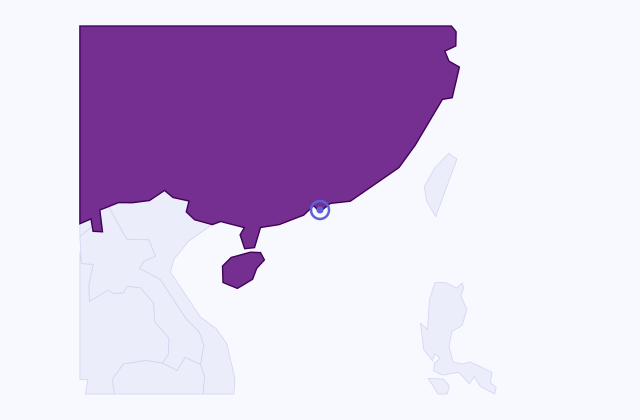
The legal framework
Adoption is regulated by the Adoption Ordinance, Cap. 290. The District Court makes the adoption order, which is full and irrevocable, and the Social Welfare Department acts as the central authority for intercountry cases. The Hague Convention applies to Hong Kong through the People's Republic of China's ratification. Applicants must normally be 25 or over, or 21 if a relative of the child, and the child must have been in their care for a continuous period before the order.
Hong Kong's adoption service is small, well organised and strongly gatekept. Both the Social Welfare Department and a handful of accredited bodies carry out assessments, and every match goes through a central register. The practical result is that private placements simply do not work here.
Cross-boundary situations are common. Families with ties to the mainland sometimes assume a child can be brought across and adopted locally; that is not how it works, and mainland adoptions are handled through the Chinese central authority under the Hague Convention.
Post-adoption support and access to records have improved. Adopted adults may apply to the Social Welfare Department for information about their origins, and the department operates a reunion service where both parties have registered an interest.
Same-sex couples: same-sex marriage is not available; the Court of Final Appeal held in September 2023 that the government must establish a framework for recognising same-sex partnerships, and implementation has been contested. Joint adoption is not available; adoption by a single person is.
Key points
| Statute | Adoption Ordinance, Cap. 290 |
|---|---|
| Court | District Court of Hong Kong |
| Central authority | Social Welfare Department |
| Minimum age | 25, or 21 for a relative of the child |
| Care period | The child must have lived with the applicants for a continuous period before the order |
| Hague Convention | Applies through China's ratification |
In practice
- Apply to the Social Welfare Department's Adoption Unit or to an accredited body.
- Attend the preparation programme and complete the home study assessment.
- Be approved by the Adoption Service Advisory Committee and placed on the register.
- Receive a placement and complete the statutory care period under supervision.
- Apply to the District Court for the adoption order, then register the adoption with the Immigration Department.
Cost and coverage
Local adoption through the Social Welfare Department is largely free apart from court and legal fees of a few thousand Hong Kong dollars. Intercountry adoption through an accredited body costs HKD 100,000 to 250,000 depending on the country. Employees adopting are covered by their employer's policy; statutory maternity leave applies to childbirth rather than adoption.
Recent changes
The number of local children placed for adoption has declined, while more children waiting are older or have special needs; accredited bodies have expanded recruitment for those profiles.
Where to go
- Social Welfare Department, Adoption Unit
- Accredited bodies including Mother's Choice and the International Social Service Hong Kong Branch
- District Court of Hong Kong
- Immigration Department, for the adopted child register and identity documents
- Post-adoption services of the Social Welfare Department
Worth knowing
Private arrangements outside the Social Welfare Department or an accredited body are prohibited, and the court will refuse an order made outside the official route.
Frequently asked questions
Who decides adoptions in Hong Kong?
The District Court makes the order, on the basis of the Social Welfare Department's assessment and report.
Can I arrange an adoption privately?
No. Placements must go through the Social Welfare Department or an accredited body; private arrangements are prohibited.
What is the minimum age to adopt?
25, or 21 if you are a relative of the child.
Does the Hague Convention apply to Hong Kong?
Yes, through China's ratification, so intercountry adoptions follow the Convention procedure with the Social Welfare Department as central authority.
Official sources and links
- GovHK — official government portal