Tanzania: marriage, divorce, inheritance and abortion
In Tanzania the Mainland's Law of Marriage Act still prints a minimum marriage age of 15 for girls despite a Court of Appeal ruling of 23 October 2019, Zanzibar punishes the circumcision of a girl with five to ten years under its Children's Act of 2011, the Personal Data Protection Commission has regulated personal data since 1 May 2023, and the Penal Code still prescribes death for murder although the last known execution took place in 1994.
The country in brief
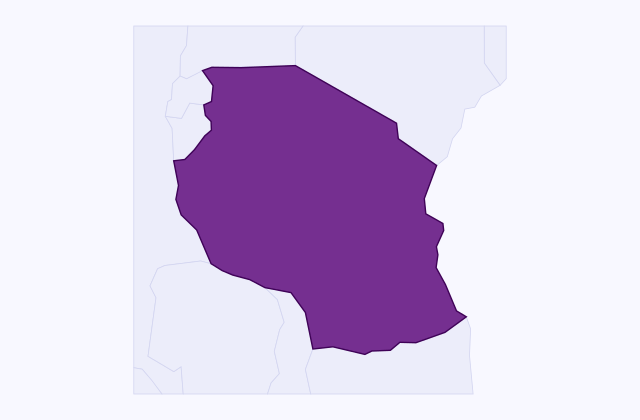
Tanzania. Simplified location map — Natural Earth data, public domain.
The United Republic of Tanzania joins Tanzania Mainland and Zanzibar, and the 2022 census counted 61,741,120 people, of whom 59,851,347 live on the Mainland and 1,889,773 in Zanzibar (National Bureau of Statistics, initial results of October 2022). Each part has its own legal order: the Penal Code (Cap. 16), the Law of Marriage Act (Cap. 29) and the Law of the Child Act apply to the Mainland only, while Zanzibar has its own Constitution (Revised Edition 2006), Penal Act (No. 6 of 2018), Children's Act (2011) and High Court; some Union statutes, such as the Personal Data Protection Act and the Cybercrimes Act, apply to both. Statutes are enacted in Kiswahili and the Attorney General publishes official English versions (the Personal Data Protection Act appeared in English in Government Notice No. 395B of 13 June 2023), and the British government's travel advice notes that Zanzibar and Pemba have a high Muslim population.
On the Mainland the Law of Marriage Act defines marriage as the voluntary union of a man and a woman intended to last for their joint lives and recognises monogamous and potentially polygamous marriages: a marriage in Islamic form or by customary rites is presumed potentially polygamous, any other is presumed monogamous (ss. 9 and 10). The printed minimum age is 18 for men and 15 for women (s. 13), although the Court of Appeal upheld on 23 October 2019 a High Court finding that the rule is unconstitutional. A man and a woman who have lived together for two years or more with the reputation of husband and wife are presumed married, and if the presumption is rebutted the woman can claim maintenance for herself and a child (s. 160). No spouse has a right to inflict corporal punishment (s. 66), a husband must maintain his wife or wives (s. 63), and a divorce petition normally has to go first to a Marriage Conciliation Board (s. 101). In the 2022 survey the median age at first marriage among people aged 25 to 49 was 19.8 for women and 24.9 for men.
For German citizens the embassy in Dar es Salaam explains that a Tanzanian marriage is generally recognised in Germany if each fiance meets the requirements of his or her own law and the law of the place of marriage; German nationals are asked for a certificate of no impediment (Ehefaehigkeitszeugnis) from the registry office of their last German residence, which costs between EUR 45 and EUR 100 depending on the state, Tanzanian documents must be legalised and translated, and registering the marriage in Germany is voluntary but useful for a couple who will live there, with Registry Office I in Berlin currently quoting about three years of processing. In Zanzibar civil and church marriages follow the Marriage (Solemnisation and Registration) Decree No. 11 of 1915 and Muslim marriages the Marriage and Divorce (Muslim) Registration Decree 1936, and under Islamic law a non-Muslim man may not marry a Muslim woman. British nationals are told by the Foreign, Commonwealth and Development Office that same-sex sexual activity is illegal throughout Tanzania, Zanzibar included, and that a victim of sexual assault can report it with the help of the British High Commission in Dar es Salaam.
The Constitution of the United Republic of 1977 declares that all human beings are born free and equal (Art. 12(1)), protects the right to life (Art. 14), bans torture and inhuman or degrading punishment (Art. 13(6)(e)), guarantees personal freedom (Art. 15) and the privacy of a person's family, matrimonial life, residence and private communications (Art. 16(1)). Anyone alleging that a basic right has been, is being or is likely to be violated by any person anywhere in the Union may start proceedings for redress in the High Court, which has original jurisdiction (Art. 30(3) and (4)). Zanzibar has its own Constitution (Revised Edition 2006): Art. 13 protects life and forbids torture and inhuman or degrading punishment, Art. 24(1)(a) says the right not to be tortured cannot be limited, and Art. 24(2) lets a person allege a violation before the High Court of Zanzibar, which may declare the violation and order compensation.
The Commission for Human Rights and Good Governance (CHRAGG) is created by Art. 129 of the Constitution and regulated by Cap. 391. It may receive complaints, inquire into infringements of human rights, and, if necessary, institute court proceedings to prevent a violation (Art. 130(1)); it is an autonomous department, but the President may still give it directives (Art. 130(2) and (3)). Complaints may be made orally or in writing by any individual or body (Act s. 23(1) and (3)); the Commission deals with every complaint unless the complainant has known of the matter for more than 24 months (an exception applies where justice or constitutional importance requires, s. 23(4) and (5)), another remedy should first be exhausted, or the matter is outside its jurisdiction. It may not investigate a matter pending before a court, a matter of mercy, or the conduct of the President of the United Republic or of Zanzibar (s. 17). Its findings have the status of a commendation to the authority concerned, which must report, within a period of up to three months set by the Commission, on what it has done; if no adequate action follows the Commission may bring an action or recommend that a competent authority do so (ss. 18 and 29). For Zanzibar authorities the report goes through the Zanzibar minister responsible for human rights, who must forward it within 21 days (s. 30). CHRAGG's head office is in Dodoma (email info@chragg.go.tz), with an office for Zanzibar and branches in Dar es Salaam, Wete-Pemba, Mtwara, Mwanza and Tabora.
Treaty participation, with the dates shown in the United Nations treaty collection: the International Covenant on Economic, Social and Cultural Rights and the International Covenant on Civil and Political Rights (both by accession, 11 June 1976), the Convention on the Elimination of Racial Discrimination (accession, 27 October 1972), the Convention on the Elimination of All Forms of Discrimination against Women (ratified 20 August 1985) and the Convention on the Rights of the Child (ratified 10 June 1991). In the African system, according to an archived University of Minnesota table (1 February 2023) and the Center for Reproductive Rights (2012), Tanzania ratified the African Charter on Human and Peoples' Rights on 18 February 1984 and the African Charter on the Rights and Welfare of the Child on 16 March 2003, and the University of Pretoria records the Maputo Protocol on the rights of women as ratified on 3 March 2007 and deposited on 7 May 2007; the African Commission's mission of 23 to 28 January 2023 recorded that the declaration under Article 34(6) of the African Court's Protocol was withdrawn in 2019, and the Minnesota table shows the Second Optional Protocol to the ICCPR (abolition of the death penalty) as not signed.
The death penalty remains in law. Section 197 of the Penal Code provides that a person convicted of murder shall be sentenced to death, by hanging (s. 26(1)); a woman proved to be pregnant is instead sentenced to life imprisonment (proviso to s. 26(1)), and a person under 18 at the time of the offence is detained during the President's pleasure (s. 26(2)). In Republic v Mbushuu, decided in 1994, the Court of Appeal found the death penalty cruel and inhuman yet not unconstitutional, treating ss. 196 and 197 as non-arbitrary and lawful, as a 2009 African Human Rights Law Journal article records. The World Coalition Against the Death Penalty reported that the last known execution took place in 1994 and that on 9 December 2020 President Magufuli announced the commutation of 256 death sentences to life imprisonment; on 28 November 2019 the African Court on Human and Peoples' Rights held in Ally Rajabu and Others v Tanzania (Application No. 007/2015) that the mandatory death sentence under s. 197 is an arbitrary deprivation of life contrary to Art. 4 of the African Charter, that hanging violates Art. 5, and awarded each applicant TZS 4,000,000 in moral damages.
Key points
Union Constitution
1977, text as amended to 2005; Bill of Rights enforceable in the High Court (Art. 30(3) and (4))
Constitution of Zanzibar
1984, Revised Edition 2006; Art. 13 life and ban on torture; Art. 24(2) High Court of Zanzibar may declare and order compensation
National institution
Commission for Human Rights and Good Governance (Arts 129 to 131; Cap. 391)
Complaint to CHRAGG
Oral or written, any individual or body; normally within 24 months of knowing (s. 23)
UN core treaties
ICESCR and ICCPR by accession, 11 June 1976; CERD by accession, 27 October 1972; CEDAW 20 August 1985; CRC 10 June 1991
African treaties
African Charter 18 February 1984; Children's Charter 16 March 2003; Maputo Protocol ratified 3 March 2007
Death penalty
Mandatory for murder by hanging (Penal Code ss. 197 and 26(1)); last known execution 1994; 256 commuted on 9 December 2020
African Court ruling
Ally Rajabu and Others v Tanzania, 28 November 2019: s. 197 breaches Arts 4 and 5; TZS 4,000,000 each
In practice
To complain about a state authority, write to or call CHRAGG (oral or written complaints are accepted); do it within 24 months of learning of the matter and before any court case starts, because pending cases are excluded (Act ss. 17(2) and 23(4)).
To enforce a constitutional right directly, petition the High Court under Art. 30(3) of the Union Constitution, or the High Court of Zanzibar under Art. 24(2) of the Zanzibar Constitution for a Zanzibar matter.
For a complaint against Zanzibar authorities, expect the report to travel through the Zanzibar minister responsible for human rights, who has 21 days to refer it (s. 30).
Recent changes
On 9 December 2020 President John Magufuli announced that 256 death sentences would be commuted to life imprisonment, saying the law required him to hang all 256 convicts (World Coalition Against the Death Penalty, 11 December 2020).
Where to go
CHRAGG head office, Mtaa wa Nyerere, Plot 339, Kilimani, P.O. Box 1049, Dodoma; telephone +255 738 279744; info@chragg.go.tz.
High Court of Tanzania (Art. 30(3)) and High Court of Zanzibar (Zanzibar Constitution Art. 24(2)).
African Commission on Human and Peoples' Rights, whose 2023 mission urged Tanzania to reinstate the Article 34(6) declaration.
Worth knowing
CHRAGG's decisions are commendations, not binding orders (s. 18(1)); its power to bring a court action arises only if the authority's report on redress is inadequate (s. 29(3)).
Frequently asked questions
Can I complain to the human rights commission about a police officer or a government department?
Yes: the Commission can investigate a decision or act that breaches fundamental rights or is unreasonable, unjust, oppressive or discriminatory (s. 29(1)), but not while the same matter is pending before a court (s. 17(2)(a)) and, as a rule, not if you have known of it for over 24 months (s. 23(4)(a)).
Is the death penalty abolished in Tanzania?
No. Section 197 of the Penal Code still provides that a person convicted of murder shall be sentenced to death, although no execution is recorded since 1994 and the African Court held the mandatory sentence unlawful in 2019.
Where do I enforce a constitutional right?
In the High Court under Art. 30(3) of the Union Constitution; for violations in Zanzibar the Zanzibar Constitution provides a suit in the High Court under Art. 24(2).
Text prepared with artificial intelligence, reviewed and checked by the AffectionPlus team (method and sources: About). This content does not replace medical or legal advice. Spotted an error? Write to us.