
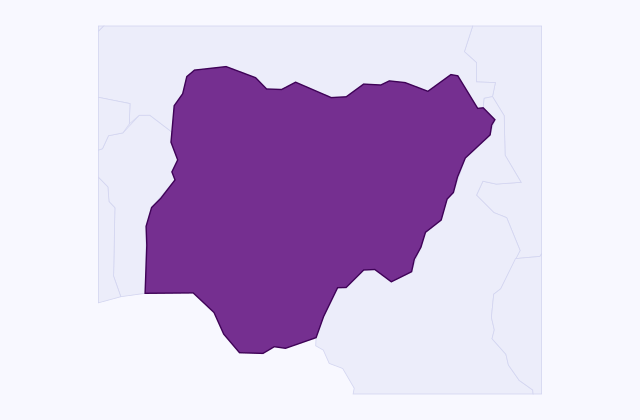
The legal framework
The Violence Against Persons (Prohibition) Act of 2015 prohibits FGM at federal level, and a number of states had already legislated. Prevalence is around one woman in five nationally but varies enormously by region, with the highest rates in the south-west and south-east. Nigeria has one of the largest absolute numbers of affected women in the world, and cutting is increasingly performed by health workers.
Nigeria prohibited the practice federally in 2015 through the Violence Against Persons (Prohibition) Act, but that Act must be adopted state by state to apply outside the Federal Capital Territory, and adoption is uneven. Prevalence is concentrated in the south rather than the north, contrary to a common assumption, and the worrying trend is medicalisation: an increasing share of procedures performed by health workers.
Key points
| Federal law | Violence Against Persons (Prohibition) Act 2015 |
|---|---|
| State laws | Several states legislated before the federal Act; adoption varies |
| Prevalence | Around one in five women, highly concentrated in the south |
| Age | Frequently performed in infancy, unlike much of the region |
| Medicalisation | Rising, with a growing share performed by health workers |
| Absolute numbers | Among the largest affected populations in the world |
| Care | Available in teaching hospitals; awareness among clinicians is uneven |
In practice
- Check whether your state has adopted the federal Act: enforcement depends on it.
- Report concerns to the police gender desk or to the state agency where one exists.
- Tell the midwife at the first antenatal visit: it changes how delivery is managed.
- Community and religious leaders are central to the programmes that work.
Cost and coverage
Care in public facilities is low cost; teaching hospital services vary.
Where to go
- State agencies established under the Violence Against Persons Act.
- Police gender desks and child protection networks.
- Teaching hospitals for treatment of complications.
Worth knowing
Because cutting is often done in infancy in Nigeria, many women do not know it happened to them. If you have unexplained gynaecological or obstetric difficulties, ask to be examined.
Frequently asked questions
Does the federal ban apply everywhere in Nigeria?
Not automatically. The Violence Against Persons (Prohibition) Act applies directly in the Federal Capital Territory and must be domesticated by each state to apply there. Many states have done so; several have not, and a few have their own older laws.
Why is medicalisation a concern?
Because a growing share of procedures is carried out by nurses, midwives or doctors, which makes the practice look safer and more legitimate without changing what it does. Professional bodies treat it as misconduct, and the law makes no exception for medical settings.
Official sources and links
- Nigeria.gov.ng — official government portal