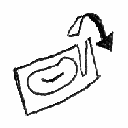
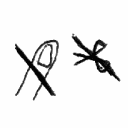
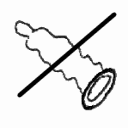
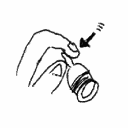
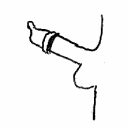
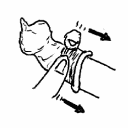
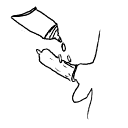
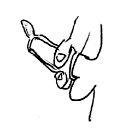
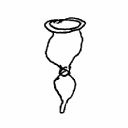
Twelve steps, twelve drawings: open without damaging, put it on before any contact, pinch the tip, unroll, lubricate, withdraw, dispose. And what to do if it broke.
Used properly, the male condom prevents 98% of pregnancies; as it is actually used — put on too late,
badly unrolled, damaged by an oil — it lets about 13% through per year. The gap between the two figures
comes entirely from the steps below. It remains the only method that protects against both pregnancy
and most STIs; the page on condoms explains
the rest — the internal condom, sizes, latex allergies. The drawings are those of the first version of
this site.
The twelve steps
1. Check the packetDate not passed, wrapper intact, CE mark or equivalent, condom kept dry and away from heat — not months in a wallet or glove box. Open the wrapper from the middle, with your fingers.2. No nails, teeth or scissorsAnything that can pierce the latex is to be avoided. If in doubt about the condition of the condom, throw it away and take another.3. Do not unroll it firstOut of the wrapper it is a ring, the rolled rim on the outside. It unrolls on the penis, never before.4. Before any contactIt protects against infections as much as against pregnancy: put it on before any contact between genitals and genitals, mouth or anus, not only before penetration. Caresses can wait for the condom.5. On the erect penisAlways on a fully erect penis, foreskin pulled back. Put on a flaccid penis, it pinches or tears at the moment of erection.6. Pinch the tipBetween thumb and forefinger, to squeeze the air out: the reservoir must be able to receive the semen without bursting. A condom without air also feels thinner.7. Place it on the glans, the right way roundThe rolled rim must be on the outside, otherwise it will not unroll. If it was placed inside out, do not turn it over: it has touched the glans and may carry pre-ejaculate — take another. Never two condoms one over the other: the friction damages them.8. Unroll to the baseForming a ring with thumb and forefinger, without forcing. If it does not unroll well, or is too tight or too loose, change it — the size (nominal width, 47 to 60 mm) is on the box and really matters.9. Lubricant: water- or silicone-basedMost condoms are pre-lubricated; adding more reduces breakage, especially for anal sex. Never oil-based products — oil, petroleum jelly, cream, butter — with latex: they make it porous within minutes.10. Withdraw before the erection endsAfter ejaculation, withdraw while the penis is still firm, holding the condom at the base so that it does not stay inside.11. Knot it, bin itAway from your partner, slide it off, tie a knot, wrap it and put it in the bin — not down the toilet.12. One condom, one useIt is never reused or washed. If it broke or slipped: emergency contraception within five days (the sooner the better), STI testing at three weeks, and, if there is an HIV risk, post-exposure treatment started at an emergency department as soon as possible, and no later than 72 hours.
Official or institutional documents this page relies on, consulted on 12 October 2026. Links open in a new tab.
Page checked in . The data cited can change.
Text prepared with artificial intelligence, reviewed and checked by the AffectionPlus team (method and sources: About). This content does not replace medical or legal advice. Spotted an error? Write to us.