
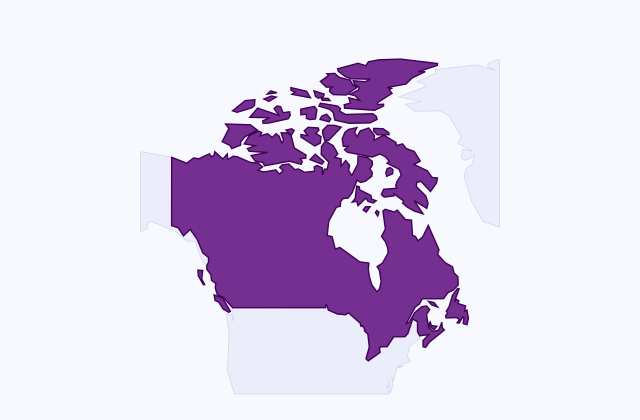
The legal framework
Federal divorce legislation defines a child of the marriage to include a child for whom a spouse stands in the place of a parent. The practical consequence is significant: a step-parent who has taken on a parental role can be ordered to pay child support after separation, even without adoption and even though the biological parent's obligation continues. Provincial law governs guardianship, contact and adoption, and rules differ, notably in Quebec.
Canadian law focuses on function rather than status: a person who stands in the place of a parent — a concept written into the Divorce Act — can be ordered to pay child support after separation, and the amount takes into account what the biological parents pay. The corollary is that such a person can also apply for parenting time. Adoption and guardianship are provincial, and British Columbia in particular has an expansive statutory scheme.
Key points
| Child support | Possible where the step-parent stood in the place of a parent |
|---|---|
| Biological parent | Their obligation continues; the amounts are apportioned |
| Guardianship and contact | Governed by provincial law; terms and tests vary |
| Quebec | No equivalent support obligation under the Civil Code |
| Adoption | Available for a spouse's or partner's child, with consent |
| Intestacy | A stepchild is not an heir without adoption |
| Benefits | Stepchildren are generally covered by employer benefit plans |
In practice
- Understand the exposure before taking on a parental role: support can outlast the relationship.
- Provincial rules on contact after separation differ: check the test that applies where you live.
- Make a will naming stepchildren if you intend to provide for them.
- Add stepchildren to benefit plans during the enrolment period.
Cost and coverage
Step-parent adoption costs are provincial and modest, often a few hundred dollars in fees plus legal costs. Contested support or parenting applications are considerably more expensive; legal aid exists but is means-tested.
Recent changes
Amendments to the Divorce Act brought in best-interests criteria and replaced custody and access language with parenting time and decision-making responsibility, which has made applications by non-biological caregivers more straightforward.
Where to go
- Provincial family court and family justice services.
- Community legal clinics.
- Notary or lawyer, for wills and estate planning.
Worth knowing
The contrast between the common law provinces and Quebec is real. A step-parent who moves between them can find the support position reversed.
Frequently asked questions
What does standing in the place of a parent mean?
That an adult has taken on a parental role in fact — providing, deciding, being relied on — regardless of biology or marriage. Courts look at the relationship from the child's point of view. It creates both a possible support obligation and a possible claim to parenting time.
Can a step-parent be ordered to pay support in Canada?
Yes, if they stood in the place of a parent. The court sets an amount having regard to the obligations of the biological parents, so it is usually less than a full table amount, but the obligation is real and has surprised many step-parents after a separation.
Official sources and links
- Canada.ca — official government portal
- Justice Laws Website — federal statutes and regulations