
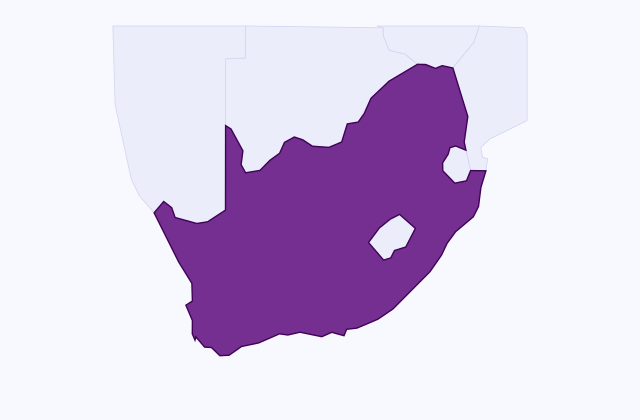
The legal framework
Chapter 2 of the 1996 Constitution is enforced by a Constitutional Court that can invalidate legislation and conduct. Section 8(2) gives the Bill of Rights horizontal application, binding private persons where appropriate. Socio-economic rights — housing, health care, water, education — are justiciable, as the Grootboom and Treatment Action Campaign judgments established. Chapter 9 institutions provide non-judicial routes.
Key points
| Constitution | Chapter 2, Bill of Rights, supreme law |
|---|---|
| Horizontal application | Section 8(2): binds private persons where applicable |
| Socio-economic rights | Justiciable, subject to progressive realisation |
| Limitation clause | Section 36: law of general application, reasonable and justifiable |
| Chapter 9 institutions | SAHRC, Public Protector, Commission for Gender Equality |
| Regional | African Charter; South Africa has accepted the African Court's jurisdiction |
| Section 38 | Broad standing, including public interest and class actions |
| Meaningful engagement | A remedy developed in housing cases requiring the state to consult |
| Costs | The Biowatch principle protects unsuccessful litigants against the state from costs |
In practice
- Exhaust domestic remedies first: no regional or international body will look at a case before that.
- Watch the deadlines — several are counted in months from the final domestic decision.
- Complain to the national human rights institution first: it is free and sometimes enough.
- Keep every decision, letter and acknowledgement: regional bodies will ask for the full record.
- Cite the Biowatch principle: a litigant suing the state on constitutional grounds is normally protected from costs.
Where to go
- South African Human Rights Commission, free complaints.
- Public Protector for maladministration.
- Legal Aid South Africa and university law clinics.
Worth knowing
The SAHRC can investigate and litigate on your behalf at no cost: for systemic problems it is often more effective than an individual court case. The costs protection for constitutional litigation against the state removes the largest deterrent to bringing a claim.
Official sources and links
- gov.za — official government portal
- South African Human Rights Commission — constitutional rights body