
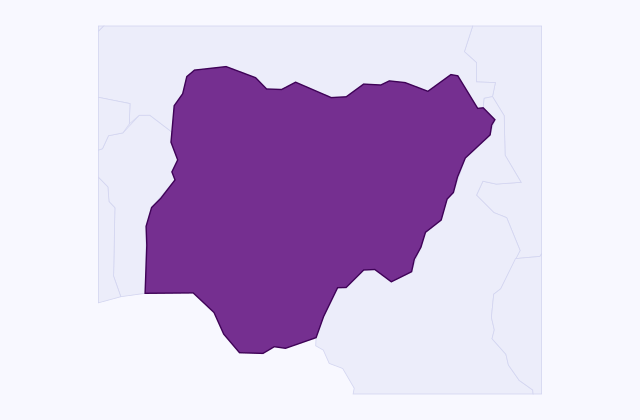
The legal framework
Chapter IV of the Constitution guarantees fundamental rights, enforced through the Fundamental Rights (Enforcement Procedure) Rules 2009, which provide a simplified and expedited High Court procedure with relaxed standing and an express public interest orientation. The ECOWAS Court of Justice can be approached directly by individuals, without exhausting domestic remedies — a rare and valuable feature.
Chapter IV of Nigeria's Constitution sets out enforceable fundamental rights, and the Fundamental Rights (Enforcement Procedure) Rules provide a fast, simplified procedure in the High Court — no requirement to show locus standi in the old restrictive sense, and no limitation period. Chapter II, covering social and economic objectives, is expressly non-justiciable, which is the constitution's central limitation.
Key points
| Constitution | Chapter IV, fundamental rights |
|---|---|
| FREP Rules 2009 | Simplified, expedited procedure with relaxed standing |
| Commission | National Human Rights Commission, whose awards are enforceable as court judgments |
| ECOWAS Court | Direct individual access, no exhaustion requirement |
| African Charter | Domesticated by statute and directly enforceable in Nigerian courts |
| Chapter II | Directive principles, generally not justiciable |
| Enforceable Commission awards | National Human Rights Commission awards are enforceable as court judgments |
| African Charter Act | Domesticated, so its provisions can be pleaded directly |
In practice
- Exhaust domestic remedies first: no regional or international body will look at a case before that.
- Watch the deadlines — several are counted in months from the final domestic decision.
- Complain to the national human rights institution first: it is free and sometimes enough.
- Keep every decision, letter and acknowledgement: regional bodies will ask for the full record.
- Plead the African Charter directly: it is domesticated and binding in Nigerian courts.
Where to go
- National Human Rights Commission.
- Legal Aid Council of Nigeria.
- ECOWAS Court of Justice, Abuja.
Worth knowing
The African Charter is domesticated in Nigeria, so its provisions can be pleaded directly in a Nigerian court — a shortcut that is often overlooked. The ECOWAS Court can be approached without exhausting domestic remedies, which makes it the most accessible regional forum anywhere covered here.
Frequently asked questions
How quick is a fundamental rights application?
Faster than ordinary litigation. The enforcement rules provide a summary procedure, allow public interest applicants to sue, and remove the limitation period for bringing a claim. Practice varies by court, but a well-prepared application can be heard in months rather than years.
Why are social and economic rights not enforceable?
Because Chapter II of the Constitution, which covers education, health and welfare objectives, is declared non-justiciable. Courts have found indirect routes through the African Charter, domesticated into Nigerian law, which contains economic and social rights and has been used to fill the gap.
Official sources and links
- Nigeria.gov.ng — official government portal