
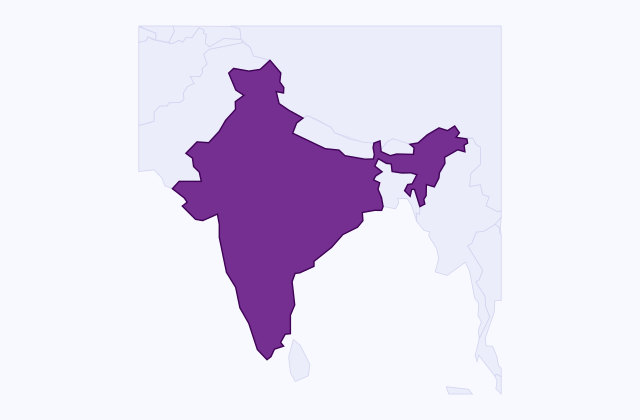
The legal framework
Part III of the Constitution guarantees fundamental rights, enforceable directly in the Supreme Court under Article 32 and in the High Courts under Article 226. Public interest litigation has widened standing dramatically: a letter can be treated as a petition. The basic structure doctrine limits even constitutional amendments, and the National Human Rights Commission provides a non-judicial route.
Key points
| Part III | Fundamental rights, including equality, life and liberty, and free expression |
|---|---|
| Article 32 | Direct petition to the Supreme Court, itself a fundamental right |
| Article 226 | Wider High Court writ jurisdiction, covering legal as well as fundamental rights |
| Public interest litigation | Relaxed standing; letters have been treated as petitions |
| Basic structure | Constitutional amendments themselves can be struck down |
| NHRC | Recommendatory powers; state commissions in each state |
| Locus standi | Relaxed for public interest litigation; letters have been treated as petitions |
| Continuing mandamus | Courts retain supervision over compliance with their orders |
| Legal services authorities | Provide free representation at every level |
In practice
- Exhaust domestic remedies first: no regional or international body will look at a case before that.
- Watch the deadlines — several are counted in months from the final domestic decision.
- Complain to the national human rights institution first: it is free and sometimes enough.
- Keep every decision, letter and acknowledgement: regional bodies will ask for the full record.
- Approach the district legal services authority for free representation before filing.
Where to go
- National Human Rights Commission and state commissions.
- High Court legal services authority for free legal aid.
- Supreme Court Legal Services Committee.
Worth knowing
Article 226 is usually the better starting point than Article 32: it is wider in scope, closer to home, and the Supreme Court often asks why the High Court was bypassed. Article 226 is usually the better route than Article 32: wider in scope, closer to home, and the Supreme Court often asks why it was bypassed.
Official sources and links
- India.gov.in — national portal of India
- India Code — central and state legislation