
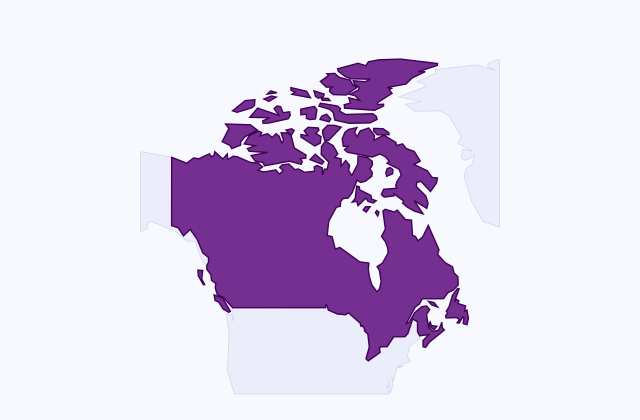
The legal framework
The Civil Marriage Act of 20 July 2005 made Canada the fourth country in the world to open marriage nationally, confirming a position already reached by court decisions in most provinces from 2003. Adoption is open across the country, parentage rules are provincial, and several provinces recognise more than two legal parents in defined circumstances.
Canada opened marriage through the courts first and the legislature second, which is why the federal statute of 2005 was less a turning point than a consolidation. The division of powers still shapes daily life: Ottawa defines marriage, the provinces define parenthood, and it is the second that generates most of the practical questions for couples with children.
Key points
| Marriage | Nationwide since 20 July 2005 |
|---|---|
| Route | Provincial court decisions from 2003, then federal legislation |
| Adoption | Available in every province and territory |
| Parenthood | Provincial; presumption for the birth mother's spouse in most provinces |
| Multi-parent families | Recognised in several provinces, including British Columbia and Ontario |
| Surrogacy | Altruistic only; payment is a federal offence |
| Discrimination | Canadian Human Rights Act and provincial codes |
In practice
- No residence is required to marry in Canada, which makes it a destination for couples from restrictive countries.
- A federal provision allows non-resident couples married in Canada to divorce there in defined circumstances.
- Parentage paperwork differs by province: check the rules where the birth will take place, not where you live.
- Paying a surrogate beyond reimbursed expenses is a criminal offence, however the arrangement is described.
Cost and coverage
A marriage licence costs roughly one hundred to one hundred and sixty Canadian dollars depending on the province, plus the officiant's fee. Provincial coverage of assisted reproduction varies widely.
Recent changes
Several provinces have modernised their parentage statutes to cover assisted reproduction and, in some cases, more than two legal parents — an area where Canada is among the most advanced.
Where to go
- Provincial vital statistics office, for the licence and registration.
- Provincial human rights commission, for discrimination.
- Fertility clinics, for donor and parentage documentation.
Worth knowing
Marriage is federal but parenthood is provincial: a couple recognised as two parents in one province may need to redo paperwork after an interprovincial move.
Frequently asked questions
Can foreigners marry in Canada?
Yes, there is no residence requirement. It is a frequent option for couples from countries that do not allow it. Divorce normally requires residence, but a federal provision allows non-resident couples married in Canada to dissolve the marriage there under conditions.
Is surrogacy allowed?
Altruistic surrogacy is lawful; paying a surrogate, or paying an intermediary to arrange one, is a criminal offence under federal law. Reimbursement of documented expenses is permitted. Parentage is then settled under provincial law, which differs significantly.
Official sources and links
- Canada.ca — official government portal
- Justice Laws Website — federal statutes and regulations