
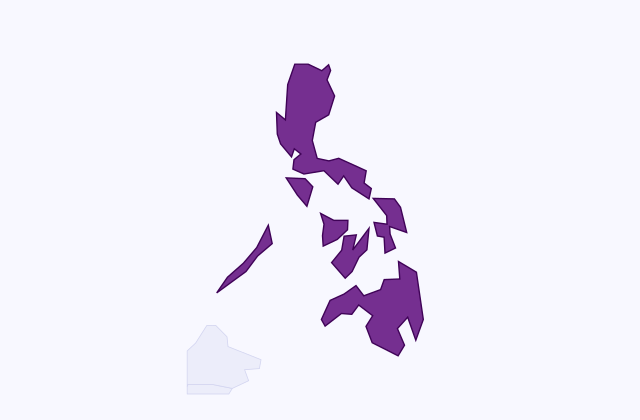
The legal framework
Philippine law protects compulsory heirs — legitimate and illegitimate children, the surviving spouse and, in their absence, ascendants — with a legitime fixed by the Civil Code. Only the free portion may be disposed of by will. Illegitimate children inherit half the share of a legitimate child. The estate tax was simplified by the TRAIN law of 2017 to a flat six per cent above a standard deduction, with a further deduction for the family home.
The single most useful action in the Philippines is to check the beneficiary designations attached to pensions, retirement savings and life insurance. They pass outside the will, they override it, and they are almost never updated after a separation or a remarriage.
Intestacy is not a neutral default. It distributes according to a statutory formula that rarely matches what a couple would have chosen, and it makes no provision at all for step-children, unmarried partners in some jurisdictions, or a business that needs to keep trading.
Cross-border assets complicate everything. A holiday home or an account abroad usually requires a separate procedure in that country, and the two systems may disagree about which law applies. Taking advice before buying abroad is far cheaper than resolving it afterwards.
Key points
| Law | Civil Code of the Philippines, Book III |
|---|---|
| Compulsory heirs | Children, surviving spouse, and ascendants in their absence |
| Legitime | Reserved share that a will cannot reduce |
| Illegitimate children | Inherit half the share of a legitimate child |
| Estate tax | Flat 6 % since the TRAIN law of 2017, with standard and family-home deductions |
| Extrajudicial settlement | Possible where there is no will and heirs agree |
In practice
- Locate the will and apply for the grant, letters of administration or local equivalent.
- Value the estate, including assets that pass outside it by nomination or survivorship.
- Advertise for creditors where the law requires it, and settle debts before distributing.
- File the tax returns that death triggers, and obtain any clearance required.
- Distribute only after the claim period has expired, and keep a signed distribution account.
Cost and coverage
Court fees are modest; professional costs are not, and in a contested estate they routinely exceed what is in dispute. Where an inheritance or estate tax exists, the exemptions matter more than the headline rate. Assets passing outside the estate — pensions, insurance, joint accounts — are usually the largest items and the least reviewed.
Recent changes
Successive estate tax amnesty laws have allowed families to regularise long-unsettled estates at reduced cost; deadlines have been extended more than once.
Where to go
- Probate court or registry with jurisdiction over the estate
- Revenue authority, for the returns and clearances that death triggers
- Law society or bar association referral service
- Banks, insurers and pension administrators, for assets passing outside the estate
- Civil registry, for the death certificate and proofs of relationship
Worth knowing
Extrajudicial settlement requires publication in a newspaper of general circulation for three consecutive weeks and a two-year period during which an omitted heir can reopen the distribution.
Frequently asked questions
Who inherits if there is no will?
The statutory order: surviving spouse or partner and children first, then other relatives in the sequence set by the legislation.
Do pensions and life insurance form part of the estate?
Usually not. They pass to the person named on the nomination form, which overrides the will.
How long does administration take?
Commonly six to eighteen months for an uncontested estate, considerably longer where there is a dispute or assets abroad.
Can a will be challenged?
Yes, on capacity, undue influence or formality, and in most of these jurisdictions by a dependant seeking provision. Time limits are short and strictly applied.
Official sources and links
- gov.ph — official government portal