
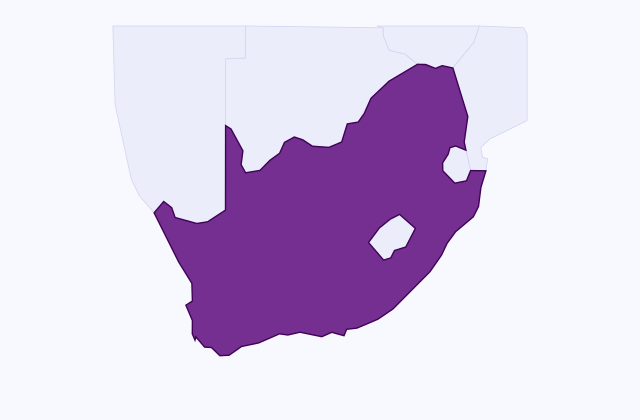
The legal framework
Chapter 15 of the Children's Act 38 of 2005 sets out who may adopt, how consent is given and withdrawn, and the effect of an order, which is full: the child becomes the child of the adoptive parents for all purposes. Only a designated child protection organisation or an accredited social worker may facilitate an adoption. The Register on Adoptable Children and Prospective Adoptive Parents, kept by the Department of Social Development, is used to match children with families. South Africa has been a party to the Hague Convention since 2003.
The mismatch in South Africa is between need and process. Very large numbers of children live outside parental care, but only a small fraction are legally adoptable, and the procedural requirements — tracing, consent, sixty-day withdrawal period, RACAP listing — mean that a placement rarely happens quickly.
Race remains part of the conversation. Transracial adoption is lawful and common, and the Act does not impose a same-race requirement, but social workers weigh the child's cultural background among the factors, and families should expect that discussion during screening.
Customary care by the extended family is the default across much of the country and is not adoption: a child raised by a grandmother has no adoptive parentage and no automatic inheritance from her. Where the family wants legal security, the Children's Act offers both adoption and, alternatively, a court order granting guardianship or care.
Same-sex couples: joint adoption has been available since Du Toit v. Minister of Welfare (2002) and is confirmed by the Children's Act; the Civil Union Act 2006 opened marriage.
Key points
| Statute | Children's Act 38 of 2005, Chapter 15 |
|---|---|
| Court | Children's Court |
| Facilitation | Only accredited social workers and designated child protection organisations |
| Consent | Withdrawable within 60 days of signature |
| Register | RACAP, the national register of adoptable children and prospective parents |
| Hague Convention | Party since 2003 |
In practice
- Contact an accredited adoption social worker or a designated child protection organisation.
- Complete the screening: interviews, home visits, medical and psychological assessment, police clearance and checks against the child protection and sexual offences registers.
- Be placed on the register of prospective adoptive parents.
- Be matched with a child, often after the child has been on RACAP for the prescribed period.
- Attend the Children's Court for the adoption order, then obtain the amended birth certificate from Home Affairs.
Cost and coverage
Adoption through a state social worker is free. Through a private accredited social worker, fees run from R 15,000 to R 40,000. Intercountry adoption costs more once the foreign agency and travel are counted. South African law provides ten weeks of adoption leave for one adoptive parent of a child under two, with parental leave for the other.
Recent changes
Long delays in clearing children through RACAP, and a shortage of accredited social workers, have kept the number of adoptions low relative to the number of children in need of permanent families; the Children's Amendment Act has sought to simplify parts of the process.
Where to go
- Department of Social Development, adoption services
- Accredited adoption social workers and designated child protection organisations
- Children's Court in the district where the child resides
- National Adoption Coalition South Africa
- Department of Home Affairs, for the amended birth record
Worth knowing
Payment for a child is a criminal offence; only prescribed professional fees may be charged, and unaccredited intermediaries operate illegally.
Frequently asked questions
Who can facilitate an adoption in South Africa?
Only an accredited adoption social worker or a designated child protection organisation. Anyone else offering to arrange a placement is acting illegally.
How long can a birth parent withdraw consent?
Within 60 days of signing the consent, after which it becomes final.
What is RACAP?
The Register on Adoptable Children and Prospective Adoptive Parents, the national database used to match children and families.
Can single people and same-sex couples adopt?
Yes. The Children's Act permits adoption by single people, married couples, civil union partners and permanent life partners.
Official sources and links
- gov.za — official government portal
- South African Human Rights Commission — constitutional rights body