
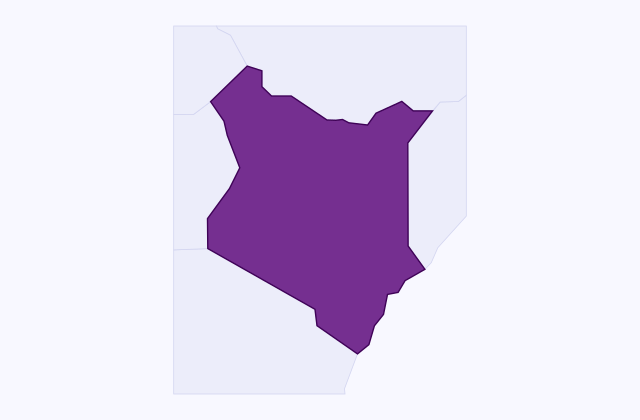
The legal framework
Adoption is regulated by the Children Act 2022, which replaced the 2001 Act. The High Court makes the adoption order, on the application of a registered adoption society, and the National Adoption Committee oversees the system. Kenya acceded to the Hague Convention in 2007, but a government moratorium on intercountry adoption introduced in November 2014 suspended new foreign placements; resident adoption by people living in Kenya has continued.
The 2014 moratorium came after investigations into child trafficking and irregular placements. Its effect has been to make Kenya a country where adoption happens almost entirely between Kenyan residents — including foreign nationals who genuinely live and work in Kenya, who can apply as resident applicants.
Kinship care is the dominant reality. Most children who lose parental care are absorbed by the extended family without any legal step. The Children Act 2022 recognises kinship care as a formal placement option, which gives carers a status they previously lacked, though it is not adoption.
The three-month fostering period before the petition is non-negotiable and is supervised. It is the stage at which most difficulties surface, and adoption societies use it deliberately: a placement that is not working is better ended before an irrevocable order.
Same-sex couples: same-sex relations are criminalised; no recognition and no joint adoption.
Key points
| Statute | Children Act 2022 |
|---|---|
| Court | High Court of Kenya |
| Oversight | National Adoption Committee; registered adoption societies |
| Fostering period | Three months of continuous care before the application |
| Intercountry | Moratorium on intercountry adoption since November 2014 |
| Hague Convention | Party since 2007 |
In practice
- Apply to a registered adoption society and attend the assessment.
- Complete the vetting: home study, medical reports, police clearance, references and financial evidence.
- Be matched with a declared-free child and take the child into care for the three-month fostering period.
- The adoption society files the petition in the High Court on your behalf.
- Obtain the adoption order and the new birth certificate from the Civil Registration Services.
Cost and coverage
Society fees and legal costs commonly total KES 150,000 to 400,000. The process takes eighteen months to three years, the fostering period and the court calendar being the main variables. Kenyan employment law provides three months of adoptive leave from the date of placement.
Recent changes
The Children Act 2022 modernised the framework, strengthened the role of the National Adoption Committee and clarified the position of kinship care; the intercountry moratorium has nonetheless not been formally lifted.
Where to go
- National Council for Children's Services and the National Adoption Committee
- Registered adoption societies, whose list is published by the department of children's services
- High Court of Kenya, family division
- Children's officers in each sub-county
- Civil Registration Services, for the amended birth entry
Worth knowing
The intercountry moratorium remains in force: applicants who are not resident in Kenya should not begin a process on the assumption that it will be lifted.
Frequently asked questions
Can foreigners adopt in Kenya?
Only if they are genuinely resident in Kenya. The moratorium on intercountry adoption introduced in November 2014 blocks non-resident applicants.
Which court grants the adoption?
The High Court, on a petition filed by a registered adoption society.
How long is the fostering period?
Three months of continuous care before the petition can be filed.
Is kinship care the same as adoption?
No. The Children Act 2022 recognises kinship care as a placement, but it does not transfer parentage or create inheritance rights.
Official sources and links
- eCitizen — official government services portal