
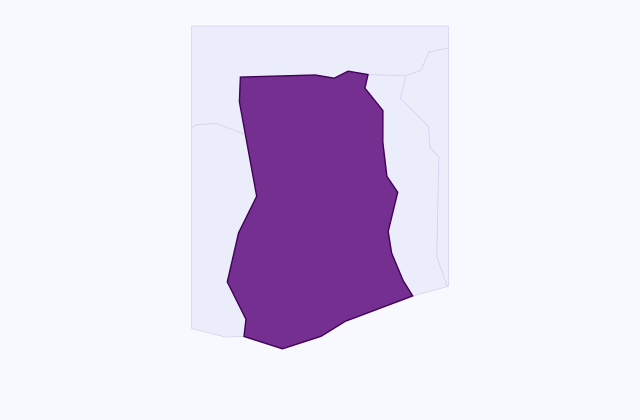
The legal framework
Adoption is governed by the Children's Act 1998 as substantially amended by the Children (Amendment) Act 2016, which created the Central Adoption Authority within the Department of Social Welfare and imposed accreditation on adoption agencies. The High Court or the Circuit Court makes the order, which confers full parentage. Ghana's accession to the Hague Convention took effect in 2016, ending the period in which private arrangements with orphanages were common.
The audit finding is the single most important fact about adoption in Ghana. Most children in residential care were placed there because of poverty, not because they had no family. Adoption is therefore treated as a last resort, after reunification and kinship care have been explored, and the number of orders is deliberately small.
Before 2016, private arrangements with orphanages were routine and several were used as gateways for foreign adopters. Accreditation, the Central Adoption Authority and Hague accession ended that model. Families who relied on old contacts will find they no longer function.
Customary fostering, in which a child is raised by an aunt, a grandmother or a family friend, remains widespread and has no legal effect. It is not a step towards adoption and does not give the carer authority to consent to medical treatment, obtain a passport or inherit on the child's behalf.
Same-sex couples: same-sex relations are criminalised under the Criminal Offences Act, and further restrictive legislation has been before Parliament; no recognition and no joint adoption.
Key points
| Statutes | Children's Act 1998; Children (Amendment) Act 2016 |
|---|---|
| Authority | Central Adoption Authority, Department of Social Welfare |
| Court | High Court or Circuit Court |
| Fostering period | Supervised placement before the order |
| Accreditation | Mandatory for adoption agencies and placement bodies |
| Hague Convention | Party since 2016 |
In practice
- Apply to the Department of Social Welfare and attend the assessment and orientation.
- Complete the home study, medical reports, police clearance and financial verification.
- Be matched by the Central Adoption Authority with a child declared adoptable.
- Complete the supervised fostering placement.
- Petition the court for the adoption order and obtain the amended birth certificate.
Cost and coverage
Official fees are modest, and legal costs are moderate. The full process commonly takes eighteen months to three years. For diaspora applicants, travel and the parallel procedure in the country of residence dominate the cost.
Recent changes
The 2016 reform followed a national audit that found a large majority of children in Ghanaian orphanages had at least one living parent; the policy response has been deinstitutionalisation and family reunification rather than expanded adoption.
Where to go
- Central Adoption Authority, Department of Social Welfare and Community Development
- Accredited adoption agencies listed by the Authority
- High Court or Circuit Court of the region
- Births and Deaths Registry
- Ghanaian missions abroad, for diaspora applicants
Worth knowing
Orphanages that are not licensed cannot place a child, and several were closed after the 2016 reform; check accreditation before any contact.
Frequently asked questions
Is Ghana a party to the Hague Convention?
Yes, since 2016. Intercountry adoptions must go through the Central Adoption Authority and the authority of the receiving country.
Can I adopt directly from an orphanage?
No. Only accredited bodies may place children, and matching is decided by the Central Adoption Authority.
Why are so few children adoptable?
Because most children in Ghanaian residential care have living parents; policy prioritises reunification and kinship care over adoption.
How long does an adoption take?
Commonly eighteen months to three years, including assessment, matching and the supervised placement.
Official sources and links
- Ghana.gov — official government portal