
The legal framework
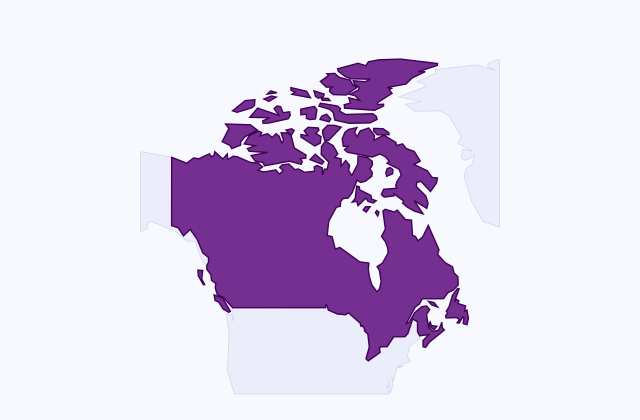
Canada has thirteen adoption regimes. Ontario's Child, Youth and Family Services Act 2017, British Columbia's Adoption Act, Alberta's Child, Youth and Family Enhancement Act and their equivalents each set their own eligibility and consent rules. The federal role is limited but decisive: Immigration, Refugees and Citizenship Canada issues the visa or grant of citizenship, and no child enters without provincial approval first. Customary adoption by Indigenous communities is recognised in several provinces and territories.
The provincial patchwork matters in practice. Ontario and British Columbia have well-developed public adoption programmes and long waits for infants; the Prairie provinces place a higher proportion of older children; Quebec runs its own system, including the banque mixte. Moving province during a process usually means starting the assessment again.
Openness is the Canadian standard in public adoption. Agencies routinely negotiate openness agreements covering letters, photographs or visits, and in several provinces those agreements can be filed with the court. Adopters who want a closed adoption will find few matches.
Customary adoption is now recognised in law in Quebec, the territories and several provinces. A community-issued certificate produces civil effects, which ends the historic situation where a child raised under custom had no recognised status outside the community.
Same-sex couples: joint adoption is available in every province and territory, and both mothers can be recorded at birth.
Key points
| Law | Provincial and territorial adoption statutes; federal immigration and citizenship rules |
|---|---|
| Routes | Public adoption through child protection, licensed private agency, and intercountry |
| Home study | SAFE or equivalent assessment required everywhere |
| Openness | Open adoption agreements are common and enforceable in several provinces |
| Customary adoption | Recognised for Indigenous children in several jurisdictions |
| Hague Convention | Party since 1997 |
In practice
- Contact the provincial adoption authority or a licensed agency and attend the mandatory education programme.
- Complete the home study, including references, medical reports and criminal record checks.
- For public adoption, wait to be matched with a child in permanent care; for private adoption, work with a licensed agency or licensee.
- For intercountry adoption, obtain provincial approval, then a letter of no objection, before any match is confirmed.
- Finalise the adoption before the provincial court or, for a foreign order, obtain recognition and the child's citizenship.
Cost and coverage
Public adoption is free and often carries subsidies for children with higher needs. Private domestic adoption costs CAD 15,000 to 30,000. Intercountry adoption costs CAD 25,000 to 50,000. Employment Insurance now includes a 15-week shareable adoption benefit in addition to parental benefits, and Quebec has its own regime. A federal adoption expense tax credit applies to eligible fees.
Recent changes
The reckoning over the Sixties Scoop, in which thousands of Indigenous children were removed and placed with non-Indigenous families, has reshaped practice: federal legislation on Indigenous child and family services affirms the jurisdiction of Indigenous communities over their own children.
Where to go
- Provincial or territorial adoption authority
- Licensed adoption agencies and licensees in your province
- Adopt Ontario, AdoptBC Kids and equivalent provincial registries
- Immigration, Refugees and Citizenship Canada, for the immigration or direct citizenship route
- Adoption Council of Canada
Worth knowing
Never accept a match proposed abroad before your province has issued its approval: a child matched without it cannot be brought to Canada.
Frequently asked questions
Is adoption federal or provincial in Canada?
Provincial. The federal government only handles immigration and citizenship for children adopted abroad, and cannot approve an adoption itself.
What is a letter of no objection?
The provincial confirmation that it does not object to a proposed intercountry match. Without it, the child will not be granted a visa or citizenship.
How long does public adoption take?
Assessment takes six to twelve months; matching depends entirely on the child's profile, from a few months for an older child or sibling group to several years for an infant.
Is customary Indigenous adoption recognised?
Yes in several provinces and territories, where a certificate issued by the community produces civil effects including a new birth registration.
Official sources and links
- Canada.ca — official government portal
- Justice Laws Website — federal statutes and regulations