
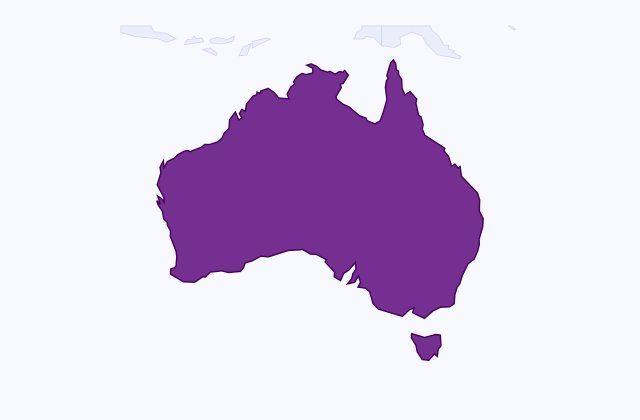
The legal framework
Adoption is governed by state and territory legislation — the Adoption Act 2000 in New South Wales, the Adoption Act 1984 in Victoria, and their counterparts elsewhere. The Commonwealth Attorney-General's Department manages intercountry adoption and maintains a short list of partner countries. Adoption orders are full and irrevocable. Every jurisdiction now requires the child to be told of the adoption and gives adopted adults access to their records.
The low numbers are deliberate, not accidental. From the 1950s to the 1970s tens of thousands of babies were taken from unmarried mothers under coercive practices, and the Senate inquiry that led to the 2013 national apology documented them in detail. Australian policy has since been cautious about adoption in a way that has no equivalent in Britain or the United States.
Most adoptions today are known-child adoptions: a step-parent, a relative or a long-term carer. Adoption of a child from out-of-home care is rare outside New South Wales, which has legislated to make it a permanency option; other states prefer permanent care or guardianship orders that do not sever the legal relationship with the birth family.
For Aboriginal and Torres Strait Islander children, the Aboriginal and Torres Strait Islander Child Placement Principle applies: placement preference goes to family, then community, then other Indigenous carers. Given the history of the Stolen Generations, adoption of an Indigenous child by a non-Indigenous family is exceptional and closely scrutinised.
Same-sex couples: joint adoption is available in every state and territory, the Northern Territory being the last to open it in 2018.
Key points
| Law | State and territory adoption acts; Commonwealth role for intercountry adoption |
|---|---|
| Numbers | Around 200 to 250 adoptions finalised nationally each year |
| Known-child adoptions | The majority: step-parent, relative and carer adoptions |
| Intercountry programmes | A small list of partner countries managed by the Commonwealth |
| Access to records | Adopted adults have access to identifying information in every jurisdiction |
| Hague Convention | Party since 1998 |
In practice
- Apply to the state or territory adoption service, or to an accredited body in New South Wales or Victoria.
- Attend the education and preparation seminars.
- Complete the assessment, which covers health, finances, references, criminal history and working-with-children checks.
- For intercountry adoption, be allocated to a partner country programme and wait for an allocation.
- After placement and the supervision period, apply to the Supreme Court or the relevant court for the adoption order.
Cost and coverage
Domestic adoption costs little beyond court fees. Intercountry adoption costs between AUD 20,000 and AUD 50,000 depending on the country, including the Commonwealth and state fees, agency costs and travel. Paid parental leave and employer schemes apply to adoptive parents on the same basis as birth parents in most cases.
Recent changes
The national apology of 2013 for forced adoption practices, and the state apologies that preceded it, transformed how adoption is discussed in Australia; policy now emphasises permanency through guardianship rather than adoption for children in care, except in New South Wales.
Where to go
- State or territory adoption service within the department of communities or families
- Intercountry Adoption Australia, the Commonwealth information service
- Accredited bodies in New South Wales and Victoria
- Post Adoption Resource Centres in each state
- Adoption Origins and support organisations for people affected by past practices
Worth knowing
Waiting times for intercountry adoption commonly exceed five years, and some programmes close without notice.
Frequently asked questions
Why are there so few adoptions in Australia?
Because of the history of forced adoptions and a deliberate policy preference for guardianship and permanent care over adoption for children in out-of-home care.
How long does intercountry adoption take?
Typically five years or more from application to placement, and some country programmes close during the wait.
Can same-sex couples adopt?
Yes, in every state and territory.
Can an adopted adult get their original birth certificate?
Yes. Every jurisdiction now allows adopted adults access to identifying information, with contact vetoes in some states that restrict contact but not knowledge.
Official sources and links
- Federal Register of Legislation — Commonwealth law as made and in force
- Services Australia — government services and payments