
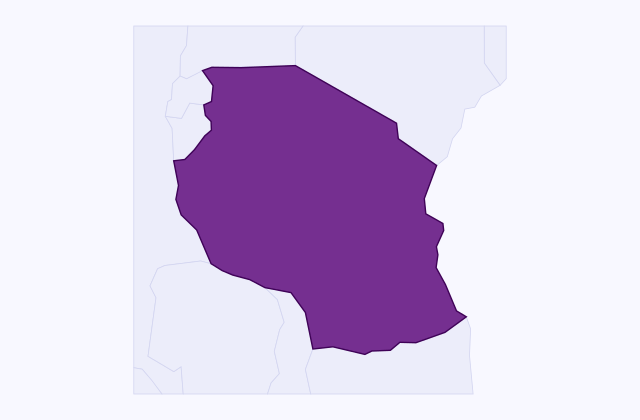
Abortion
Sections 150 to 152 of the Penal Code, Cap. 16 (Revised Edition 2023) create three offences: attempting to procure a woman's miscarriage, whether or not she is pregnant; a pregnant woman procuring her own miscarriage or permitting it; and supplying anything knowing it is meant to be used unlawfully for that purpose. Section 219 separately punishes 'child destruction', and s. 230 relieves from criminal responsibility an operation done in good faith, with reasonable care and skill, on an unborn child to preserve the mother's life. The Code lists no other grounds. These provisions apply on the Mainland; Zanzibar has its own Penal Act No. 6 of 2018, whose abortion provisions were not found in the sources opened and are therefore not described here.
Section 150 applies to a person who, with intent to procure a woman's miscarriage, whether or not she is with child, acts unlawfully by any means; the penalty is imprisonment for fourteen years. Section 151 applies to a woman with child who acts unlawfully to that end, or permits it, and carries seven years; s. 152 carries three years. Under s. 219 it is an offence, punishable by life imprisonment, to destroy by a wilful act, before it has an existence independent of its mother, a child capable of being born alive, unless the act was done in good faith only to preserve the mother's life; evidence that the woman had been pregnant for 28 weeks or more is prima facie proof that the child was capable of being born alive (s. 219(3)).
Sources read the exception differently. The Center for Reproductive Rights (2012) argues that the 1938 English decision in Rex v Bourne, affirmed by the East African Court of Appeal, reads 'preserving life' to include a woman's physical and mental health, so that s. 230 covers life and health. Guttmacher (2016) calls the law ambiguous and says the Code is broadly understood to allow abortion to save the woman's life, with its position on physical or mental health unclear. A Tanzanian law firm's Q&A of 5 January 2026 states that abortion is prohibited except to save the mother's life, that a licensed physician must carry it out and that the medical necessity must be documented. The Ministry of Health's 2002 post-abortion care curriculum, quoted by the CRR, says the law allows therapeutic abortion with the life of the woman as the priority, that few people know it and that the law does not allow abortion 'by demand'.
Guttmacher, reporting a study published in 2015 by Keogh and colleagues, estimated 405,000 induced abortions in Tanzania in 2013, or 36 per 1,000 women aged 15 to 49 and 21 per 100 live births, with rates from 11 per 1,000 on Zanzibar to 47 in the Southern Highlands and 51 in the Lake zone. Nearly 67,000 women were treated in health facilities for complications and almost 100,000 who needed care did not receive it. The same 2016 fact sheet attributed to unsafe abortion more than one-third of hospitalisations for pregnancy complications and roughly one-quarter of maternal deaths, citing a maternal mortality ratio of 410 per 100,000 live births, an older estimate than the 104 measured by the 2022 TDHS-MIS. Regional and referral hospitals treated about 710 and 1,140 post-abortion cases each on average.
Tanzania signed the Maputo Protocol on 5 November 2003, ratified it on 3 March 2007 and deposited its instrument on 7 May 2007. Article 14(2)(c) asks states to authorise medical abortion in cases of sexual assault, rape and incest, and where continuing the pregnancy endangers the physical or mental health of the woman or the life of the woman or the foetus; the CRR notes no indication that Tanzania made a reservation. The Revised Edition 2023 of the Penal Code lists none of those grounds.
Key points
| Attempt to procure a miscarriage | Imprisonment for 14 years, for any person (Penal Code, s. 150) |
|---|---|
| Woman procuring her own miscarriage | Imprisonment for 7 years, including permitting it to be done (s. 151) |
| Supplying the means | Imprisonment for 3 years, if the supplier knows the purpose (s. 152) |
| Child destruction | Life imprisonment, unless done in good faith only to preserve the mother's life (s. 219(1)-(2)) |
| 28 weeks or more | Prima facie proof of a child 'capable of being born alive' (s. 219(3)) |
| Operation to save the mother | No criminal responsibility if in good faith, with reasonable care and skill and reasonable in the circumstances (s. 230) |
| Abortions in 2013 | About 405,000, i.e. 36 per 1,000 women aged 15 to 49 (Guttmacher, 2016) |
| Post-abortion care in 2013 | Nearly 67,000 women treated; almost 100,000 who needed care did not receive it |
| Maputo Protocol | Ratified 3 March 2007; Article 14(2)(c) lists rape, incest, sexual assault and health or life of the woman or foetus |
In practice
- A woman with complications after a miscarriage or an abortion can seek treatment at a public health facility: the Ministry's 2002 post-abortion care curriculum trains medical officers, assistant medical officers, clinical officers and nurse-midwives to provide it.
- Where a doctor considers that a pregnancy puts the woman's life at risk, s. 230 turns on good faith, reasonable care and skill and reasonableness in the circumstances; a Tanzanian law firm advises that a licensed physician perform the procedure, that medical necessity be documented and that the hospital's protocols be followed.
- Expect uneven access to post-abortion care: in 2013 Guttmacher counted just under 8 facilities providing it per 100,000 women nationally, more than 10 on Zanzibar and fewer than 6 in the Eastern zone.
Recent changes
On 5 January 2026 a Tanzanian law firm restated, under the Penal Code, Cap. 16 R.E. 2023, that abortion is prohibited except to save the mother's life, which is a narrower reading than the one the Center for Reproductive Rights published in 2012.
Where to go
- Regional and referral hospitals, which treated about 710 and 1,140 post-abortion cases each on average in 2013 (Guttmacher).
- The Ministry of Health, which issued the 2002 Post-Abortion Care Clinical Skills Curriculum (as cited by the CRR).
Worth knowing
The Mainland Code's text names only the mother's life (ss. 219(2) and 230) and sets out no list of grounds; the reading that extends to health rests on English and East African case law, as the CRR argues, and no Tanzanian judgment applying it was found for this page.
Frequently asked questions
Is abortion legal in Tanzania?
On the Mainland the Penal Code punishes procuring a miscarriage 'unlawfully' (ss. 150 to 152) and protects operations to preserve the mother's life (ss. 219(2) and 230). Whether health is covered is read differently by the CRR, Guttmacher and a Tanzanian law firm, and the Zanzibar Penal Act's provisions were not found for this page.
What penalties does the Penal Code set?
Imprisonment for 14 years for a person who attempts to procure a miscarriage (s. 150), 7 years for a woman who does so to herself or permits it (s. 151), 3 years for a person who supplies the means (s. 152) and life imprisonment for child destruction (s. 219).
How many abortions take place in Tanzania?
Guttmacher estimated 405,000 in 2013, a rate of 36 per 1,000 women aged 15 to 49, with 11 per 1,000 on Zanzibar and 51 in the Lake zone.
Sources
- Penal Code, Cap. 16, Revised Edition 2023 (Attorney General's Office, official revised text) — ss. 150 to 152, 219 and 230, Revised Edition 2023
- Guttmacher Institute, "Induced Abortion and Postabortion Care in Tanzania", fact sheet (March 2016; Keogh et al., PLOS ONE 10(9), 2015) — 2013 incidence, regional rates, post-abortion care figures and the statement on the legal context (March 2016)
- Center for Reproductive Rights, "Abortion and the Law in Mainland Tanzania: Q&A" (June 2012) — June 2012 Q&A: Penal Code text, Rex v Bourne argument, Ministry's 2002 post-abortion care curriculum, Maputo Protocol Article 14(2)
- FB Attorneys, Q&A "Abortion to save mother's life" (5 January 2026) — 5 January 2026 reading of ss. 150 to 152 and 230 under R.E. 2023
- Centre for Human Rights, University of Pretoria -- Maputo Protocol status page for Tanzania — signature 5 November 2003, ratification 3 March 2007, deposit 7 May 2007
- 2022 Tanzania Demographic and Health Survey and Malaria Indicator Survey -- Summary Report (NBS and OCGS with The DHS Program) — maternal mortality ratio of 104 per 100,000 live births (seven years before the 2022 survey)
- Immigration and Refugee Board of Canada, response TZA106150.FE of 17 September 2018 (texts of the Mainland Penal Code and the Zanzibar Penal Act No. 6 of 2018) — identity of the Zanzibar Penal Act No. 6 of 2018 (assented 16 March 2018, repealing the 2004 Act)
The general article: Abortion · Compare with another country