
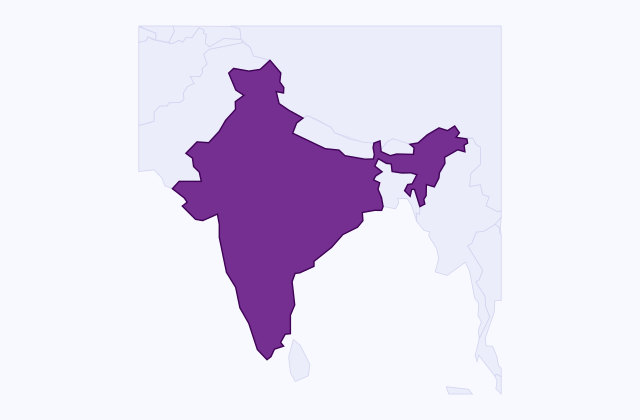
The legal framework
The Supreme Court read down the colonial provision criminalising same-sex relations in 2018, holding it unconstitutional as applied to consenting adults. In 2023 the Court declined to recognise same-sex marriage, holding that it was for Parliament to legislate, while directing government to address discrimination. Transgender people have statutory recognition following a 2014 ruling and a 2019 Act. There is no general statute prohibiting discrimination on grounds of sexual orientation.
The Supreme Court decriminalised consensual same-sex conduct in 2018, reading down the colonial provision. In 2023 the same court declined to extend marriage to same-sex couples, holding that this was for Parliament, while directing the government to consider practical protections through a committee. There is no statute prohibiting discrimination on grounds of sexual orientation, and transgender people have separate legislation with its own difficulties.
Key points
| Decriminalisation | Achieved by Supreme Court ruling in 2018 |
|---|---|
| Marriage | Not recognised; the Supreme Court left the question to Parliament in 2023 |
| Discrimination | No general statutory prohibition on grounds of sexual orientation |
| Transgender recognition | Established by a 2014 ruling and a 2019 statute |
| Conversion therapy | Treated as professional misconduct by the medical regulator |
| Adoption | Not open to same-sex couples jointly |
| Social climate | Varies enormously between metropolitan areas and elsewhere |
In practice
- Decriminalisation is settled law: police action premised on the old provision is unlawful.
- Complaints against a doctor offering conversion therapy can be made to the medical council.
- Legal aid clinics and organisations provide free advice in the major cities.
- A will is particularly important where a partner has no legal status: intestacy will not recognise them.
Cost and coverage
Court fees are modest and legal aid is available; documenting a will and nominations costs little.
Recent changes
The Supreme Court's 2023 marriage judgment left the question to Parliament while directing consideration of practical entitlements; a committee at central government level has been examining these.
Where to go
- Legal aid services and community legal clinics.
- National helplines run by non-governmental organisations.
- State human rights commissions, for official misconduct.
Worth knowing
Without marriage or partnership recognition, a partner has no automatic inheritance, hospital or decision-making rights. A will, a nomination and a medical power of attorney are the practical substitutes.
Frequently asked questions
Can same-sex couples marry in India?
No. The Supreme Court held in October 2023 that creating such a right is for Parliament, not the courts, and declined to read marriage law as covering same-sex couples. A government committee was directed to examine practical entitlements such as joint bank accounts, hospital visiting and pensions.
Is there a law against discrimination?
Not for sexual orientation specifically. Constitutional equality guarantees apply against the state, and the 2018 judgment is authoritative on dignity, but there is no general statute covering employment or services. The Transgender Persons Act provides some protections for transgender people, with criticism of its recognition procedure.
Official sources and links
- India.gov.in — national portal of India
- India Code — central and state legislation