
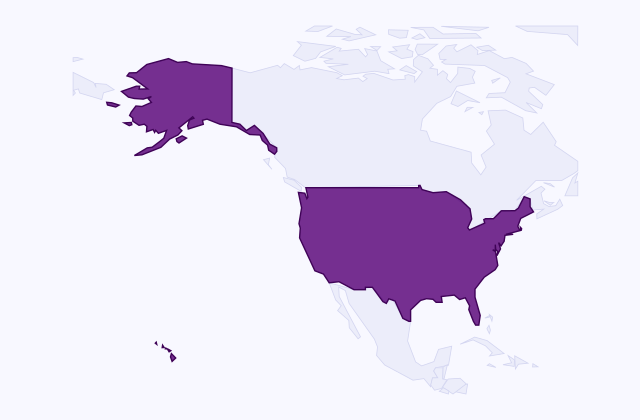
What the rules provide
The United States has no federal sales tax, so the “tampon tax” is a state matter. Five states have no sales tax at all, and a growing majority of the others have exempted menstrual products since New York, Connecticut and Illinois did so in 2016; by the mid-2020s roughly half the states plus the District of Columbia exempt them, while a dozen or so still tax them. At federal level, the CARES Act of March 2020 made menstrual products eligible expenses for flexible spending accounts and health savings accounts.
Free provision in schools is also state law: California requires products in public schools, community colleges and state universities, New York in schools, and more than twenty states now have similar requirements, usually for grades 6 to 12. Federal law requires products in federal prisons since 2018; the Menstrual Equity for All Act, reintroduced several times, has not passed.
There is no menstrual leave; absence falls under sick leave, which is unpaid at federal level except where state or city laws or employers provide paid sick days. Federal food assistance cannot be used for period products.
Endometriosis care depends on insurance: diagnosis and surgery are covered as medical care subject to deductibles, and specialised excision surgeons are concentrated in large cities, often out of network. The Endometriosis Foundation of America and other groups list specialists.
Key points
| Sales tax | State by state: five states with none, about half exempt period products, a dozen still tax them |
|---|---|
| FSA and HSA | Menstrual products eligible since the CARES Act (2020) |
| Free provision | More than twenty states require products in public schools; federal prisons since 2018 |
| Menstrual leave | None; sick leave rules vary by state and employer |
| Endometriosis | Covered as medical care under insurance; specialists mostly in large cities |
In practice
- Check your state's list of exempt items: the exemption may cover pads, tampons, cups and period underwear or only some of them.
- Use FSA or HSA funds for period products: they qualify since 2020.
- Ask the school whether products are stocked in restrooms; in states with a law, they must be.
- For endometriosis, ask the gynaecologist whether they perform excision surgery or refer to someone who does, and check network status before surgery.
What it costs
A cycle costs roughly $5 to $15 in disposables, plus sales tax in the states that still charge it. Nothing is reimbursed, but FSA and HSA dollars can be used.
What has changed recently
Michigan (2022), Maine (2022) and others have joined the exempt states; school provision laws keep spreading, and federal bills remain stalled.
Where to find help
- Alliance for Period Supplies: state-by-state map of tax and school provision laws.
- State departments of revenue: lists of exempt items.
- Endometriosis Foundation of America: information and specialists.
- Period supply banks and community organisations.
Worth knowing
A federal ban on the tampon tax does not exist despite headlines; the rule is your state's. And an exemption in one state says nothing about the next one over.
Frequently asked questions
Is there a tampon tax in the United States?
In about a dozen states, yes; about half exempt period products and five have no sales tax.
Can I use my FSA or HSA for tampons?
Yes, since the CARES Act of 2020.
Are period products free in schools?
In more than twenty states, public schools must provide them, usually in grades 6 to 12; elsewhere it depends on the district.
Official sources and links
- Alliance for Period Supplies — state-by-state tax and school provision map
- Endometriosis Foundation of America — information and specialists
- USA.gov — official guide to government services
- Congress.gov — federal legislation