
The legal framework
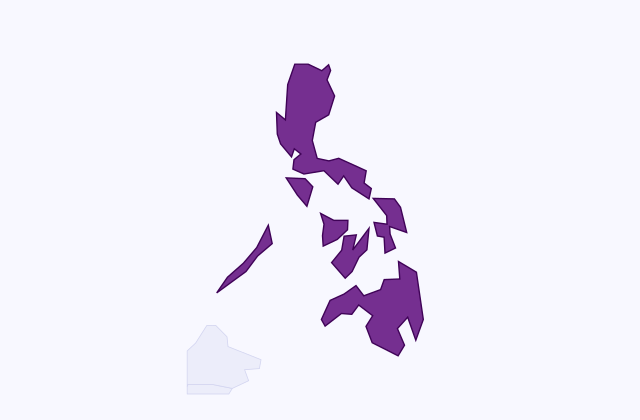
A symbolic or minor form of female circumcision, often called pag-islam or sunat, is practised in parts of the Muslim communities of Mindanao, usually on young girls and often without cutting in the strict sense. There is no specific prohibition; general provisions on child abuse and the Safe Spaces framework would apply where harm occurs. Documentation is limited.
A form of ritual cutting, usually symbolic and performed on infant girls, exists in some Muslim communities of Mindanao. It is not covered by a specific statute; the child-protection framework would apply in principle. The scale is poorly documented because national surveys have not asked about it, and the practice is rarely discussed outside the communities concerned.
Key points
| Practice | Ritual cutting, often symbolic, in parts of Muslim Mindanao |
|---|---|
| Specific law | None; general child abuse provisions would apply |
| Data | Limited documentation; no national survey |
| Type | Frequently symbolic rather than involving removal of tissue |
| Care | Available at rural health units and hospitals |
| Advocacy | Local women's organisations work on the question |
In practice
- If complications arise, any rural health unit can examine and refer.
- Community health workers can discuss the practice discreetly with families.
- Women's organisations in Mindanao provide information and support.
- Families travelling abroad should be aware of prohibitions in the destination country.
Where to go
- Rural health units and provincial hospitals.
- Local women's organisations in Mindanao.
- Commission on Human Rights regional offices.
Worth knowing
Practices in the Philippines are frequently symbolic and differ considerably from those in the Horn of Africa. That does not exempt them from the international definition, but it changes the clinical picture.
Frequently asked questions
Is there a specific law in the Philippines?
No. The child-protection legislation on abuse and on practices harmful to children would apply in principle, but there is no provision naming this and no recorded prosecution. Local health units in the affected regions are the realistic point of contact.
Who can help a family that wants to refuse?
Barangay health workers and local social welfare officers, and in the affected regions the women's health organisations that work with Muslim communities. The conversation usually happens within the family rather than through the authorities, and that is where support matters most.
Official sources and links
- gov.ph — official government portal