
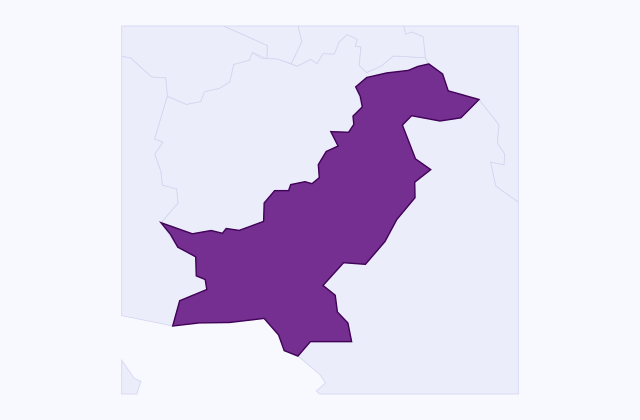
The legal framework
As in India, the practice is confined almost entirely to the Dawoodi Bohra community and is rarely discussed publicly. There is no specific criminal provision; the acts would fall under general provisions on hurt and under child protection legislation. Survivor-led organisations working across South Asia provide the main source of support and documentation.
As in India, the practice in Pakistan is associated with one community and is rarely discussed publicly. No statute names it, and there is very little data — no national survey has measured it. General provisions on hurt could apply in principle. For a couple with a link to Europe, North America or Australia, the home country's extraterritorial law is usually the operative rule rather than Pakistani law.
Key points
| Community | Confined almost entirely to the Dawoodi Bohra community |
|---|---|
| Specific law | None; general hurt and child protection provisions would apply |
| Visibility | Very low; the practice is rarely discussed publicly |
| Support | Survivor-led organisations operate across South Asia |
| Care | Available in gynaecology departments, though awareness among clinicians is limited |
| Diaspora | Families abroad are subject to the law of their country of residence |
In practice
- Survivor-led organisations offer confidential support and can advise families.
- Gynaecological complications can be treated in any teaching hospital department.
- If a child is at immediate risk, child protection units of the police can be contacted.
- Families living in Europe, North America or Australia should know that the practice is prosecuted there.
Where to go
- Child protection units of the police.
- Survivor-led organisations working in South Asia.
- Gynaecology departments of teaching hospitals.
Worth knowing
Because the practice is largely invisible, clinicians frequently do not recognise it. Being explicit about what was done, and when, changes the quality of the care you receive.
Frequently asked questions
Is there a law against it in Pakistan?
No specific statute. General criminal provisions on causing hurt could in theory apply, but there is no record of them being used for this. The absence of data and of public debate is itself part of the problem.
What if the family lives abroad?
Then the law of the country of residence will usually apply as well, and most Western countries prosecute the act even when it takes place abroad and is lawful there. For families settled in the UK, Ireland, Canada, the United States or Australia, that is the rule that matters.
Official sources and links
- Government of Pakistan — official government portal