
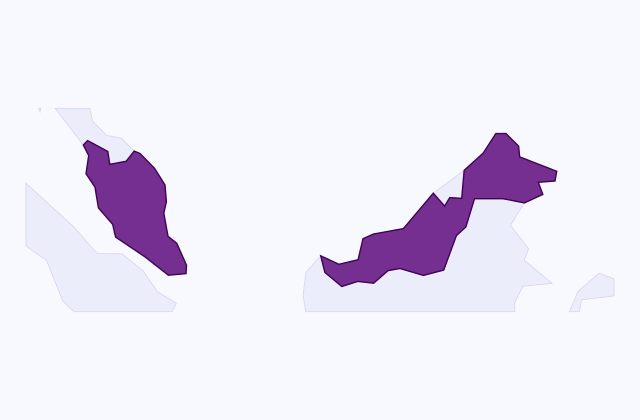
The legal framework
Malaysia is an unusual case: female genital cutting is practised among a large majority of Malay-Muslim women, is very largely medicalised, and has been the subject of a national religious ruling describing it as obligatory. There is no criminal prohibition, and health ministry guidance has at times treated it as a medical procedure. International bodies have repeatedly called for both the ruling and the medicalisation to be reversed.
Malaysia is an outlier among the countries covered here: the practice is widespread, has been medicalised into clinics, and a national religious ruling in 2009 treated it as obligatory for Muslim women, though it is not enforced as law. There is no prohibition. Health ministry guidance has fluctuated. For a couple where one partner is Malaysian, this is one of the issues most likely to surface with the extended family.
Key points
| Prevalence | Very high among Malay-Muslim women |
|---|---|
| Medicalisation | Predominant: usually performed in clinics by health professionals |
| Religious ruling | A national fatwa has described the practice as obligatory |
| Specific law | None; there is no prohibition |
| Type | Usually described as minor, but within the international definition |
| International position | United Nations bodies have called for prohibition and an end to medicalisation |
| Care | Available in public hospitals; awareness among clinicians varies |
In practice
- A gynaecologist can examine and explain what was done, if you want to know.
- Medicalisation does not make the practice safe or reversible in its effects.
- Women's rights organisations provide information and support.
- Families travelling abroad should know that many countries prosecute the practice regardless of where it was performed.
Where to go
- Public hospital gynaecology departments.
- Women's rights organisations.
- Family health clinics of the health ministry.
Worth knowing
Malaysia is one of very few countries where the practice is both widespread and carried out in clinics. That combination is what makes international bodies treat it as a distinct policy problem.
Frequently asked questions
Is it legal in Malaysia?
There is no law prohibiting it, and it is commonly performed in clinics. A 2009 fatwa from the national religious council described it as obligatory, without the force of statute. Efforts to regulate or discourage it through health guidance have not settled the question.
What if the child is a citizen of another country too?
Then that country's law may apply regardless of what happens in Malaysia. Most Western states prosecute the act when committed abroad by residents or citizens, and lawfulness at the place of the act is no defence. For a dual-national child, that is the decisive point.
Official sources and links
- MyGovernment — official government portal