
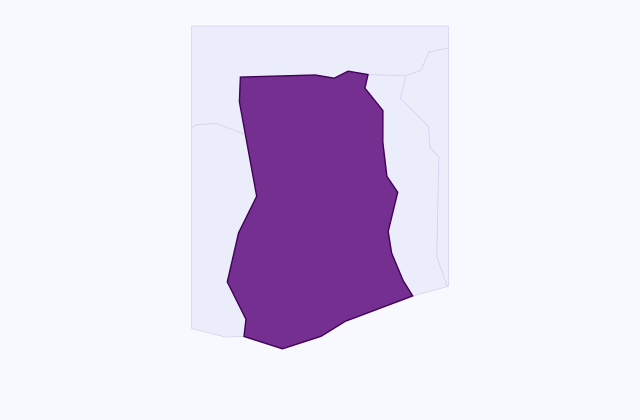
The legal framework
Ghana criminalised FGM in 1994 and broadened the offence in 2007 to cover anyone who carries out, procures or assists the practice, with a minimum sentence. National prevalence is low, but it remains significant in the Upper East and Upper West regions and among migrant communities from neighbouring countries.
Ghana criminalised the practice in 1994 and strengthened the offence in 2007, raising the penalty and widening the range of people who can be prosecuted to include those who arrange or assist. Prevalence is confined to the far north of the country and has fallen markedly, though enforcement in remote districts remains difficult and cases are often settled within communities rather than reported.
Key points
| Statute | Criminal Code amendments of 1994 and 2007 |
|---|---|
| Minimum sentence | Provided for by the 2007 amendment |
| Scope | Covers carrying out, procuring and assisting |
| Prevalence | Low nationally, concentrated in the Upper East and Upper West |
| Cross-border | Cutting sometimes takes place across the northern borders |
| Reporting | Through DOVVSU, the police domestic violence unit |
| Care | Available in regional hospitals |
In practice
- Report to DOVVSU rather than a general police station.
- Cross-border cutting is a known pattern in the north: report planned travel if you are concerned.
- Tell the midwife at the first antenatal visit.
- Community and traditional leaders are central to prevention programmes.
Cost and coverage
Reporting and public health care are free or low cost.
Where to go
- DOVVSU, the police domestic violence and victim support unit.
- Department of Social Welfare.
- Regional hospitals for treatment of complications.
Worth knowing
The northern borders are porous, and cutting sometimes takes place in a neighbouring country to avoid Ghanaian law. Reporting planned travel is what allows intervention.
Frequently asked questions
What did the 2007 amendment change?
It raised the minimum sentence and widened liability beyond the person who performs the procedure to those who arrange, assist or procure it, including parents. It also made clear that custom is not a defence.
Who enforces it in practice?
The Domestic Violence and Victim Support Unit of the police, working with the Department of Gender and with chiefs and community leaders in the northern districts. Reporting is the weak point: most cases never reach the unit.
Official sources and links
- Ghana.gov — official government portal