
The legal framework
FGM is a criminal offence in every Australian state and territory, with penalties of up to twenty-one years in some. Every jurisdiction also makes it an offence to take a child out of the state or territory for the purpose. Specialist services exist in the states with the largest affected communities, providing deinfibulation, obstetric care and counselling.
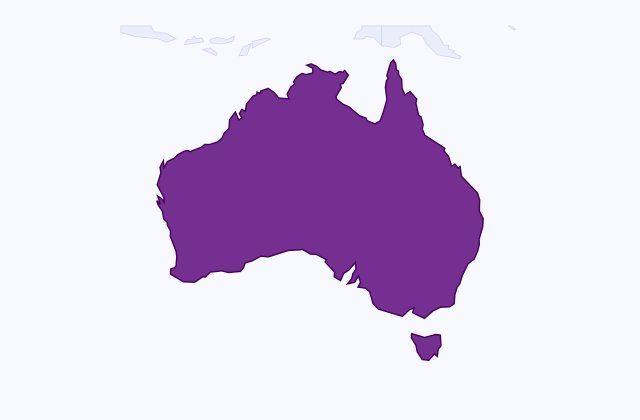
Because criminal law is state and territory business in Australia, every jurisdiction has its own offence — and all of them also criminalise taking a child out of the jurisdiction for the purpose, which closes the obvious gap. Commonwealth law adds reporting and border-related measures. The practical consequence for families is that the applicable rules follow the state you live in, not a single national statute.
Key points
| Offences | In every state and territory, with penalties up to twenty-one years |
|---|---|
| Removal | Taking a child out of the jurisdiction for FGM is a separate offence |
| Consent | Not a defence |
| Reporting | Mandatory child protection reporting applies to clinicians and teachers |
| Specialist services | Established in the states with the largest affected communities |
| Family Court | Can make orders preventing a child from being taken overseas |
| Affected population | Concentrated among communities from the Horn of Africa and parts of Asia |
In practice
- If you fear a child may be taken overseas, the Family Court can order that her name be placed on the airport watch list.
- Specialist clinics provide deinfibulation before childbirth or before marriage, free through the public system.
- Bicultural workers attached to these services can support the conversation with families.
- Report any concern about a child to the state child protection agency.
Cost and coverage
Specialist services are provided free through the public health system.
Where to go
- State child protection agencies.
- Specialist FGM services in the major states.
- Family Court of Australia for overseas travel orders.
Worth knowing
The airport watch list is the most practical protective tool in Australia: an order can prevent a child from leaving the country while concerns are assessed.
Frequently asked questions
Which law applies in Australia?
The law of the state or territory where you live. All of them criminalise the practice and all of them cover removing a child from the jurisdiction for that purpose, so the protection is uniform even though the statutes differ. Penalties and reporting duties vary.
Where can affected women get care?
Through specialist women's health services in the capital cities, several of which run dedicated clinics with interpreters. Care is available under Medicare for eligible residents. A GP referral is the usual route, and community health workers can arrange it where trust is an issue.
Official sources and links
- Federal Register of Legislation — Commonwealth law as made and in force
- Services Australia — government services and payments