
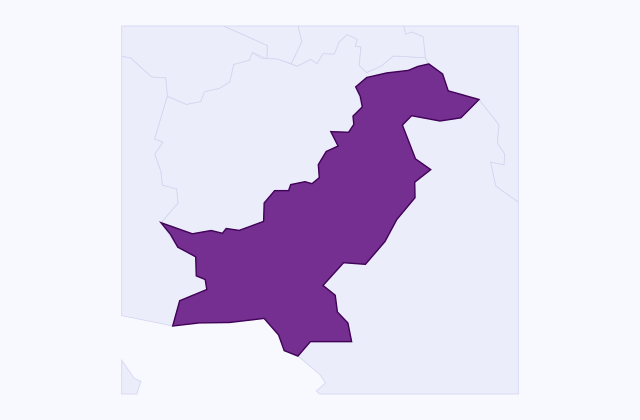
The legal framework
The Muslim Family Laws Ordinance 1961 requires a husband pronouncing talaq to give written notice to the chairman of the Union Council, which convenes an arbitration council; the divorce takes effect ninety days after notice. Women may obtain khula from the family court, generally returning the dower, or seek dissolution on the grounds listed in the Dissolution of Muslim Marriages Act 1939.
Key points
| Talaq | Written notice to the Union Council; effective after 90 days unless reconciliation occurs |
|---|---|
| Khula | Judicial dissolution at the wife's instance, usually with return of dower |
| Statutory grounds | Desertion, failure to maintain, cruelty, imprisonment, impotence and others under the 1939 Act |
| Registration | Failure to notify the Union Council can invalidate the divorce and create serious later problems |
| Nikah nama | The marriage contract can include delegated divorce and other conditions — clause 18 is particularly important |
| Maintenance and dower | Enforced through the family courts |
| Christians and other communities | Separate statutes apply |
| Talaq procedure | Written notice to the union council chairman, then ninety days of reconciliation |
| Delegated divorce | Clause 18 of the nikah nama can give the wife the right to divorce |
| Effectiveness | A talaq is not effective until the ninety-day period has run |
In practice
- Always obtain the divorce certificate from the Union Council: without it, remarriage and inheritance become contested.
- Check clause 18 of the nikah nama: a delegated right of divorce makes dissolution far simpler for the wife.
- Family courts have exclusive jurisdiction and are intended to be quicker than ordinary civil courts.
- Legal aid is available through bar associations and NGOs in the main cities.
- Serve the notice on the union council: without it the divorce is not legally effective.
- Keep the union council certificate — it is the proof required for remarriage and for visas.
Cost and coverage
Court fees are low; lawyers' fees vary. NGOs provide free representation in many family cases.
Recent changes
Provincial reforms have strengthened enforcement of maintenance and formalised the registration of marriages and divorces, though implementation varies.
Where to go
- Union Council offices for notification and certificates.
- Family courts in each district.
- Legal aid NGOs and bar association free legal aid committees.
Worth knowing
The single most consequential document is the Union Council divorce certificate. Many disputes years later — over remarriage, inheritance, or a child's status — turn on whether it exists. Failing to notify the union council is the most common error. Without the certificate the divorce may be treated as never having taken effect.
Official sources and links
- Government of Pakistan — official government portal