
The legal framework
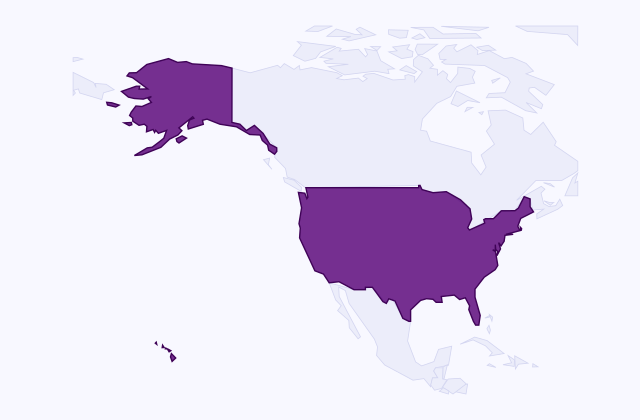
The Bill of Rights and the Fourteenth Amendment, enforced through judicial review, give American courts the power to invalidate legislation. The key limitation is the state action doctrine: constitutional rights generally constrain government, not private employers, landlords or platforms. Civil rights statutes fill part of that gap, and section 1983 provides a damages action against state officials.
Key points
| Judicial review | Courts may hold any statute unconstitutional |
|---|---|
| State action | Constitutional rights do not generally bind private parties |
| Section 1983 | Damages action against state officials for constitutional violations |
| Qualified immunity | A significant obstacle to suing individual officials |
| Civil rights statutes | Title VII, ADA, Fair Housing Act and their state equivalents |
| International | The United States has not accepted the jurisdiction of the Inter-American Court |
| Standing doctrine | Requires concrete injury, causation and redressability |
| Exhaustion | Many claims require an agency process first, with short deadlines |
| Attorney fees | Recoverable under civil rights statutes if you prevail |
In practice
- Exhaust domestic remedies first: no regional or international body will look at a case before that.
- Watch the deadlines — several are counted in months from the final domestic decision.
- Complain to the national human rights institution first: it is free and sometimes enough.
- Keep every decision, letter and acknowledgement: regional bodies will ask for the full record.
- Check the administrative deadline first: employment discrimination charges can expire in months.
Where to go
- American Civil Liberties Union state affiliates.
- Equal Employment Opportunity Commission for workplace discrimination.
- Legal aid organisations and law school clinics.
Worth knowing
Many claims must go through an administrative agency before court, with strict deadlines — employment discrimination charges in particular can expire in a matter of months. Qualified immunity frequently defeats damages claims against individual officials even where a violation is found. Claims against the entity may survive.
Official sources and links
- USA.gov — official guide to government services
- Congress.gov — federal legislation