
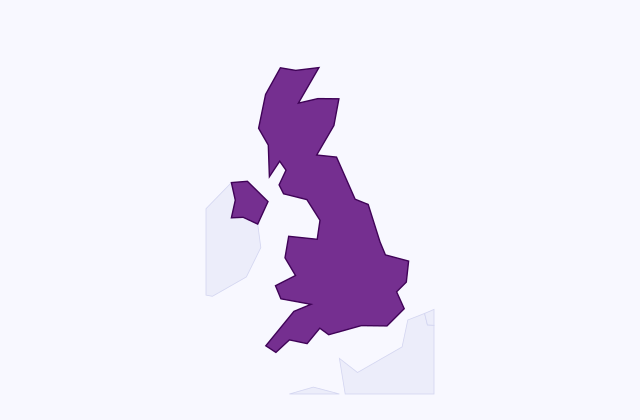
The legal framework
Same-sex marriage came into force in England and Wales in March 2014 and in Scotland in December 2014. Northern Ireland followed only in January 2020, and not by its own assembly: Westminster legislated while devolution was suspended. Civil partnerships remain available, and since 2019 they are open to opposite-sex couples too.
The United Kingdom took the parliamentary route, and the sequence matters: civil partnerships first in 2005, marriage nine years later, and Northern Ireland only when Westminster stepped in. That staggered history explains why civil partnerships still exist here when most countries abolished them on opening marriage — and why they were eventually extended to opposite-sex couples after a successful court challenge.
Key points
| Marriage | England and Wales and Scotland since 2014; Northern Ireland since January 2020 |
|---|---|
| Civil partnership | Retained, and open to all couples since 2019 |
| Conversion | A civil partnership can be converted into a marriage |
| Adoption | Joint and step-parent adoption available |
| Parenthood | The mother's wife or civil partner can be the second legal parent where licensed treatment is used |
| Surrogacy | Lawful but unenforceable and unpaid; a parental order is required |
| Discrimination | Equality Act 2010, in work, housing, services and education |
In practice
- For the second parent to be recognised at birth, treatment must take place at a licensed UK clinic with the right consent forms signed beforehand.
- A parental order after surrogacy must be applied for within six months of the birth — the deadline is strict.
- Religious organisations may but need not conduct same-sex marriages; the Church of England does not.
- A UK marriage is recognised across the EU and most of the Commonwealth's high-income members, but not everywhere.
Cost and coverage
Giving notice costs a statutory fee per person, and a register office ceremony a modest amount; approved venues cost far more. A parental order application has a court fee, with fee remission on low income.
Recent changes
Northern Ireland's first same-sex marriages took place in February 2020, completing the picture across the four nations more than five years after England and Wales.
Where to go
- Register office of the district where you live, to give notice.
- Human Fertilisation and Embryology Authority, for licensed clinics and consent forms.
- Equality Advisory and Support Service, for discrimination.
Worth knowing
Parenthood is the weak point, not marriage: where conception takes place outside a licensed clinic, the second parent has no automatic status and must adopt.
Frequently asked questions
Should you convert a civil partnership into a marriage?
You do not have to; an existing civil partnership remains valid. Conversion is a short administrative process and the marriage is treated as having existed since the date of the civil partnership, which can matter for immigration and pension purposes. Weigh it against the fee, which varies by nation.
Who is the second legal parent?
If the child is conceived through treatment at a licensed UK clinic, the mother's wife or civil partner is the second legal parent from birth, provided the consent forms were signed before treatment. Outside that route — home insemination, a clinic abroad — she is not, and must apply to adopt.
Official sources and links
- GOV.UK — official portal for public services and rights
- legislation.gov.uk — the statute book as enacted and revised