
Your married life according to your first name

Enter your first name: traditional numerology draws three numbers from it — what you are like as a partner, what you expect from marriage, what your spouse sees in you — and, with the other's first name, your couple's number. A game, calculated in your browser.

Appear on this page

Get our daily news watch

Name numerology is an old practice: each letter is given a value from 1 to 9, the values are added, reduced to a single digit, and read. Three numbers come out — from all the letters, from the vowels, from the consonants — which tradition links to what you show, what you desire and what others perceive. We read them here from the angle of life as a couple, the way one reads a horoscope: for the pleasure of recognising oneself, or of protesting.

Enter your first name (and your partner’s) to get three numbers and their reading for life as a couple.

How the calculation is done

The so-called Pythagorean table gives A=1, B=2, C=3 … I=9, then starts again: J=1, K=2 … R=9, S=1 … Z=8. Accents are ignored (É counts as E), so are hyphens and spaces. The expression number adds all the letters; the soul urge number takes only the vowels — A, E, I, O, U and Y —; the personality number takes only the consonants. Each total is reduced digit by digit to 1-9, except 11 and 22, which tradition keeps as "master numbers". The couple's number is the sum of the two expression numbers, reduced the same way.
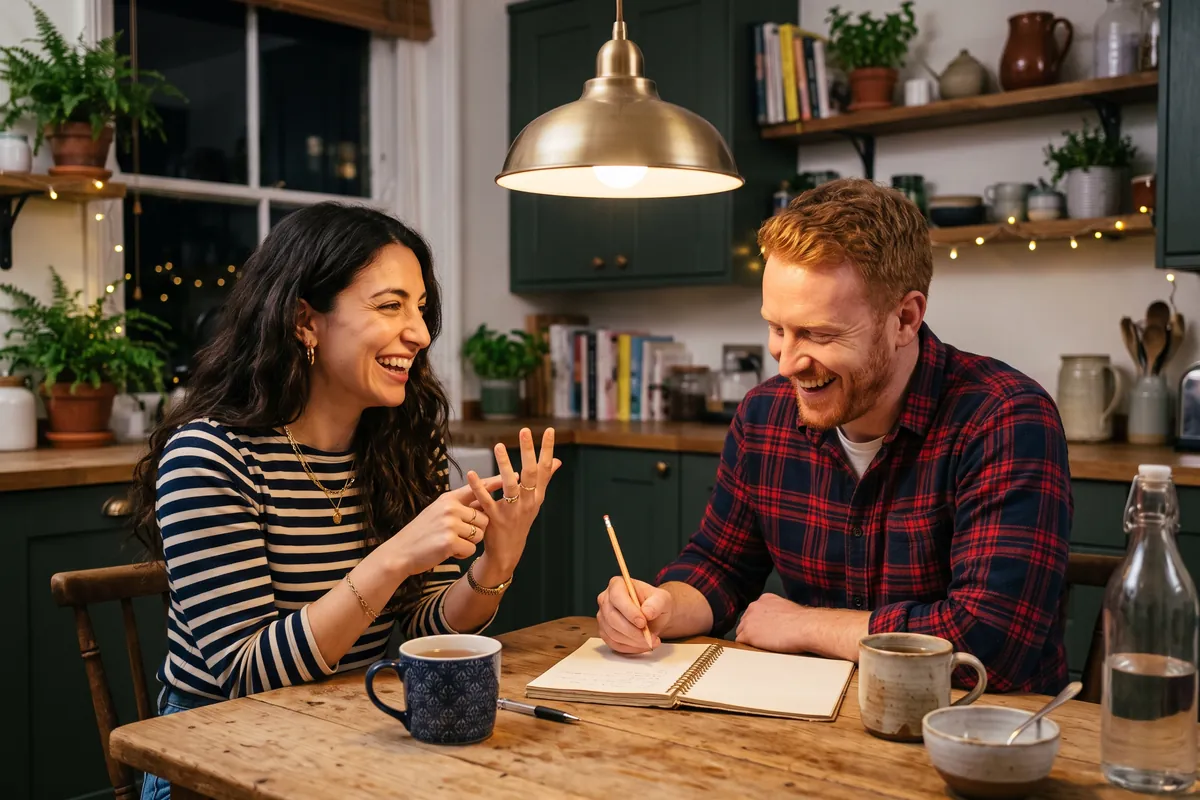
A couple playfully counts on their fingers at the kitchen table
Each letter is worth a number, you add them up and reduce: a game to play together, and nothing more.

The same first name spelled differently — Ann and Anne, Leslie and Lesly — gives different numbers: that is the rule of the game, not a flaw in the program. Middle names and surnames are not counted here; the page on name numerology explains the life path, calculated from the date of birth, and the love compatibility test compares two first names and two dates.

A game, and nothing more

No study has ever found a link between the letters of a first name and married life. If the text sounds like you, that is the Barnum effect: descriptions general enough to fit almost everyone. It remains a good way of talking about yourselves as a couple — which, for its part, is documented as useful.

Page checked in . The data cited can change.

Text prepared with artificial intelligence, reviewed by the AffectionPlus team (method: About). Spotted an error? Write to us.

Locate this page in the site map