
The legal framework
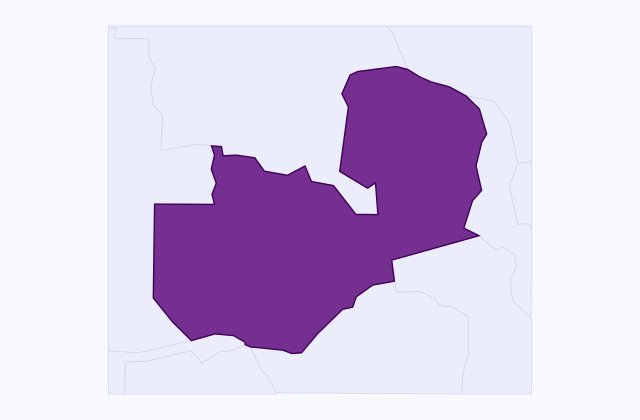
The Intestate Succession Act, chapter 59, applies fixed shares on intestacy: twenty per cent to the surviving spouse or spouses, fifty per cent to the children, twenty per cent to the parents and ten per cent to dependants. The matrimonial home and household goods are dealt with separately in favour of the spouse and children. Property grabbing — relatives removing assets from the home after a death — is a specific criminal offence. Customary law continues to apply to certain property and to intestates who married under customary law, subject to the Act.
In Zambia the decisive question is usually not who inherits but whether the property can be transferred. Land held without a registered title, or held in undivided family shares, cannot be dealt with however clear the entitlement.
Widows remain the most exposed group. Where the deceased's relatives remove property or occupy the home, the legal answer exists but requires going to court quickly; the practical answer is a will and a registered title made during the owner's lifetime.
For families with members abroad, remittances often paid for the property while the title stayed in one relative's name. That mismatch between who paid and who is registered is the single most common source of inheritance disputes in the diaspora.
Key points
| Statute | Intestate Succession Act, cap 59 |
|---|---|
| Shares | 20 % spouse, 50 % children, 20 % parents, 10 % dependants |
| Matrimonial home | Dealt with separately in favour of the spouse and children |
| Property grabbing | A specific criminal offence |
| Administration | Local court, subordinate court or High Court depending on the value |
| Wills | Permitted under the Wills and Administration of Testate Estates Act |
In practice
- Obtain the death certificate and establish which system of succession applies.
- Apply for probate or letters of administration at the competent court.
- Inventory the estate, including land, and check that titles are registered.
- Advertise for creditors and settle debts before any distribution.
- Distribute according to the statutory shares, and record the distribution in writing.
Cost and coverage
Court and registry fees are modest. The heavy costs are lawyers in contested estates and the surveying and titling of land that was never registered. Families who regularise a title while the owner is alive spend a fraction of what their children will spend afterwards.
Recent changes
The HIV epidemic left a generation of widows and orphans exposed to property grabbing, which is why the criminal provision was strengthened and publicised.
Where to go
- Probate registry of the High Court or the competent lower court
- Administrator General or public trustee, where one exists
- Lands registry, for the transfer of immovable property
- Legal aid or law society referral, for families without means
- Civil registry, for the death certificate and proofs of relationship
Worth knowing
Removing property from the deceased's home before the estate is administered is the offence of property grabbing and is prosecuted.
Frequently asked questions
Who inherits if there is no will?
The statutory shares set by the applicable Act: the surviving spouse and children first, then parents and other dependants.
Can a widow be evicted from the family home?
No. In each of these jurisdictions the law protects the surviving spouse's occupation, and in some it is a criminal offence to interfere.
What if the land has no title?
The succession cannot be completed until the title is regularised. That is the first step, before any distribution.
Does a partner who was never married inherit?
Only where the law recognises cohabitants, and usually by making a claim to the court rather than as an automatic entitlement.
Official sources and links
- UN Human Rights Office — ratified treaties and country reviews
- ILO NATLEX — national legislation database