
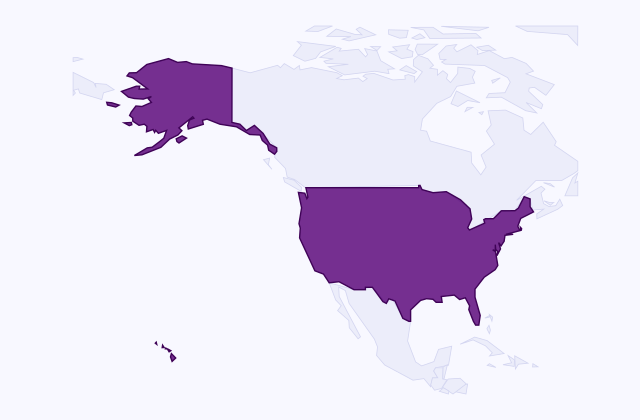
The legal framework
There is no federal law of succession in the United States. Each state sets its own intestacy rules, its own probate procedure and its own protections. In common-law states the surviving spouse can usually claim an elective share of roughly one third against the will; in the nine community-property states half of the marital property already belongs to the survivor. Children can be disinherited everywhere except Louisiana, which retains forced heirship for children under twenty-four or with a disability. Federal estate tax applies only above a very high exemption.
The most consequential American feature is that much of a typical estate never goes through the will at all. Retirement accounts, life insurance, transfer-on-death accounts and jointly held property pass by designation or survivorship. Reviewing those forms matters more than the will itself.
Community property changes the analysis completely in Arizona, California, Idaho, Louisiana, Nevada, New Mexico, Texas, Washington and Wisconsin. Half of what was earned during the marriage already belongs to the survivor, so only the deceased's half is inherited.
Because law varies by state, moving is a planning event. A will valid in one state is generally recognised in another, but elective shares, homestead protections and probate procedure differ enough that a review after a move is worthwhile.
Key points
| Law | State statutes; Uniform Probate Code adopted in part by many states |
|---|---|
| Spouse | Elective share in common-law states; community property in nine states |
| Children | May be disinherited, except in Louisiana |
| Probate | Court-supervised; avoided through revocable trusts and beneficiary designations |
| Federal estate tax | Applies above a high exemption; several states levy their own estate or inheritance tax |
| Non-probate assets | Retirement accounts, life insurance and joint accounts pass outside the will |
In practice
- Find the original will and file it with the probate court in the county of residence.
- Apply to be appointed executor or personal representative and obtain letters.
- Inventory the estate, notify creditors and publish as the state requires.
- File the final income tax return and, where applicable, the federal and state estate tax returns.
- Distribute only after the creditor period has closed.
Cost and coverage
Probate costs commonly run from 3 to 7 % of the estate once court fees, executor commissions and attorney fees are counted, and can be far higher in states with percentage-based fee statutes. A revocable living trust costs a few thousand dollars to set up and avoids probate entirely, which is why it is standard practice in California and Florida.
Recent changes
The federal estate tax exemption is scheduled to change, which has made lifetime gifting and portability elections a recurring planning topic for larger estates.
Where to go
- Probate court of the county where the deceased lived
- State bar association lawyer referral service
- Internal Revenue Service, for estate and income tax filings
- State department of revenue, for state estate or inheritance tax
- Plan administrators and insurers, for non-probate assets
Worth knowing
Beneficiary designations on retirement accounts and life insurance override the will: an ex-spouse left on an old form will inherit, and many states' automatic revocation rules do not reach federally regulated plans.
Frequently asked questions
Can I disinherit my children?
Yes in every state except Louisiana, which keeps forced heirship for children under twenty-four or with a disability.
Can I disinherit my spouse?
Not fully. Most common-law states allow the survivor to elect against the will for roughly a third; community-property states already give them half of the marital property.
How do I avoid probate?
Through a revocable living trust, beneficiary designations, transfer-on-death registrations and joint ownership — all of which pass outside the will.
Will my estate pay federal estate tax?
Only above the federal exemption, which is high; several states impose their own estate or inheritance tax at much lower thresholds.
Official sources and links
- USA.gov — official guide to government services
- Congress.gov — federal legislation