
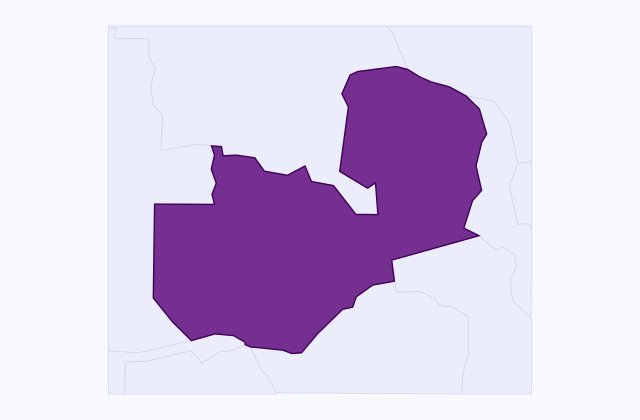
The legal framework
The Children's Code Act 2022 brought together the previously scattered law on children, alongside the Adoption Act. Adoption is granted by the High Court after a supervised fostering period, on the report of the Department of Social Welfare, and confers full parentage. Zambia acceded to the Hague Convention with effect from 2015, so intercountry adoptions must pass through the central authority in both countries.
Zambia's adoption numbers are small and most orders are made in favour of residents, including expatriates working in the country. Foreign non-resident applicants find the fostering requirement decisive: it presumes presence in Zambia.
The HIV epidemic left a very large number of children in the care of grandparents and other relatives. Most of those arrangements remain informal. The 2022 Code gives kinship care a clearer legal footing, which for many families is a better fit than adoption because it does not sever the child's ties.
Since Hague accession in 2015, intercountry adoption follows the Convention route, with a certificate of conformity that secures recognition in the other contracting states. That is a significant improvement on the position in neighbouring countries that have not acceded.
Same-sex couples: same-sex relations are criminalised; no recognition and no joint adoption.
Key points
| Statutes | Children's Code Act 2022; Adoption Act |
|---|---|
| Court | High Court of Zambia |
| Authority | Department of Social Welfare, Ministry of Community Development |
| Fostering period | Required before the petition, commonly three to six months |
| Hague Convention | Party since 2015 |
| Consent | Of the parents or guardian, or dispensed with by the court |
In practice
- Apply to the Department of Social Welfare in the district and undergo assessment.
- Obtain a fostering placement and complete the supervised period.
- Assemble the report, medical certificates, police clearance and financial evidence.
- Petition the High Court, which hears the matter with the social welfare report.
- Obtain the adoption order and the amended birth record from the Department of National Registration.
Cost and coverage
Court and legal fees are moderate, typically a few thousand US dollars equivalent. The process usually takes one to two years, dominated by the fostering period and the court list.
Recent changes
The Children's Code Act 2022 modernised and consolidated children's law, strengthening alternative care planning and the position of kinship carers alongside adoption.
Where to go
- Department of Social Welfare, Ministry of Community Development and Social Services
- High Court of Zambia
- Registered child care facilities approved by the department
- Department of National Registration, Passport and Citizenship
- Zambian missions abroad for diaspora applicants
Worth knowing
Zambia applies subsidiarity strictly: a child is only considered for intercountry adoption once a Zambian placement has been sought and not found.
Frequently asked questions
Is Zambia a Hague Convention country?
Yes, since 2015, so an intercountry adoption follows the Convention procedure and is recognised in other contracting states.
Do I have to foster the child first?
Yes. A supervised fostering period is required before the adoption petition can be heard.
Which court grants the order?
The High Court of Zambia, on the report of the Department of Social Welfare.
Can relatives caring for a child get legal status without adopting?
Yes. The Children's Code Act 2022 gives kinship care a clearer legal footing, which suits families who do not want to sever the child's original ties.
Official sources and links
- UN Human Rights Office — ratified treaties and country reviews
- ILO NATLEX — national legislation database