
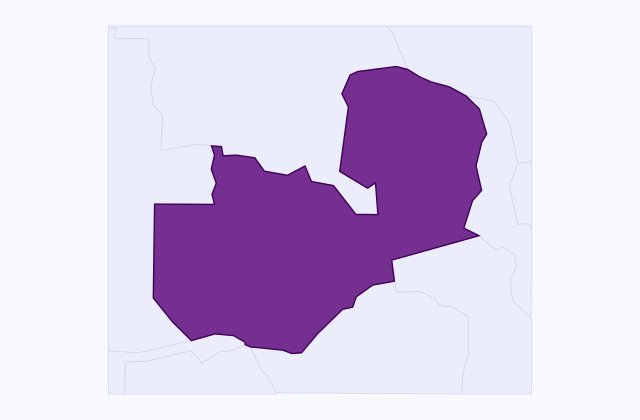
The legal framework
Protection rests on the Anti-Gender-Based Violence Act 2011, which provides protection orders, shelters and fast-track courts for gender-based violence cases. One-stop centres in major hospitals combine medical, police and psychosocial services. As elsewhere in the region, the gap is not in the legislation but in shelter capacity, transport to courts and consistent police response.
Key points
| Protection order | Available from the magistrates' court, usually without a lawyer |
|---|---|
| Definition of abuse | Includes psychological and economic abuse in the more recent statutes |
| Emergency response | Police units specialising in gender-based violence exist in most districts |
| Medical evidence | A medical report is the key document; obtain it as early as possible |
| Shelters | Limited in number and mostly NGO-run |
| Children | Can be included in a protection order |
| Anti-Gender-Based Violence Act 2011 | Provides protection orders and establishes shelters |
| Fast-track courts | Established for gender-based violence cases |
| Victim Support Unit | Police units in every district |
| Occupation orders | Can exclude the respondent from the home |
In practice
- Build a record: dated notes, photographs, medical reports, messages and names of witnesses.
- Plan the exit before announcing it — separation is statistically the most dangerous period.
- Keep identity documents, some money and a spare set of keys somewhere safe outside the home.
- Tell schools and employers where safety arrangements are needed.
- Apply for a protection order at the magistrate's court; the Victim Support Unit can assist.
- Ask whether a fast-track court sits in your district.
Cost and coverage
Protection order applications are free or very low-cost; legal aid organisations and law clinics provide free representation.
Recent changes
The clearest regional improvement has been the spread of one-stop centres, which remove the need to travel between police station, hospital and court.
Where to go
- Victim Support Unit of the Zambia Police Service.
- One-stop centres in provincial hospitals.
- Young Women's Christian Association shelters and legal aid.
Worth knowing
Getting the medical report early is decisive: most cases that fail in these systems fail for want of documentation, not for want of law. Fast-track courts for gender-based violence exist in several districts and hear cases far more quickly than the general courts. Ask for one by name.
Official sources and links
- World Health Organization — international reference on this topic
- WHO Regional Office for Africa — country data and programmes