
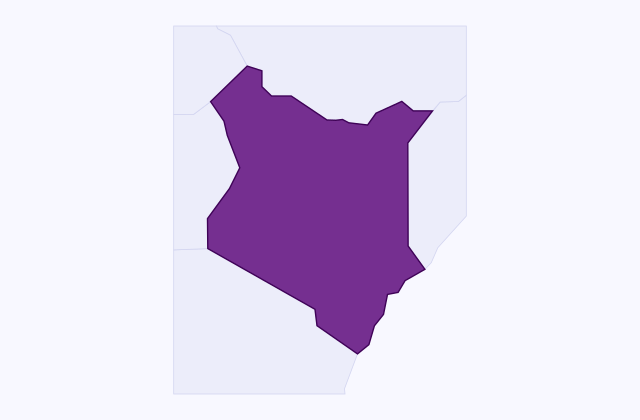
The legal framework
Protection rests on the Protection Against Domestic Violence Act 2015, which provides protection orders and defines violence broadly to include economic abuse and harmful cultural practices. Applications are made to the magistrates' court and can be heard urgently. As elsewhere in the region, the gap is not in the legislation but in shelter capacity, transport to courts and consistent police response.
Key points
| Protection order | Available from the magistrates' court, usually without a lawyer |
|---|---|
| Definition of abuse | Includes psychological and economic abuse in the more recent statutes |
| Emergency response | Police units specialising in gender-based violence exist in most districts |
| Medical evidence | A medical report is the key document; obtain it as early as possible |
| Shelters | Limited in number and mostly NGO-run |
| Children | Can be included in a protection order |
| Protection Against Domestic Violence Act 2015 | Broad definition including economic abuse and forced marriage |
| Protection orders | From the magistrate's court, with interim orders available |
| Police gender desks | Established at stations to handle these cases |
| Free legal aid | Available through the National Legal Aid Service |
In practice
- Build a record: dated notes, photographs, medical reports, messages and names of witnesses.
- Plan the exit before announcing it — separation is statistically the most dangerous period.
- Keep identity documents, some money and a spare set of keys somewhere safe outside the home.
- Tell schools and employers where safety arrangements are needed.
- Apply for an interim protection order first; it can be granted without the respondent present.
- Report at the gender desk and keep the OB number.
Cost and coverage
Protection order applications are free or very low-cost; legal aid organisations and law clinics provide free representation.
Recent changes
The clearest regional improvement has been the spread of one-stop centres, which remove the need to travel between police station, hospital and court.
Where to go
- National GBV helpline 1195, free and 24/7.
- Gender-based violence recovery centres in major hospitals.
- FIDA Kenya for legal representation.
Worth knowing
Getting the medical report early is decisive: most cases that fail in these systems fail for want of documentation, not for want of law. The 2015 Act expressly covers economic abuse and harmful cultural practices. Cite the specific conduct listed in the Act when applying.
Official sources and links
- eCitizen — official government services portal