
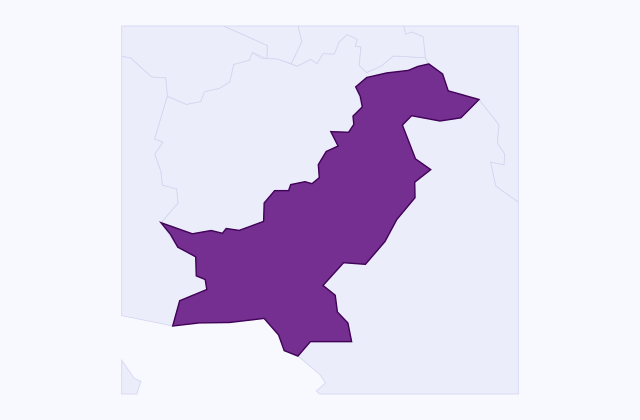
Mental health
The Mental Health Ordinance 2001 replaced the Lunacy Act of 1912; since the 18th Amendment of 2010 devolved health to the provinces, each province has its own law: the Sindh Mental Health Act 2013, the Punjab Mental Health (Amendment) Act 2014, the Khyber Pakhtunkhwa Mental Health Act 2017 and the Balochistan Mental Health Act 2019. Implementation is uneven, and faith-based healing is often the first recourse.
Specialist provision in Pakistan is very limited — a few hundred psychiatrists for 241 million people at the 2023 census — and concentrated in Karachi, Lahore and Islamabad. Distress is frequently presented as physical symptoms to a general practitioner, and the psychiatry departments of public teaching hospitals remain the most accessible specialist route.
Key points
| Legislation | Mental Health Ordinance 2001, then provincial acts (Sindh 2013, Punjab 2014, Khyber Pakhtunkhwa 2017, Balochistan 2019) |
|---|---|
| Attempted suicide | No longer an offence since section 325 of the Pakistan Penal Code was removed in 2022 |
| Provision | A few hundred psychiatrists, mainly in Karachi, Lahore and Islamabad |
| Medication | Essential psychotropics available in public hospitals |
| Cost | Public consultations are inexpensive; private care is out of reach for most |
Cost and coverage
Public hospital consultations are inexpensive; helpline counselling is free.
Where to go
- Psychiatry departments of public teaching hospitals.
- Non-governmental mental health organisations.
Frequently asked questions
Is attempted suicide still a crime?
No. The Criminal Laws (Amendment) Act 2022 removed section 325 of the Pakistan Penal Code, which had punished attempted suicide with up to one year in prison.
The general article: Mental health · Compare with another country
Dental care
Public dental care in Pakistan is provided through teaching hospitals and a small number of government facilities at nominal cost. There is no general dental insurance; almost all routine care is paid directly to private practitioners, whose fees are unregulated. Dentists must be registered with the Pakistan Medical and Dental Council, restored by the PMDC Act 2022 in place of the short-lived Pakistan Medical Commission.
Dental colleges such as de'Montmorency College of Dentistry in Lahore, founded in 1934, and the public dental colleges of Karachi and Islamabad treat patients at low cost with supervised students. Lip and oral cavity cancer, linked to areca nut, betel quid, gutka and naswar, is among the most frequent cancers in Pakistan; Sindh banned the making and sale of gutka and mainpuri by an act of 2019.
Key points
| Public | Teaching hospitals, nominal cost |
|---|---|
| Insurance | No general dental insurance |
| Registration | Pakistan Medical and Dental Council (PMDC Act 2022) |
| Oral cancer | High burden linked to areca nut, gutka and naswar; gutka banned in Sindh since 2019 |
Cost and coverage
Examination Rs 500–Rs 2,000. Filling Rs 1,500–Rs 5,000. Crown Rs 8,000–Rs 30,000. Implant Rs 60,000–Rs 150,000.
Where to go
- Dental colleges and teaching hospitals.
- Pakistan Medical and Dental Council register.
- Private clinics in the large cities.
Worth knowing
Unqualified practitioners fitting dentures and extracting teeth are common outside Pakistan's cities; the PMDC online register shows whether a dentist is licensed.
The general article: Dental care · Compare with another country
HIV and AIDS
WHO and UNAIDS estimated in 2025 that around 350,000 people live with HIV in Pakistan. In 2024 only 21% of them knew their status, 16% were on treatment and 7% had a suppressed viral load, although the number on antiretroviral therapy rose from about 6,500 in 2013 to 55,500 in 2024. Treatment and testing are free at government centres of the National AIDS Control Programme and the provincial programmes.
Alongside transmission among people who inject drugs, unsafe injections and reused equipment in healthcare settings have caused outbreaks: in Ratodero, Sindh, 1,182 people tested positive in 2019, 942 of them children. The epidemic is concentrated among key populations, and stigma keeps many from testing.
Key points
| People living with HIV | About 350,000 (WHO and UNAIDS, 2025) |
|---|---|
| Cascade 2024 | 21% diagnosed, 16% on treatment, 7% virally suppressed |
| Treatment | Free at designated antiretroviral therapy centres |
| Ratodero 2019 | 1,182 cases, 942 of them children, linked to reused syringes |
| PrEP | Limited availability, mainly through programme sites |
Cost and coverage
Testing and treatment are free at government centres.
Where to go
- Government antiretroviral therapy centres.
- Provincial AIDS control programmes.
- NGOs providing outreach testing and support.
Frequently asked questions
Where is treatment available in Pakistan?
At designated HIV treatment centres in the major cities, free of charge, run under the National AIDS Control Programme with support from the Global Fund. Testing is available at the same centres and through outreach organisations working with key populations.
Hepatitis B
About 2.5% of adults carry hepatitis B, there is no national birth dose, and unsafe injections drive continued transmission.
The national survey of the Pakistan Medical Research Council in 2007-08 found hepatitis B surface antigen in 2.5% of the population and hepatitis C antibodies in 4.8%. Hepatitis B vaccination has been in the Expanded Programme on Immunization since the early 2000s, today in the pentavalent vaccine at 6, 10 and 14 weeks, but a birth dose is not part of the national schedule.
A pilot in Islamabad in 2023 gave the birth dose to 2,000 of 2,008 newborns in three months, and in 2025 the Minister of State for Health promised a nationwide introduction. Reuse of syringes and unsterilised equipment in informal healthcare settings remains a documented driver of transmission in Pakistan, for hepatitis B as for hepatitis C.
Key points
| Prevalence | 2.5% carry the surface antigen (PMRC survey 2007-08) |
|---|---|
| Vaccination | Pentavalent vaccine at 6, 10 and 14 weeks |
| Birth dose | Not national; Islamabad pilot in 2023 |
| Blood safety | Screening of donated blood is mandatory |
Cost and coverage
Provincial programmes provide free testing and treatment in many districts; private care is expensive.
Where to go
- Provincial hepatitis control programmes.
- Expanded Programme on Immunization centres.
- Teaching hospital gastroenterology departments.
Worth knowing
Reused injection equipment remains a real risk in informal settings in Pakistan; a syringe unwrapped in front of the patient is the simplest protection.
General sources
- Government of Pakistan — official government portal